
Category: Marketing

  • Common Math Mistakes People Need to Stop Making

    Common Math Mistakes People Need to Stop Making

    Remember how you were always told to pay attention in math class? If you did, then you wouldn’t have been caught making these common math mistakes. Take a look at these real-life marketing examples and see if you can catch where the math went wrong.

    Math Mistakes that Cost Money

    Remember when your math teacher taught you about fractions? Back then, you might not have realized how fractions could help you to decide which burger to buy. In the 1980s, A&W marketed their competition for McDonald’s Quarter Pounder.

    The A&W one-third pound hamburger was a hit with customers who liked the taste and thought it was a better product than the Quarter Pounder. Both burgers were the same price. However, people thought that price-wise, the quarter-pound hamburger was the better deal.

    Consumers believed that four was bigger than three, which meant that for the same price, a quarter-pound of meat was the better value.

    Sometimes, marketers and businesses just cannot assume that consumers know how to compare fractions.

    Best Value for Your Money

    Sometimes a marketing blunder occurs because people just can’t do the math. At other times, marketers are counting on consumer math skills to influence what they buy.

    Take a look at these price points. You can get the small fries for $6.00. Or you can pay a dollar more for twice the amount of fries at 32 oz. Seems like a bargain! Then you have the third choice, $9.50 for almost three times the amount of fries. Which one is the best bargain?

    When considering the three choices, you’re not just looking for the best bargain anymore. You’re looking for the best value. The large size seems to be the best value for your money, as well as the best choice.

    Think again, however. Do you want to buy 88 oz of fries? Sometimes the math isn’t about calculating the best value, but the best deal for what you need. If 32 oz of fries is enough for you, then paying a dollar more for twice the fries (32 oz) is the best choice.

    Photo credit: Sara Van Der Werf

    One Little Dot Makes a Big Difference

    How are your money math skills? In a few different price listings, we’ve noticed the placement of a little dot can make a big difference. Look at the picture that follows.

    What would you rather pay for? 89¢ pancakes or .89¢ pancakes?

    Well, 89¢ pancakes seem like a good deal. They cost less than a dollar. But .89¢ pancakes must be from another time! When was the last time you could buy something for less than a penny?

    (In the USA, you might be able to find a penny in your pocket to buy your breakfast. In Canada, however, they stopped making pennies, so you can’t even find a penny for your less than a penny pancakes.)

    Photo credit: Sara Van Der Werf

    How Much Are You Getting? Do the Math… If You Can!

    Do you make mistakes when calculating how much value you’re getting? Someone made a math mistake with percents. See if you can solve the following math problem.

    The previous laundry detergent size could wash 25 loads. The new, larger size laundry detergent can clean 53 loads. According to the equation on the ad, 25 + 25 = 53, or roughly double the number of loads for the new size. Seems like the new size is a better deal than the old one… until you notice another number on the bottle.

    The new detergent size does 30% more loads than the previous one. The ad wants you to think that 30% approximately doubles what you’ll get with the new product. What do you think?
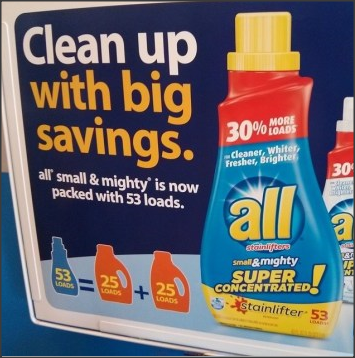
    Photo credit: Sara Van Der Werf

    Key Takeaways

    Paying attention in math class does have its benefits! Those math skills can help you to find the best value, catch misleading calculations, and avoid tiny but significant mistakes. Did you catch all the common consumer math mistakes right away?

    If you enjoyed this article, subscribe to make sure you don’t miss the next post!

  • What is Copywriting?

    What is Copywriting?

    Stellar copywriting grabs your attention, pushes your buttons, and persuades you to buy a product or service. Good copywriting gets you hooked when you read the first word, but great copywriting is what keeps you reading until the last.

    So what is copywriting? It’s more than just putting a bunch of words together on a page. It’s the copy – also called sales copy – used in marketing and promotional materials. There’s a lot more technique to it than the report writing and essay writing they teach you in school. Here’s a closer look at what copywriting is… and what makes it so enticing.

    Copywriting Speaks to You

    Copywriting is like hearing the voice inside your head speaking to you. You’re having a conversation with the page. The copywriter did a lot of research before writing the first word to really understand you, the reader, and what you’re looking for.

    The copywriter carefully crafted the headline to capture your attention and grab your curiosity. You want to know the answer the headline is asking.

    Like a trail of breadcrumbs, you’re drawn to the heading, then you read the first sentence to find out more information. But it doesn’t stop there. That first sentence knows exactly what you’re thinking. You had a question, a problem, or a pain point on your mind and that first paragraph just stated what you’re thinking. So you keep reading.

    You keep reading that paragraph, and the next and the next until you’ve reached the end, when it asks you to take action and sign up or buy something and you do. The copy is convincing because it understands you.

    The Real Nuts and Bolts of Copywriting

    It seems seamless and magical, the way the words flow, but there is a technique to crafting killer copy. First, the copywriter researched their audience. They want to know them and what’s on their mind. They’ve asked themselves, “What keeps my reader awake at night?”

    When you understand your audience’s pain, you can push their buttons and evoke their emotions. Copywriters tell stories that relate to what their audience has been through, whether it is struggling with finances, business, self-esteem, or relationships.

    Second, copywriting is concise and skimmable. The words are short and conversational, without jargon or corporate speak. Copywriting also backs up claims with reputable sources. It claims to have solutions to financial or relationship challenges, and provides evidence that if you take action, what you want can be achieved.

    Finally, copywriting has a way of creating urgency. The reader needs to take action, and take action now or miss out. It’s the reader’s chance to solve the problem that’s been on their mind.

    Key Takeaways

    If you’re wondering, “What is copywriting?” the short answer is copywriting is sales copy. Its purpose is to sell and the techniques are subtle. Copywriting is like reading a conversation with a friend who understands a problem that’s on your mind. It’s this understanding and a sense of urgency that persuades you to take action to find the solution that you need.

    If you enjoyed this article, subscribe to make sure you don’t miss the next post!
  • Why Is Marketing Important?

    Why Is Marketing Important?

    What’s the difference between sales and marketing? That’s a question someone once asked me. Sales is when a customer buys from you and happens after a customer knows what it is that you sell. The marketing comes first. But how do you persuade people to reach that stage when money changes hands?

    You need to tell people about how your business helps them. That’s why marketing is important – without it, a business may not get any sales. Here are some of the vital roles that marketing plays in the birth and survival of a business.

    Tell the world what it is that you do.

    Hundreds of businesses are born everyday, and most of us don’t know about them. Through social media posts, newsletters, videos, advertisements, and other multi-media, these businesses build their brand by telling us their story.

    They tell us what it is that they do, what market they serve, and how they can solve our problems and make our lives better. Without this content marketing, we wouldn’t know how a certain business can help us with our needs.

    Competition is fierce.

    In an ideal world, your business would be the only one of its kind, but it most likely isn’t. How do you stand out from the crowd? Why should a prospect pick you? Your marketing message needs to clearly say what makes you different.

    Is your product the most advanced in your niche? Does your service offer perks that your competitor does not? If the answer to both questions is No, you can still get the edge with something as simple as personalized service that makes your customer feel special. When you have customer loyalty, you can be competitive.

    Marketing to a global economy.

    Technology has made it possible to market businesses to a global economy. You are no longer restricted to your own city or country. Many prospects use a business’s website to decide how legitimate a business is and whether they want to do business with them. Your website can also make your business seem larger (with more staff) than it is just by how you present your business online.

    Social media and your online presence have the important role of reaching out to your prospects and building a relationship with them. A prospect in Europe may subscribe to newsletters and YouTube videos for your business based in the USA. They’ll read your customer reviews and how you respond to those reviews. Over time, they develop an interest in your products and buy from you. Developing that trust is important when there are so many possibilities for scams or problems when you’re working with a business far from your home.

    Marketing for consultative sales.

    A transactional sale is simple and common. You’re thirsty so you buy a bottle of water from the nearest grocery store. When you buy something you need from a business that one time and possibly never buy from them again, you’ve made a transactional purchase.

    Most businesses want more than a one-time purchase from a customer, however. Imagine hundreds of people buying from your business once and never seeing them again. Not a great return on investment after all the money you put into your marketing.

    Instead, it’s important to focus your marketing on building relationships and establishing customer loyalty. You want your customers to buy from you time and time again. With consultative sales, your goal is to establish a long-term relationship with your customer. For example, offering discounts for repeat customers and providing customer loyalty programs.

    Summary

    Marketing has an important role in the survival of your business. It builds customer loyalty, raises awareness of what you do to a wider audience, and helps you stand out from your competition. Successful marketing helps you close more sales. Marketing is a vital component that helps a business gain and maintain customers.

    If you enjoyed this article, subscribe to make sure you don’t miss the next post!

  • How to Connect with Customers and Build Relationships In-Person and in the Virtual World

    How to Connect with Customers and Build Relationships In-Person and in the Virtual World

    Get closer than ever to your customers. So close that you tell them what they need well before they realize it themselves.  ~ Steve Jobs

    Connecting with your customers and building a relationship with them is a powerful way to create customer loyalty to your brand. Before COVID-19, experiential retail had been a way to immerse your customers in an emotional experience with your products. (Think of Apple, Ikea, and Build a Bear.) But now that we must stay six feet apart – or avoid meeting in person – how to do we connect with customers virtually?

    Experiential Retail – Connecting In-Person

    Back when we could invite customers into our stores, smart businesses wanted to do more than display their products for customers to come in and buy them. They did something called experiential retail, which was giving customers an immersive experience.

    Customers were invited to try out products, attend events, watch videos and listen to music. That wasn’t all. The experience was meant to have customers seeing, hearing, and touching what the business wanted them to buy.

    Think of Cineplex Odeon Cinemas. You don’t just go there to watch a movie. At some locations, you can buy food and drink for during the movie, sit in a lounge (if you meet the age requirement) and enjoy an alcoholic beverage before the show, or play arcade games if you arrive early.

    At Catfe, you can do more than look for a possible pet. In the lounge area, you can check out their collection of cats, and if you find one you like, you can adopt the feline for a fee. While you’re there, you can enjoy drinks, snacks, and merchandise with a cat theme.

    Shopping is much more exciting when it’s an emotional experience. These experiences are still possible, but slightly changed during the pandemic. Businesses have limitations on how many customers to have on site at a time, and everyone is asked to maintain physical distancing from each other.

    Connecting with Customers and Building Relationships Using Emotion

    Emotions are an important part of building relationships with customers. Much of this connection can only be achieved in person by using your tactile senses when you try out the product. As the pandemic continues, the question is whether this in-person experience will be the same.

    Build A Bear is another business which is experiential retail. At this store, you aren’t just buying a stuffed animal. A child can watch the creation of their toy, from choosing the animal that they would like, to watching as it gets the stuffing for its insides.

    Like watching a member of the family come to life, the child can also choose what voice message they would like the animal to have. Then they can choose clothes and accessories (glasses, hat) to dress up their new toy. By the time the toy reaches the cash register, the child will have already started to build a relationship with the merchandise. The certificate that goes with the stuffed animal is the final touch to make this creature another member of the family, and not just another toy.

    Ikea also connects with its customers on a deeper level. It’s not just a furniture store. In the showroom, customers can walk into kitchens, living rooms, and bedrooms to try out the furniture and imagine themselves in a room surrounded by these Ikea products.

    These items aren’t just furniture. Each piece has a name. When your desk, chair, or bookshelf has a name, it’s that much more personal, more human, than a desk or chair with just a model number. To round out the experience, Ikea has a café … because everyone likes to eat. The family can make a day of looking at furniture and then eating. You’re not just shopping, you’re spending time with family.

    Creating Strong Connections in the Virtual Photo creditWorld

    Experiential retail seemed to be the trend of shopping in the future. At the Apple store, you can try out your product before you buy. At Lush, you can decide if you like what happens when you toss a bath bomb into water. It’s fun when you can try before you buy.

    As pandemic continues to rage around the world and cities continue to impose restrictions, the next concern is whether we can connect with customers in the same emotional way. If customers cannot come to our stores, if it’s not safe for them to touch and feel and experience the products, can we get the same results with virtual selling?

    Could businesses rely on technology to build those relationships with customers and make sales without actually being there with the customer? We have the good old telephone to make calls. In addition to calling customers, businesses can also reach out through email and virtual meetings on platforms like Zoom.

    Social media also has an important role in building those connections. Businesses are posting videos about their products on Facebook, Instagram, LinkedIn, Pinterest, and YouTube. These posts use humour, curiosity, and surprise to tell customers about their products in creative ways. Some videos are straightforward, showing you the features and uses of a product. Others are unexpected, using skits or a scenario to showcase a product.

    Watching a video about making ice cream with an ice cream maker isn’t as immersive as watching the food being made in person and then tasting a sweet sample. But it is still possible to connect with customers in the virtual world and provide them with a somewhat immersive experience.  

    Summary

    Experiential marketing and virtual selling are two ways to connect with customers and build relationships with them. Customers want the opportunity to try out your product before they buy. Provide them with these opportunities through social media posts, online communication, and best of all, experiences in the store. Give customers a memorable and fun experience!

    If you enjoyed this article, subscribe to make sure you don’t miss the next post!