Tag: books

  • Self-Editing Resources for First-Time or New Writers

    Self-Editing Resources for First-Time or New Writers

    Repost

    Ask anyone who writes professionally or personally, and they’ll say that it’s hard – really hard – to find their own writing mistakes. When you are your own editor, it’s tough to remain objective and read your work with fresh eyes.

    Difficult is not the same as impossible, however. You can self-edit if you know what to look for, and you develop a process. If you’re a first-time author or new to writing professionally, you may have many questions about how to edit, what to edit, and when (what stages in your writing) to edit.

    We’ve got the answers you need with resources recommended by professional book editors.

    Here are some fabulous self-editing resources to invest your time in. If you want a break from the written word, this list includes podcasts to check out as well.

    Self-Editing: The Writing Process

    Self-editing for Self-publishers: Incorporating: A Style Guide for Fiction by Richard Bradburn

    Indie authors looking to self-publish will find this resource particularly useful. It describes a three-stage editing process similar to the traditionally published one, from structural to sentence level to proofreading.

    Self-Editing for Fiction Writers, Second Edition by Renni Brown and Dave King

    Two professional editors have written this book which teaches you editing techniques on exposition, point of view, and dialogue. They provide many examples taken from manuscripts that they have edited.

    Understanding Show, Don’t Tell And Really Getting It by Janice Hardy  

    This award-winning author uses examples to demonstrate the difference between showing, not telling, when writing a story. She helps authors understand the balance between backstory, description, and narrative. 

    Revising Your Novel: First Draft to Finished Draft: A Step-by-step Guide to Revising Your Novel by Janice Hardy  

    This book tackles the big-picture problems that can go wrong with a novel. It shows how to review character and point of view issues, plot structure problems, and setting problems. You will learn to write stronger prose and build better character arcs and compelling plots.

    Cover to Cover What First-Time Authors Need to Know about Editing by Sandra Wendel

    After writing your first book, read this book to learn what to do next, before you work with an editor and prepare the book for production and publication. This is an important resource if you know little to nothing about the publication process.

    Troubleshooting Your Novel Essential Techniques for Identifying and Solving Manuscript Problems by Steven James  

    This hands-on guide takes you through the steps that will increase your chances of selling your manuscript to a publisher or gathering an audience for your book. Topics covered include story progression, character development, narrative techniques, and troubleshooting common issues. 

    Write Great Fiction – Plot & Structure by James Scott Bell 

    If you struggle with creating a plot that engages your readers, this is a resource to add to your library. The book tackles common plot problems, developing story structure, and how to create strong beginnings, middles, and ends to your story.

    Keys to Great Writing Revised and Expanded Mastering the Elements of Composition and Revision by Stephen Wilbers and Faith Sullivan 

    The writing process can be daunting. This book provides helpful techniques for the entire writing process, from prewriting to proofreading. It also has exercises to strengthen your writing skills from the sentence to the paragraph level.

    The Magic of Fiction Crafting Words Into Story: The Writer’s Guide to Writing & Editing by Beth Hill 

    This handbook for the writing and editing process is a valuable resource on all aspects of writing and editing. It covers writing and self-editing your own stories, whether you are a first-time or experienced author. 

    Self-Editing at a Sentence Level

    The Best Punctuation Book, Period by June Casagrande 

    Whether you write for an online, print, academic, or business audience, this quick reference guide covers your questions about punctuation for all styles, including AP (Associated Press), MLA (Modern Language Association), APA (American Psychological Association), and Chicago Manual of Style.

    Editing Fiction at Sentence Level by Louise Harnby 

    This book teaches you how to self-edit your manuscript at the sentence level, from narrative to dialogue. Examples are also provided to demonstrate the lessons.

    Eats, Shoots & Leaves The Zero Tolerance Approach to Punctuation by Lynne Truss 

    This resource covers grammar and punctuation insights using humor and history. It is clear from this book that a simple comma or apostrophe can completely alter the meaning of a sentence – sometimes in a hilarious way.  

    Artful Sentences Syntax as Style by Virginia Tufte  

    This book breaks down standard sentence patterns and forms to show how they convey meaning. New writers and those who love language will find this book fascinating.

    The Elements of Style by William Strunk and Elwyn Brooks White 

    Among writing manuals, this book is considered a classic. It even has its own Wikipedia entry! This guide covers good writing and composition principles, lists commonly misused words and expressions, and lists often misspelled words.

    Self-Editing Resources: Podcasts

    The Midnight Quill Podcast hosted by writers T. C. Emerys, M. J. Glenn and Maisy Osbon

    Listen to discussions about writing techniques, worldbuilding and self-publishing, with new episodes every week.

    The Editing Podcast hosted by Louise Harnby and Denise Cowle

    Explore practical tips and insights for editors and proofreaders. This podcast is available in 60 countries. 

    Key Takeaways 

    New writers published authors will find value in self-editing resources. These books cover important topics in the editing and writing process. 

    Experienced writers will benefit from the review and the checklists, and new writers finishing their first manuscript will benefit from the insight and tips. 

    For some of the latest advice on editing, writers and editors can stream podcasts from multiple sources, such as YouTube and apps.

    If you enjoyed this article, subscribe so you don’t miss the next post!
  • Your perfect space for reading and writing

    Your perfect space for reading and writing

    Daily writing prompts: You get to build your perfect space for reading and writing. What’s it like?

    My perfect space for reading and writing would look both classic and high tech at the same time. 

    To start, I would have a desk for my writing work. The center of the desk has a computer and multiple monitors because multiple screens are needed to display multiple pages or multiple documents. I’ll also need speakers to play music in the background and set the mood for creative thinking. 

    Writing on a computer would be much faster and more convenient. When I’m finished with a piece of writing, I can use editing software to check over what I’ve written. If I want to go to a coffee shop, I take my writing with me and continue writing on my tablet.

    My perfect space for reading and writing has a corner of the room, opposite the desk, for reading. Floor-to-ceiling bookshelves have my favorite books, arranged by subject. When I’m in the mood to read, I can take a book from this collection, sit in my beanbag chair with pillows, and read.

    This comforting space is a room with windows to let in the light. And in addition to the music I can play to set a relaxing atmosphere, I’ll also have plants to give the room some life.

    How about you? If you have a reading space, what is it like?  

  • 5 Reasons to Join a Writing Group

    5 Reasons to Join a Writing Group

    Do you feel like you’re the only one in the world striving hard to achieve your writing goal? If you do, you’ve found one excellent reason to join a group. Writers often work on their masterpieces by themselves, stopping now and then to recall the spelling of a word or ponder whether to make the paragraph longer or shorter. But why ask yourself those questions when you could ask a bunch of like-minded individuals? Here are five reasons to join a writing group. 

    Social conversation with like-minded people

    Some writing groups like to get together to talk over a beer or a coffee. Now you might wonder how that’s different from socializing with friends. The difference is a group of writers talking about life, video games, jobs, or movies will eventually start talking about stories.

    They’ll compare movie plots with plots in novels. They’ll talk about historical events and how those events can become plots in stories.

    Life conversations revolve around writing. How does one find time to write if one has a full-time job? How do writers get inspiration for their writing? When is the best time of day to write?

    Just being around like-minded people can get you in the mood to either start writing or keep writing, knowing that other people face the same struggles.

    Discussions about writing

    Writing groups are a safe space to hold discussions in-person or online about writing. Unlike casually chatting with your friend (who doesn’t write outside of work) about a novel you are working on, your writing group is not only interested in what you’re doing, but they can provide you with support. They empathize with your struggles when you have writer’s block. 

    They know the pain when you forgot to save 1000 words because you shut off your computer by mistake at 3 a.m. Most importantly, they might have suggestions on books and other resources to help you write better or get over the hurdle of developing your protagonist.

    You have a group of people who have been where you are and know what you’re going through.

    Ideas, resources, and industry information 

    A writing group that meets in person and has an online discussion platform can keep the discussion going after an in-person meeting. For example, if the group sets up channels on a platform such as Discord, they can share thoughts under specific topics, such as conversations for future get togethers, self promos for books, writing topics, publishing topics, and critiques of each other’s work. 

    They can also share resources, such as writing books they recommend, and thoughts on industry trends for best ways to promote books, and what types of literature is most popular.

    Accountability for writing goals

    You can find people in the group who are looking for accountability partners. Some people find it difficult to find motivation to write or stick to their writing goals if they are easily distracted or overwhelmed by life’s challenges and distractions (good and bad).

    If you have an accountability partner, you know you will report to someone at the end of a designated time period to tell them about your writing progress. Between the two of you, you don’t want to be the one who didn’t achieve your writing goals!

    An audience

    The most important reason for joining a writing group is you already have an audience. This is especially important if you are a first-time writer and you don’t have an audience for your work. Your writing group is there to support you on your journey to finish (or just work on) your writing project. You have an audience who will give you feedback and comments and encourage you to keep writing.

    Key Takeaways

    Joining a writing group has a lot of perks. You’ll be in an environment of supportive, like-minded people who face some of the same writing struggles that you do. They can help you with resources and advice and hold you accountable to your writing goals. Also, if you’ve lost the motivation to write, your writing group can inspire you to start thinking about writing again.

  • Read Bad Books with Bad Writing

    Read Bad Books with Bad Writing

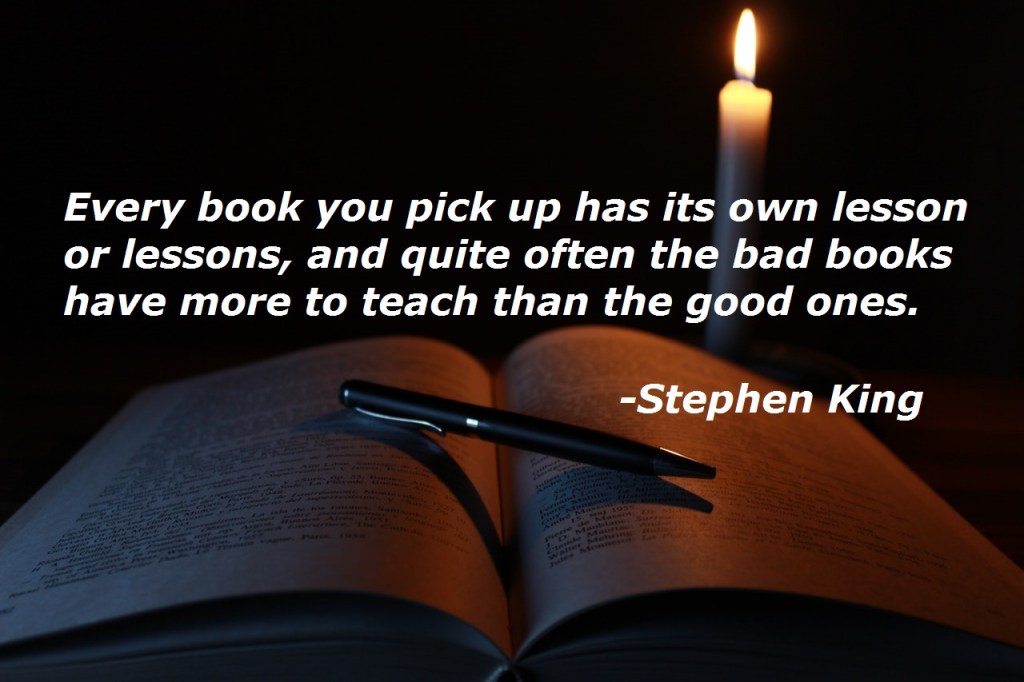
    “Every book you pick up has its own lesson or lessons, and quite often the bad books have more to teach than the good ones.”  – Stephen King, a.k.a. “The King of Horror”

    Today we have a few words of wisdom to share with you, someone who reads and writes. Yes, you are “someone who reads and writes.” Not specifically a reader or a writer, because usually we think of readers as people who like to read books and writers as people who write for a living or as a hobby. Here we mean anyone who reads anything and writes anything.

    If you text your friends or write emails for work. If you read your friend’s texts, restaurant menus, or read emails at work. Anyone who reads or writes.

    Take a moment to read some bad writing. Read an email full of grammar mistakes. Read a book that shouldn’t have been published. Why? Because you can learn a lot from reading something that is poorly written. Bad books can have just as important lessons to teach as good books.

    Good communication is vital for everyone. If you write clearly, you can avoid misunderstandings from bad texts. If you write well, you are a good communicator. And that’s just the beginning.

    Read a lot, and don’t just read the good stuff. When you read bad prose, you learn what not to write. If you want to write well, for blog posts or for your novel, then read a lot. Read good books and bad books. Be a critical reader and take lessons about what makes a piece of writing good, and what makes it bad. As author Stephen King once said, each book you read has valuable lessons to offer.

    What lessons have you learned from something you’ve read?

  • What If Books Were Free?

    What If Books Were Free?

    What if books were free? I admit, I would like a free book about a topic I’m only mildly interested in. It’s much easier to get a free copy of a book these days. You can press download, and viola! you have a free ebook to enjoy.

    Here’s another perspective. An author can spend months or years to write a book. That’s hundreds and thousands of hours put into a piece of writing.

    Recently, an author was horrified to find her book could be downloaded for free on a website. She asked for help to prevent this from happening.

    Imagine working for thousands of hours for no pay. I know the feeling. I’ve worked as a book editor with authors who spend two years on a book and don’t finish it. I’ve also worked with authors who patiently work through several drafts, rewriting the same chapters until perfection.

    It’s horrifying to see thousands of hours of hard work given away for nothing. What would you do if you came across a free book?

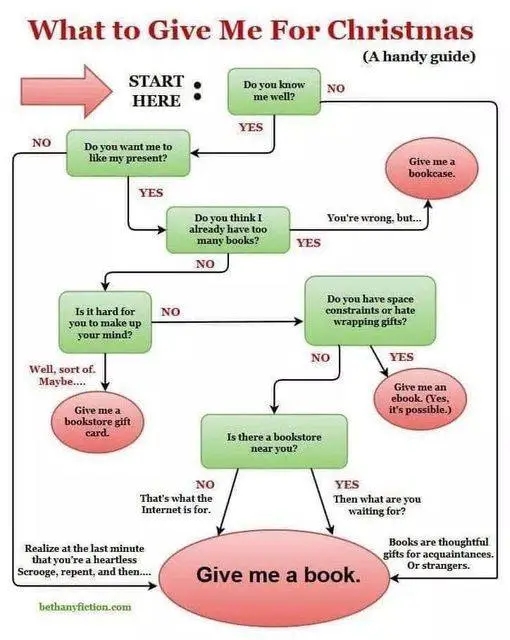
    And on another note for book lovers, I’ll leave you with this handy guide for buying books.

    image credit: bethanyfiction.com