Tag: grammar

  • Does punctuation matter? Some comma humor.

    Does punctuation matter? Some comma humor.

    Does punctuation matter? The answer is in this story about a panda that walked into a cafe, ordered a sandwich, ate it, and fired a gun into the air. But why did the panda do such a thing?

    The answer lies in a badly punctuated manual with a definition of “panda”:

    “Large black-and-white bear-like mammal, native to China. Eats, shoots and leaves.” – Lynne Truss, Eats, Shoots and Leaves

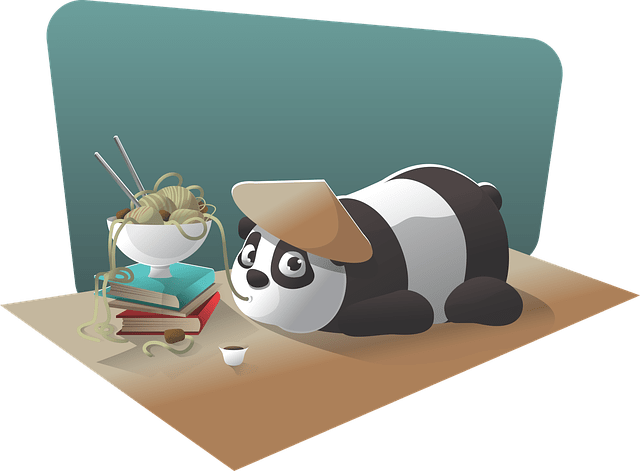
    Panda lying on table, slupping noodles.

    How important is it to learn punctuation rules?

    Let’s start with the disasters that could occur when the series comma is not used when it’s needed. The series comma (also called the Oxford comma, the Harvard comma, and the serial comma) is the comma that is used before you list the final item in a series of three or more items. For example, the serial comma is placed after “bunnies” in the following sentence:

    They like cats, bunnies, and bears.

    The series comma

    American English tends to use the series comma more than British English, but it really depends on which style guide a writer or editor is using.

    In some cases, the use of the series comma is necessary to clarify the meaning of a sentence, such as the sentence below, which doesn’t use the series comma.

    I like cooking my family and my pets. (Scary)

    A series comma changes the meaning.

    I like cooking, my family, and my pets. (Normal)

    Similarly, this sentence, without a series comma, describes a dog with two job titles:

    We went on a trip with my dog, the company CEO and my manager. 

    And this sentence describes a group of people and one dog.

    We went on a trip with my dog, the company CEO, and my manager. 

    Dog staring at woman, both are sitting at their computers at their desks.

    The period 

    A period shows the end of a complete thought and appears at the end of a sentence. Sometimes people follow their train of thought and place a period when they want to pause or conclude an idea. To check that you haven’t placed a period in the wrong spot, read your sentence out loud and check if the sentence makes sense.

    Notice the difference between the following two sentences:

    Help me get a job.
    Help me. Get a job.

    And notice the difference between these two sentences:

    No more studying!
    No. More studying!

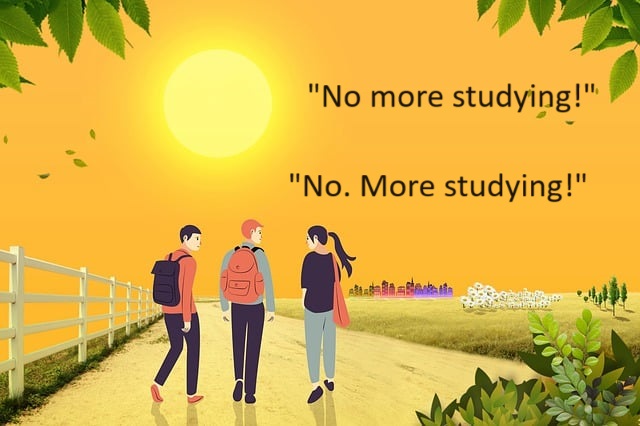
    Students walking together. "No more studying!"

    Be your own editor

    Be your own editor and check your work. Don’t leave it up to autocorrect or free, readily available editing apps to make your final edits!

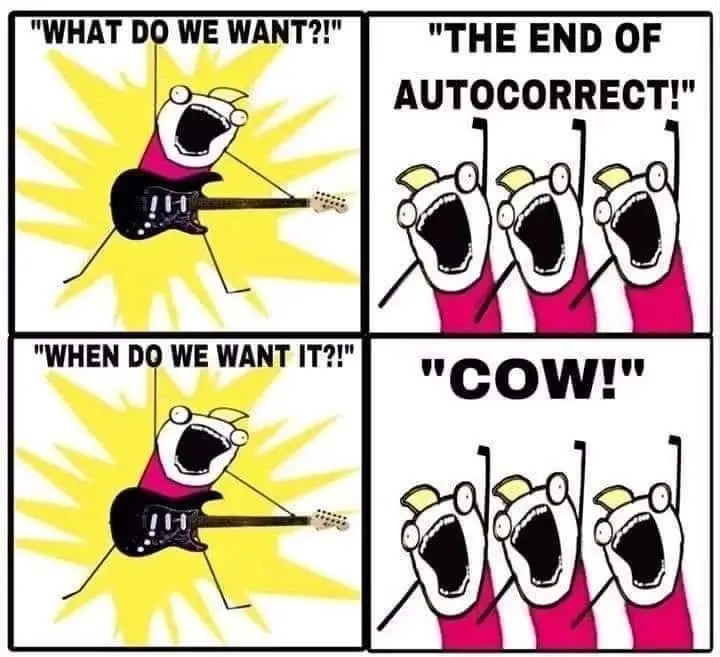
    Person shouts, "What do we want?"
People reply, "The end of autocorrect!"
Person shouts, "When do we want it?"
People reply, "Cow!"

    Photo Credits: GraphicMama-team (panda) Syaibatulhamdi (people walking), Karolina Grabowska (dog), Unknown source (autocorrect)

  • Fun With Language

    Fun With Language

    How much fun can you have with words? As much fun as your imagination can create!

    Source: Unknown

    Many languages have homonyms. But be careful how you use them. For example, watch how you use they’re, their, and there in English. These are misused more often than they should!

    Can you think of any homonyms from other languages?
    Comment below.

  • 20 Commonly Misused Words and Expressions You Should Know

    20 Commonly Misused Words and Expressions You Should Know

    A friend shared a story in which a guy typed, “Your adorable,” and the girl wrote back, “No, you’re adorable.” And romance wasn’t on her mind.

    It’s wonderful to share a joke and everyone laughs. It’s not so funny when you’re typing a serious message, and someone laughs… at you.

    To avoid these unfortunate situations, brush up on these commonly misused words and expressions. You never know when knowing the difference between these word pairs can make you seem as wise as an English professor.

    How many of the following misused expressions do you already know?

    1 Affect/Effect

    Affect: Usually a verb; meaning to impact or change something
    The rainy weather affected her mood.
    Effect: Usually a noun; meaning the result of a change, such as an outcome
    The cultural experience had a strong effect on the topics on her podcast.

    2 Afterward, Afterword

    Afterward: Adverb meaning later (more common in American English whereas afterwards is more common in British and Canadian English)
    She told us afterward that dinner had been great.
    Afterword: Noun meaning epilogue
    The novel has an afterword written by the author.

    3 All ready, Already

    All ready: meaning completely prepared
    The musicians were all ready for the concert to begin.
    Already: meaning it happened before
    She already had her coat on when the door opened.

    4 Among, Between

    Between: used for one-to-one relationships
    That secret is between you and me.
    Among: for undefined or collective relationships
    They divided the snacks among the children.

    5 Carat, Karat, Caret

    Carat: the weight of a gemstone such as a diamond
    Karat: The proportion of gold in an alloy
    Caret: mark on a manuscript  ‸

    6 Councillor, Counselor

    Councillor: someone who sits on a council, such as a city council
    Counselor: a person who gives advice, such as a marriage counselor, or a lawyer

    7 Deserts, Desserts

    Deserts: barren areas of landscape with little precipitation; punishment or what’s deserved (just deserts)
    People who intentionally hurt others will get their just deserts.
    Desserts: sweet course at the end of a meal, such as cake, ice cream, or cookies
    The desserts were served after the main course.

    8 Emigrate, Immigrate

    Emigrate: to leave the country where one used to live to live in another one
    Immigrate: to enter a country to live there
    He used to live in England but now he lives in the USA. He emigrated from England and immigrated to the US.

    9 Flammable, Inflammable

    Flammable: it can catch fire or you can set it on fire (more commonly used).
    Inflammable: can burst into flames without any ignition (decreased in use in modern English). It isn’t the opposite of flammable; the opposite of flammable is nonflammable

    10 Flare, Flair

    Flare: a glaring light
    She placed emergency flares around the stopped vehicle.
    Flair: outstanding talent or stylishness
    He had a flair for cooking exotic foods.

    11 Hangar, Hanger

    Hangar: you can find these structures housing aircraft at an airport
    Hanger: you can find these holding up clothes in closets or holding up pictures on your walls

    12 Healthy, Healthful

    Healthy: someone who is fit
    She stays healthy by exercising and eating well.
    Healthful: something that causes good health
    A healthful diet includes fruits and vegetables.

    13 Incredible, Incredulous

    Incredible: unbelievable or astonishing
    They went on an incredible trip through the woods.
    Incredulous: disbelieving or skeptical
    He was incredulous about their claims for compensation.

    14 In regard to, In regards to

    In regard to: the correct expression
    In regards to: remove this from your vocabulary forever

    15 Less, Fewer

    Less: Use for mass amounts that you cannot count
    There was less water in the pond two months later.
    Fewer: use for things that you can count
    Fewer people are going to the movies these days.

    16 Nauseous, Nauseated

    Nauseous: makes you feel sick (modern English – this meaning is being used to mean nauseated as well)
    The smell can make you feel nauseous.
    Nauseated: condition of feeling sick
    She felt nauseated.

    17 Therefore, Therefor

    Therefore: adverb; meaning for that reason
    She wanted to buy him a nice gift; therefore, she got the more expensive one.
    Therefor: adverb; in return for
    I took back the book and the store gave me my money back therefor.

    18 Toward, Towards

    Toward: use this if you prefer American English
    Towards: Use this if you prefer British or Canadian English

    19 Whoever, Whomever

    Whoever: subject pronoun that works the same as he, she, and they
    Whoever turned on the AC in this heat is my new best friend.
    Whomever: object pronoun that works like him, her, and them
    Give the cake to whomever you see in the room.

    20 Your, You’re

    Your: the possessive form of you
    Your cat is adorable. (The cat belongs to you.)
    You’re: the contraction of you are
    You’re adorable and your cat is adorable too. (You are adorable. So is your cat)

    Bottom Line

    How did you do with these commonly confused expressions?

    Now that you know how to use these expressions correctly, keep a sharp eye on them and you’ll sound wise in your written correspondence!

    If you enjoyed this article, subscribe to make sure you don’t miss the next post!

  • Why Editing Is Important

    Why Editing Is Important


    Updated for 2022

    You may have heard the story about how a minor edit made the difference between a family dinner and the disappearance of grandma. If you haven’t, then I will explain in a minute why editing is important, whether you run a business or you’re looking for your next employer.

    Minor typos can financially impact your business or professional reputation.

    Just look at the difference between “Let’s eat, grandma” and “Let’s eat grandma.” Most people would rather enjoy a meal together with grandma than have her on the menu. And all it takes is one comma.

    Some typing or grammar mistakes are small, but other errors can have an immense impact.

    How big of an impact can it have? The cost can be as severe as $620 million to the deaths of several people. Something this disastrous is rare, but the point is that careful editing can make you look smart and professional. Let’s look at some specific examples.

    Never Underestimate the Power of Minor Errors

    If you have a hole in your sock, it’s a small detail that makes you look careless. If you have a hole in your boat and you’re at sea, you’re taking a risk. It’s the same with minor errors in your writing, whether online or in print: your web page copy, emails, proposals, or reports make a statement about you.

    At the very least, spelling and grammar errors can sabotage your first impression with your clients. Common errors include incorrect use of your and you’re, and their versus they’re. These typos create the impression that you write carelessly… making potential clients wonder if you handle your business in the same way.

    At most, these tiny typos can also have an immeasurable financial cost. It’s a strong case for why editing is important.

    For example, Mizuho Securities Co meant to sell single shares for 610,000 apiece, but a typo resulted in selling 610,000 shares for 1 yen apiece. The company lost nearly $340 million in less than a day.

    Companies that work with a lot of numbers need to take extra precautions to check that their numbers are correct. A small typo can cause a huge financial loss.

    In other cases, the effect can cause confusion or frustration, such as the reference “See Figure 8 on page 123 for the supporting data,” but there is no Figure 8 on page 123. It’s actually on page 133. Not everyone is enthusiastic about hunting around for information.

    But that’s not all that can happen when there is a minor error. 

    A Letter Can Change Your Reputation

    Spelling mistakes can range from disastrous to confusing. Some of the most common misspelled words, recieved (received) and seperate (separate), are also very commonly used words. Editing is essential when it comes to advertising or guarantees.

    For example, during the production process for an ad, a typographical mistake resulted in substituting the “x” for an “r,” so that “exotic travel” became “erotic.” Because of the misprint, the travel agency suffered irreversible damage to its professional reputation and lost nearly 80 percent of its customers.

    Also, assuring your customer that you will do everything to complete the project on schedule is slightly different than ensuring that you will do everything according to schedule. In the latter case, it’s best to have a lawyer on hand in case you are late.

    So if spelling isn’t your strong point, or you weren’t an ace at spelling bees, the internet is here to help. You can make use of some great spelling resources here and here.

    It Does Not Take Much to Cause Disaster

    The previous examples show that chaos can ensue over a minor omission or typo. You might even be able to relate to these stories. It’s even happened to me before, even though I consider myself extremely careful.

    I was rushing through a reply in a conversation and realized to my horror, that I missed the word “not” in the sentence. What a big difference!

    The following example is an extreme case that drives home the point of why editing is important. The result of cases like these can be financially catastrophic or can even cost lives.

    For instance, the omission of a single hyphen resulted in the detonation of the Mariner probe spacecraft and a total loss of $620 million from the accident.

    Similarly, a minor clerical error in which a “C” became an “O” meant a rescue crew was dispatched to the wrong location, postponing rescue, and costing the lives of six fishermen.

    Your typos may not be as costly as these examples. But minor spelling and grammar errors do come with a price!

    Bad Editing and the Cost to Business

    If you’re still in doubt about the importance of editing, consider what could happen to your business if you lose the trust of your customers. Or what could happen if your business couldn’t be found. 

    The correct use of spelling and grammar is one of the primary variables a search engine analyzes when categorizing and prioritizing websites. Spelling errors for keywords can affect search engine optimization, preventing potential customers from locating specific products and services.

    One example is an e-commerce website that misspelled their product as “tihgts” instead of “tights.” The mistake resulted in a decline in sales until the error was fixed. Fixing the spelling resulted in an 80% conversion rate. In this case, details do matter.

    Great Resources to Improve Your Editing

    “A brand that disregards the details by underestimating the importance of proofreading could be a keystroke away from disaster.”—Six Degrees.com 

    Fixing typos can be low on your list of priorities if a deadline is looming or you are overwhelmed with several important tasks. There is any given number of valid reasons. So what can you do to cut down or eliminate spelling and grammar disasters?

    One solution to prevent typos is the use of technology. Word processing programs with built-in spelling and grammar editing features can help to reduce the frequency of some of these types of errors.

    It is even possible to create commands to check for specific typos, particularly if you have a habit of misspelling “definitely” wrong …. or forgetting if “between you and me” or “between you and I” is correct grammar. Or you can check if you’re making these common grammar mistakes.

    You can look to some great online resources such as Grammar Girl or Owl Purdue to help you out. To use an analogy, it doesn’t matter if you spent hours digging through your closet for the perfect outfit or hours fixing your makeup. If your appearance catches looks of approval, that’s what counts: the final result.

    However, nothing replaces having a copyeditor or proofreader to do a final check for typos and number errors. Some stubborn mistakes are acceptable to a grammar editing program, but not a fresh pair of eyes. An editor will check every detail for accuracy and consistency. 

    Final lesson: check, check, and double check. A thorough edit is worth your time!

    If you like this post, subscribe to make sure you don’t miss the next one!