How important are soft skills when it comes to advancing your career, getting a raise, or showing your employer that you deserve to take on more responsibility?
Soft skills are just as important as job-specific skills. But before we get into why or how they are vital, let’s look at why now is the right time to hone your soft skills.
Recent events during the pandemic changed the lives of millions, and many have changed careers, jobs, or where they work. The pandemic has brought much uncertainty, with people fearing the stability of their jobs and finances, especially with the escalating prices.
Forget vacations or even splurging on a new pair of shoes: now some people aren’t even sure if they can afford their groceries. So what can you do to increase your chances that you can keep your job, or get a job when a crisis like this occurs?
When I was a little girl, I dreamed of marrying a wealthy business owner, and when I got older, I dreamed of becoming a successful business owner, but teachers and family had other plans for me. Instead, they wanted me to attend university and have a career as a doctor or dentist. Helping people and changing lives appealed to me, but being around sick people or staring at teeth all day did not. So when I finally decided to step out of the box and become an entrepreneur, I discovered all my years of schooling weren’t enough to fulfill my dream.
Employee vs Entrepreneur
School taught me how to be an excellent employee. I went from obeying the teacher to obeying the boss, from taking six classes a day to working set hours. I performed according to expectations and job requirements, and challenged myself to leave my comfort zone when it meant a pay raise or getting fired. Having a job and a career were great — I really enjoyed my writing career after graduating from university. However, it didn’t bring me any closer to fulfilling my dream.
Now that I have my own business, I’ve realized that there are entrepreneurship skills that school doesn’t teach you that are relevant no matter what career you choose for yourself. Some of the most successful entrepreneurs, including Richard Branson and Henry Ford, were not known for having a shining academic performance.
Students who are well behaved, complete their homework, and perform well on tests are praised by their teachers. Students like Branson who struggled with dyslexia, disliked schoolwork, or didn’t fit the “good student” stereotype were told they needed to change. A friend who failed in school (because it didn’t challenge him) now owns two flourishing side businesses.
Perhaps, in addition to the current school curriculum, children should be taught entrepreneurship from an early age. Entrepreneur wannabees would benefit from these skills, but students seeking careers would benefit also.
Leadership and Communication
Two of the most important entrepreneurship skills are leadership and communication. Children who lead by example and communicate effectively are known for their charisma and optimism. Peers are drawn to their ability to make decisions and define objectives, such as making teams and establishing rules for a game. They can convince others why building a sandcastle would be a fun activity.
These leaders will listen to your problems, empathize with you, and offer advice if needed. A popular girl in my third grade embodied these qualities. She always smiled, and when you spoke to her, she listened like you were the only other person in the world.
I have never heard anyone say that they admire their bossy supervisor. But I’ve heard how much people admire leaders who get their hands dirty and treat their coworkers as equals. That’s like the child who makes the extra effort to make the new student feel welcome and encourages classmates to do the same.
An example of how leadership can inspire others is acclaimed speaker and author Adora Svitak. She advocated kids to take action about academic and environmental concerns and has also spoken for causes such as feminism and literacy. Her Ted talk “What Adults Can Learn From Kids” has received more than 4 million views and established her as a prodigy by the age of 12.
The Ability to Sell Yourself
Not everyone likes to sell or become a salesperson, but everyone should learn how to sell to succeed in life. Before the age of 18, children have done various jobs, from opening a lemonade stand to having a paper route, mowing lawns, and babysitting. These jobs teach you about tracking sales and developing your sales skills.
Moziah Bridges was 11 when he started to sell his bow tie creations on Etsy. He learned to sew from his grandmother. He’s made more than $600,000 in sales and continues to grow his business with a seven-figure deal with the NBA to make bow ties for 30 professional basketball teams.
Evan of EvanTube reviews toys and covers topics that interest other kids his age through video recordings. He makes more than one million per year with his band, and he’s not even ten years old.
Having the ability to sell can start at a young age and be just as valuable when you’re an adult. If you can convince someone you have what it takes to do a job, you will ace a job interview. Likewise, by showing someone that you have the personality and qualities that he or she is looking for, you will do well on a first date.
Finding Opportunities
Teaching children about entrepreneurship includes teaching them about weathering financial difficulties. If they need money to buy a new outfit or video game, they will speak with neighbours, friends, and family members to make some cash by shovelling snow, painting a fence, or selling a toy collection they no longer want.
We can also teach children to see opportunities instead of problems. For example, they may be seeing only the problem if they have only $100 in allowance money and the toy they want to buy is $130.
The creator of Nay Games, 14-year old Robert Nay, learned how to code through research at the public library. He programmed “Bubble Ball,” which received more than one million downloads. Nay Games now has games to help students with spelling and physics-based puzzles. Nay saw an opportunity and followed through with it.
Learning Problem Solving
Children who learn entrepreneurship also learn problem-solving. They find solutions to their problems by tackling situations head-on.
In the case of Cory Nieves, a six-year-old boy became a business owner after he decided he was tired of taking the bus to school. He wanted to buy a car because it was too cold outside. He sold hot cocoa and later branched out to selling lemonade and cookies to achieve his dream and save up for college. In 2014, when he was ten years old, he was making sales of a thousand cookies a weekend.
Busy vs Productive
Time management is a valuable skill when you own your own business. You learn to be productive, instead of just busy. Children who are adept at time management are efficient at accomplishing more in less time. Instead of finishing a homework assignment in two hours with plenty of breaks, they can finish in one hour with time for other tasks.
Business mentor and coach Cameron Herold has spoken in favour of having parents and teachers encourage kids to be entrepreneurs. At a Ted Talk in Edmonton, Alberta, he speaks about how he was bored and failing in school because teachers did not identify entrepreneurial traits as worth encouraging.
For example, at the age of seven, he was able to sell coat hangers at a higher price than originally expected, but negotiation was not a skill that he was taught.
Stories of successful kid entrepreneurs echo a similar theme to Herold’s story: they didn’t pay attention in school but became thriving business owners. As young teenagers, they were told to set aside their business ventures until they were older, but they continued to pursue their dream until they reached their goal or surpassed it.
My earliest brush with entrepreneurship was the day we brought belongings we no longer wanted and placed them on our desks at school. We walked around the class and looked for things to barter for using our items. A classmate had a pair of three-inch tall glass boots I liked. I asked her what she wanted from my desk in exchange. Sadly, what she wanted was only worth one boot — she didn’t like the other items I had. To this day, I only have one glass boot in my display case, a reminder of my early attempts at commerce.
Key Takeaways
Encourage children to pursue entrepreneurship. They will have more skills to succeed as adults, whether they choose to have a job or own a business. One lesson that successful kid entrepreneurs have taught us is that we should never limit what we want to accomplish.
If you enjoyed this article, subscribe to make sure you don’t miss the next post!

Garages and basements, not tall glass buildings, are are the birthplaces of business legends like Amazon, Microsoft, Google, and Apple. Startups may have humble beginnings, but they have the potential to grow into multimillion-dollar corporations with the right combination of people, goals, and financing.
If you’re starting a startup company, you’ll need to consider these eight tips to increase your chances of launching a successful business. First, let’s begin with defining what a startup company is.
What is a startup?
A startup is a company in its beginning stages. It’s founded by entrepreneurs and funded by banks, grants, the company founder, and possibly the entrepreneur’s families and friends.
Unlike a small business, a startup’s goal is to grow fast because there is a large market for its product. Many startups are tech companies for this reason.
It’s not surprising for startups to begin in someone’s basement or garage, with boxes of products stacked in the home and the CEO’s desk in the garage.
One of the key ingredients that will take a company from this humble beginning to rapid growth is leadership.
Startup Tip 1: Strong Leadership
Having strong leadership and a talented team are two of the most important ingredients in a startup. The CEO and the management team develop the company’s mission and vision and inspire the team to keep going, even in the darkest times. In the beginning, a startup will experience some rough ups and downs.
The leader is responsible for ensuring that roles and responsibilities are assigned to team members, and everyone is held accountable for their tasks. The leader also sets team goals and clarifies what will happen if those goals are not met. For example, will they need new goals if the original deadlines were not realistic?
Having strong leadership is key to a startup’s success. Without a clear vision for the company, a startup could drift like a lost ship blown from one direction to another, achieving little.
Startup Tip 2: Talented Team
A talented team will take the startup to the next level. What roles will each person have? Each team member should be assigned roles and responsibilities depending on their skills and expertise.
If someone has accounting experience, they can recommend the best software at an affordable price to begin tracking financial transactions, for example. Someone with HR experience can begin formalizing work contracts and policies for benefits and work hours.
The upside of a startup is the vast expanse of unexplored territory. Company rules have not been established, and decisions need to be finalized about software and communications systems. The team can choose how the company is managed.
The downside is that if the team doesn’t make these decisions to organize how the company is run, chaos and frustration can set in quickly, and team members will quit.
When finding people for a startup, choose talented people who can help get the company organized and running efficiently as quickly as possible. It’s their job to spot what needs to be done to help the leaders and the team to reach company goals.
The management team absolutely must clarify the plan for the company. What are the goals for the first month? How about goals for the second and third months? Without a clear plan, the startup is like a group of people showing up at a vacation spot with no idea what they want to do there.
After time has passed for a milestone, the company needs to assess whether the goal was met or missed. If the team fails to achieve the goal, such as having $1000 in sales for month 1, then the team needs to assess what could have gone wrong. What do they need to do differently? How could they improve?
When the team has a plan and clear goals, it’s easy to tell if they were on track with their goals or if they need to change direction to meet objectives.
Startup Tip 4: Established Culture
Establish company culture from the beginning. The management team leads by example in terms of how they treat others. When a team member works hard, do company leaders acknowledge that person’s contribution to the company?
Do company leaders take the time to get to know each team member personally? Do they know the names of a team member’s spouse, pet cat, or favourite ice cream flavour? Or does the startup staff only hear from management if they fail to complete a task?
When the company leaders set a positive and supportive environment, and not a negative one, then the entire team will also follow the example and support each other.
How much runway does the startup have? Before getting into business, the founder will have looked for financing from various sources, including company stakeholders or board members. However, how long will the funding last before the startup can no longer afford to keep the lights on? Some companies may have as little as $25,000 to begin the founder’s dream.
The amount of funding will affect how much the startup has to invest in product development, customer fulfillment, marketing, and paying staff salaries. When the funding runs out, what plan does the startup have in place to keep the business going?
Startup Tip 6: Protecting Intellectual Property
Intellectual property is like a vital piece of the company that you cannot give up. Intellectual property could be what makes the company stand out from the competition and what makes its product one-of-a-kind. Having this information stolen would be like losing an arm or a heart.
One way to protect intellectual property is by asking all staff to sign contracts about the use and distribution of this information.
Startup Tip 7: Learning from Mentors and Brands
It is rare – perhaps non-existent – for a startup to be the only one of its kind in the marketplace. The startup could learn from successful companies in the same niche and award-winning brands in the same industry. How are these established companies finding and keeping customers? What is their strategy?
In addition to learning from successful companies, startup team members could learn from a mentor or two. This person has experience with startups and running companies in that industry and functions as an advisor whenever the startup team has questions about running the business.
Startup Tip 8: Networking and Promotion
Any member of the startup team can attend networking events to form relationships with business owners interested in their product or working with their startup. They can also attend events such as conferences and conventions to find opportunities to tell potential customers about their business.
Other ways to promote the startup include creating informative content about its purpose and products on its website and social media, and building relationships with industry leaders. For example, if the startup sells medical devices, they could reach out to leaders in the medical field to tell them about the startup and create awareness of what they have to offer.
Key Takeaways
Running a successful startup depends on many key factors, starting with strong leaders and a talented team. The first year, especially the first few months, will be difficult, with many decisions to make about even the simplest things, such as where the team should hold meetings.
Proper planning is important and expecting the unexpected is crucial. Success won’t happen overnight, but having a clear plan and goals are the first steps.
If you enjoyed this article, subscribe to make sure you don’t miss the next post!

Can we teach leadership skills without considering race and ethnicity? For a long time, I thought leadership was a skill that everyone could learn. But when I wanted to cite an example of a well-known female Asian business leader as an example for this article, I couldn’t think of a single name. I realized I had made an important discovery and after a little more digging, I found an alarming pattern.
The more research I did, the more I realized leadership in business and one’s chances of earning an executive level position were in fact strongly affected by one’s ethnic background. Asians in the United States, for example, held many professional positions but few top-level leadership positions.
When I looked at my own personal experiences with race, it was clear that race and ethnicity determined how people perceive you. If that were the case, how could we teach leadership skills so that all races and ethnicities would have a fair shot at executive positions?
Can Asians Ever Be Canadian?
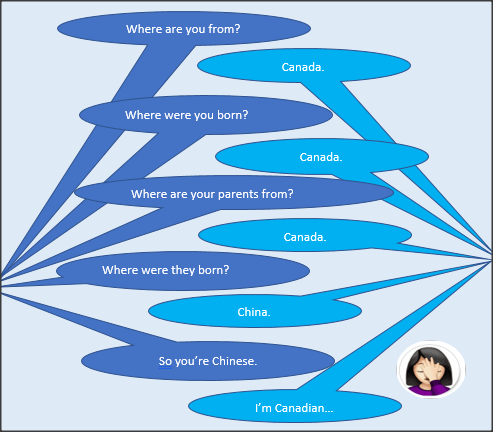
Asians born in Canada or born in the US (or any nation that isn’t considered an Asian country) are familiar with the following inquisition when they try to explain to people that they are Canadian (or American or something other than Asian).
I’ve always considered myself to be Canadian. As for role models, I choose them from any ethnic background, although I prefer successful female businesswomen, so that I could aspire to become like them.
I have quite a few women role models: teachers I admire, bosses that inspired me, and favourite authors. But out of all them, none were Asian. When I looked at my business mentors, the situation was also grim.
My two business mentors are highly successful millionaires or near millionaires and both are Chinese. They are examples of how immigrants could come to Canada, work hard, and become financially successful. They were leaders that I could follow but they were men.
The successful women leaders that I could think of were the wives of these men. They hadn’t created their financial success on their own, but they learned leadership skills to help their husbands in their careers.
I decided to look past my own experience and see if I could find more successful Asian leaders in North America. First, I wanted to establish what qualities I wanted to see in a strong leader.
What Leadership Skills Should We Teach Managers And Executives?
When you think of leaders that you admire, what qualities do they have? Are they good listeners? Do they show empathy? Do they inspire you to work hard to attain their level of success?
The leaders I admire are very good at taking charge, providing direction for the team, and being someone you can depend upon. At the same time, even though they are the leader, or the boss, I never feel like they are demanding me to complete a task. They ask me in such a way that I feel that I’m doing them a favour. A favour that I’m not likely to refuse, of course, because it’s a request from a supervisor.
Do Asians have the leadership qualities that I’ve identified?
Maybe they do. And maybe they don’t. The American workforce either lacks Asians that have what it takes to be an effective leader, or they aren’t seen as having the qualities needed for leadership. A closer look at numbers reveals a gloomy situation.
How High Is the Bamboo (Glass) Ceiling for Leadership?
A 2010 study cited by Harvard Business Review (HBR) found that “Asians do outperform other minorities and white people when it comes to education, employment, and income.” If they are so successful, then shouldn’t they also successfully climb the corporate ladder as well?
Apparently, they don’t have far to climb before they bump into the glass ceiling. HBR used the term “bamboo ceiling” – the equivalent to the glass ceiling. In addition to the 2010 report, it cited a 2015 report on diversity.
It found that, “Asians represent only 1.5% of corporate officer positions in the Fortune 500, according to 2012 data.” The situation for Asian women was worse because these women represented only 3.1% of executives five tech companies in a study, while Asian men represented 13.5%.
What could be creating these limitations?
All races face stereotyping at the workplace. Employment data cited above suggests that Asians are highly competent at finding high paying jobs. Their success may make them appear threatening in the workplace. However, Asians are also perceived to have a critical weakness.
The HBR article study observed that “stereotypes about Asians lacking social skills make them seem unfit for leadership.”
An article in Bloomberg suggests that Asian culture encourages communication and networking styles that go against the “mainstream dynamic of assertiveness and directness.” For this reason, Asian Americans are considered as fitting for “low- to mid-level management positions, but not top-level leadership.”
How Many Asians Are In Executive Positions?
A Silicon Valley report found that Asians were so underrepresented in leadership positions that they were grouped into other, larger categories. In the report, “Asian men are lumped into a ‘non-underrepresented’ category with white men” while “Asian women are assigned to a category that includes women of all races.”
These types of numbers were repeated in other industries, where Asians continued to be underrepresented in the executive ranks of companies. See the table below.
What can be done to increase the number of Asians in top level executive jobs? Could their social skills truly be so lacking that they would be unsuitable leaders? Or would it be possible to teach leadership skills in such a way to compensate for disadvantages from any cultural differences?
Future of Leadership Skills
It would be interesting to see the data for other races and ethnicities. What is the ratio of their ethnic group in jobs in an industry, compared to the percentage in executive positions for that industry?
If a wide gap exists between the lower ranks and the executive ranks, what can be done to level the playing field in leadership?
From these studies in this article alone, it seems that perception of cultural differences affect how people from different races are promoted to leadership positions.
In future, one recommendation would be to design leadership training skills that address stereotyping and culture. It’s possible to have talented and skilled leaders equally represented from all ethnic backgrounds.
If you like this post, subscribe to make sure you don’t miss the next one!
What comes to mind when you hear “teamwork” with your coworkers? Most likely, working in person in an office together with other people. However, these days, teamwork has taken on a new meaning for global companies with employees and contractors in multiple time zones. How do you develop a sense of community and company culture when your remote team is spread across countries?
Technology has enabled us to work from any location we choose, whether from home, at a coffee shop, in our car, or in a rented workspace.
A remote company can have a physical office location, but the team only works at the office if they want to. There aren’t enough desks for everyone, even if they all decide to show up to work there. Another type of remote company doesn’t have a central office. Everyone works from home.
These types of remote companies can develop a company culture and connection between team members because they have the following common factors.
Strong Leadership and Clear Goals
A positive company culture depends on strong leadership from management and a clear goal or purpose from day one.
At one remote company where I worked, I had a phone call with my new supervisor, who set up a series of Zoom meetings for me, gave me an email address to access company files, and assigned me tasks to complete.
I faced several challenges that first week. I had to chase down team members on the other side of the country or on another continent. When I needed to find a teammate I didn’t know, I had to figure out how to get a hold of them. Unlike a traditional office, there was no reception desk to call or a central place with all employee numbers written down.
Unlike a traditional office, you can’t wander the halls to find someone who can help you or knock on someone’s door to ask for help. With a remote company, that email or phone number is your lifeline. Clear guidance lessens any frustration that could arise from these unexpected issues.
My supervisor usually checked in to make sure problems could be solved or suggested how to find a solution. Having someone I could rely on to clarify things was important. Otherwise, it’s easy to start feeling isolated and alone without clarity.
My supervisor was also a role model for company culture. When I started working with other team members on projects, I set up my tasks with them the same way my supervisor did. I also checked in with team members about projects. Clear communication is vital to a remote company.
Responsive and Frequent Communication
Building a successful, remote team depends on responsive and frequent communication. Having platforms, apps, and chats set up for team messages is the first step. The second is creating a culture of responsiveness.
For one company that I worked with, communication was very infrequent. People messaged the team with reminders of team meetings or items that were due for multiple people. When anyone posted a link to a completed project or suggested an idea, one or two people responded with a thumbs up. Sometimes there would be no communication for hours or days.
As a result, it was easy to feel detached from the company, like working on a deserted island. The infrequent messaging was like seeing a beacon of light, a frail trail of words in the darkness.
In contrast, another remote company I worked with had multiple chats set up and used platforms such as Slack. When one person posted an idea for review, multiple people wrote in with feedback and suggestions. A social chat group was filled with lengthy banter about weekend activities, jokes about life, and friendly jokes about coworkers.
Although I was working alone in a room, I felt like I was in an office full of people because of all the frequent communication.
Someone at this company had started this culture of frequent communication. New team members continued the culture. Not all the chatter was about work, although it could start with a work topic. People wanted to stay in touch.
Getting to Know the Team on a Personal Level
Socializing helps a team to gel. Otherwise, you have a group of people working on tasks. When you’re just a cog in a wheel, it’s much more difficult to be invested in the company. Getting to know the team on a personal level further develops company culture.
The first step to getting to know coworkers is the jokes and quick comments about a favorite food or weekend activity during a Zoom meeting or in a team chat. It’s also important to meet with them outside of work.
Pre-covid, meeting in person for company social events such as themed lunches, Christmas parties, or company functions was one way to get to know coworkers. It’s different talking with someone in person than watching them on a Zoom screen or reading their DMs.
You connect better with people when you see their body language and hear their voice. Messaging apps do not capture these aspects of a person.
Most importantly, when you don’t have meeting time limits, it’s much easier to get into deep conversations about your coworker’s hobbies and vacations. When you know more about someone on a personal level, it becomes more like working for friends than strangers who are a name and a tiny facial profile on an app.
Now that we are highly discouraged from meeting in person, getting to know people on your remote team is harder. Harder but not impossible. I was surprised when I attended a strategy meeting, and we discussed not goals for the company, but goals for each attendee.
It was intriguing to hear about this personal side of people I had been working with remotely. At the end of the session, we had created goals for the company’s future. I also had a clear picture of the people working on this team.
Summary
Creating a strong company culture for a remote team takes effort. You need leadership and clear goals for the company and individuals. Frequent and responsive communication is necessary for building connections. Most importantly, getting to know your team members on a personal level develops a sense of community.
If you liked this post, subscribe so you don’t miss the next one!