Tag: professional development

  • Argh! How to Set Boundaries and Get Respect

    Argh! How to Set Boundaries and Get Respect

    Let’s empower ourselves. Social media and technology have made it too easy for strangers and toxic people to ignore our boundaries and invade our personal and professional lives.

    Family may ask you for a favor, not realizing (or caring) that you’re tired and need some space. Work may ask you to do extra work, in the evening, when you’re getting ready to call it a day. Strangers can send you unwanted messages via social media. 

    Only you can set some boundaries and create for yourself a peaceful, safe space. Here are some tips for saying “No” and feeling good about it.

    Personal Life Boundaries

    1. Clear Communication 

    Effective communication is key to establishing personal boundaries. This may be easier said than done, depending on how comfortable you are with telling people that they want you to do something you’re not comfortable with. 

    For instance, a friend might ask you to help them with something on a day you planned another activity. The activity might not be life-changing but it’s important to you and you don’t want to reschedule. Ask your friend questions and see if you can reach a compromise so you both can be happy with a new plan. 

    2. Prioritize Self-Care

    Friends, family, coworkers, and strangers can do or say something that presses against your boundaries. For example, a coworker asks you to work later because you’re the one without kids to take care of. Or a stranger cutting in front of you in line, although you had been patiently waiting there first.

    Even after you insist on your boundaries and say, no, I can’t work later, I have plans, you might feel bad. It’s important to prioritize self-care and de-stress. Watch a fun movie or listen to your favorite music. Treat yourself to a spa day (even if it’s at home), or play your favorite video games to “detox” and get the negativity out of your head.

    3. Learn to Say No

    Saying no is a life skill when setting personal boundaries. Decline invitations to events you don’t want to attend. Say no to responsibilities that will leave you mentally or emotionally drained. Refuse to do things that compromise your values.

    It’s okay to say no when a friend or family member asks to borrow something sentimental and you’re afraid you’ll never see it again. You may be scared of their anger, but in the long run, you may be angrier at yourself if they conveniently forget to return your precious possessions.

    Professional Life Boundaries

    1. Establish Clear Work Hours

    Define your work hours, whether you work at an office or remotely. Let your coworkers and supervisor know when you are available. This boundary is especially important with remote work, especially if your coworkers work in different time zones. If they start earlier than you, your workday may start with catching up on messages. If they work later than you, you may be bombarded with work requests during dinner or just as you’re logging off for the evening. Set expectations that you’ll answer during your office hours or within 24 hours, and your stress level will decrease.

    2. Prioritize and Discuss

    Everyone has limits to their professional boundaries. Sometimes taking on that one extra task can push your limits because your last task was stressful enough already. Instead of staying quiet to keep everyone happy, speak up. Tell others that you have a lot on your plate already. Which task should you prioritize? Your current tasks or the new one? Can someone help you so you aren’t overwhelmed? 

    3. Clarify Expectations

    Clarify your coworker’s expectations. Be clear about your tasks and roles on a project. Most importantly, write those tasks and deadlines down. This prevents others from adding more “small requests” for you to complete by the deadline. It will also avoid misunderstandings and conflicts in case the other person expects you to do more than you planned to, or conflicts because you overlapped tasks with another person. 

    Key Takeaways

    Setting personal and professional boundaries is fundamental for your mental health. Don’t hesitate to say no to requests that will make you uncomfortable, and communicate with the other person about how you can reach an agreeable compromise.

    If you enjoyed this article, subscribe to make sure you don’t miss the next post!
  • Read Bad Books with Bad Writing

    Read Bad Books with Bad Writing

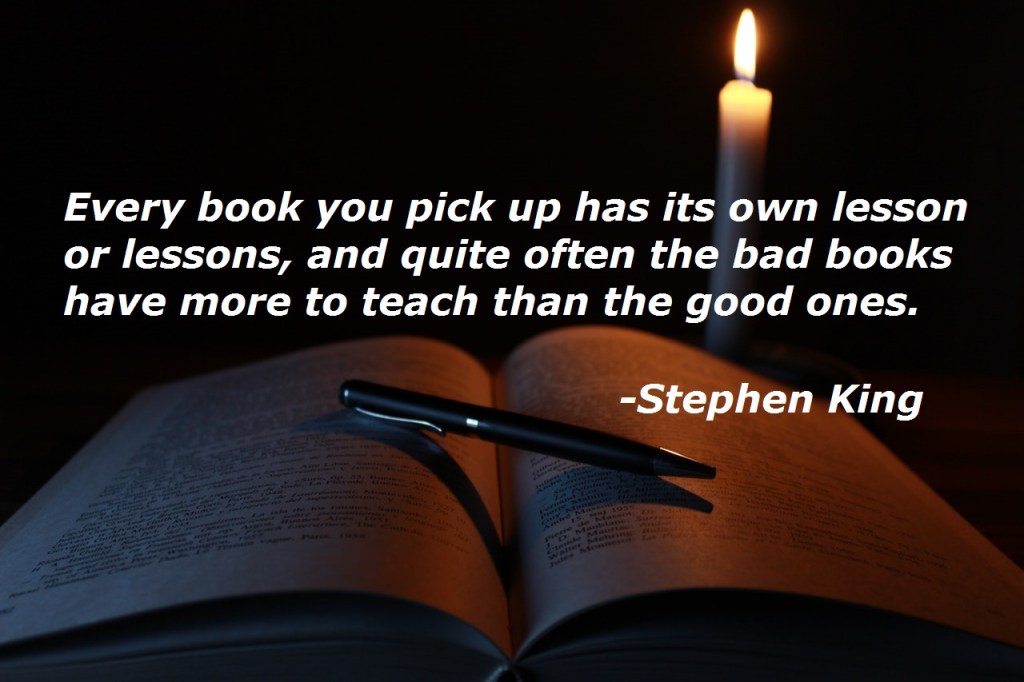
    “Every book you pick up has its own lesson or lessons, and quite often the bad books have more to teach than the good ones.”  – Stephen King, a.k.a. “The King of Horror”

    Today we have a few words of wisdom to share with you, someone who reads and writes. Yes, you are “someone who reads and writes.” Not specifically a reader or a writer, because usually we think of readers as people who like to read books and writers as people who write for a living or as a hobby. Here we mean anyone who reads anything and writes anything.

    If you text your friends or write emails for work. If you read your friend’s texts, restaurant menus, or read emails at work. Anyone who reads or writes.

    Take a moment to read some bad writing. Read an email full of grammar mistakes. Read a book that shouldn’t have been published. Why? Because you can learn a lot from reading something that is poorly written. Bad books can have just as important lessons to teach as good books.

    Good communication is vital for everyone. If you write clearly, you can avoid misunderstandings from bad texts. If you write well, you are a good communicator. And that’s just the beginning.

    Read a lot, and don’t just read the good stuff. When you read bad prose, you learn what not to write. If you want to write well, for blog posts or for your novel, then read a lot. Read good books and bad books. Be a critical reader and take lessons about what makes a piece of writing good, and what makes it bad. As author Stephen King once said, each book you read has valuable lessons to offer.

    What lessons have you learned from something you’ve read?

  • Artificial Intelligence (AI): Helpful or Harmful to Jobs?

    Artificial Intelligence (AI): Helpful or Harmful to Jobs?

    Is artificial intelligence (AI) harmful or helpful to our jobs? Will we lose our jobs to AI? Many already have faced the answers to those questions. People have lost work to AI and certain jobs will disappear completely. On the upside, AI has enhanced our work by eliminating our repetitive tasks. AI can also reduce the time it takes to complete tasks. Most importantly, AI will create new jobs. Let’s dive into this topic further.

    Will AI replace jobs?

    At first, artificial intelligence (AI) was helping us to do jobs better and faster by completing repetitive tasks. Having someone (or something) complete all the boring tasks is a good time saver. But AI will continue to improve to the point of replacing jobs and people. Here are some examples. 

    In customer service, bots answer frequently asked questions (FAQs) from customers, so staff are free to answer infrequent or more complex questions. Robot waiters can take dishes and drinks to customer’s tables. AI can use existing examples of writing and art to create stories and artwork similar to an existing style.

    Can AI help us to do our jobs better?

    AI is already helping us to do our jobs better and faster. It can help us to find errors in our writing. It can also learn from our writing style and remind us to use a spelling or word specific to our company or industry.

    It can act as a personal assistant to schedule meetings with clients and coworkers. It can generate automatic email responses so that customers will receive generated, immediate responses to their messages. Chatbots can handle frequently asked questions and common issues, handle inquiries and decide when a more complex situation needs to be passed to a human support agent.

    How can we foolproof ourselves from losing jobs to AI?

    AI will replace jobs in the future. It has already replaced jobs. If AI hasn’t replaced your job, chances are, your job will be affected by AI in some way, such as automating part of your job or changing the way you do your job.

    Jobs that AI won’t replace are those that require human interaction. For example, although AI can be used to teach in the classroom, it cannot replace the trust and close relationships that teachers have with their students. Teachers can intervene if there are arguments between students or help a student who is having personal issues at home. 

    AI cannot listen to a person’s problems and help a person through a mental health crisis. Similarly, it does not have the sensitivity to deal with a sudden job layoff, or answer a question about health benefit coverage that will have a severe impact on a person’s family.

    Why is AI beneficial for society?

    AI helps us to complete repetitive tasks more efficiently, freeing us to do other things. Instead of marking the same test a hundred times, AI can score all the tests in a matter of minutes, saving a human one to several hours of boring work.

    AI can also help people to improve their skills. For example, it can suggest ways for bad writers to improve their writing by identifying their spelling mistakes and suggesting better ways to write their sentences. This is not the same as replacing professional writers. People who need to write reports or emails at work aren’t going to invest in a professional writer to write an internal report. But they will appreciate having something to check their grammar before the report goes to their supervisor.

    Similarly, people will value a robot vacuum cleaner, pool cleaner, or pet food dispenser to help with chores around the house. One day, a robot may even be able to do all the basic housecleaning that people dislike. 

    However, technology cannot replace all tasks, especially those that require special skills. People who can afford it will want to hire writers to produce a piece of writing exactly to their specifications. People with expensive heirlooms or valuables will want the human touch to do the job right when they need a thorough cleaning of their homes.

    Key Takeaways

    As with any advancement in technology, jobs will disappear and jobs will be created. Jobs that require a human element will be the hardest for AI to replace. But AI will also provide us with many benefits, such as replacing boring and time-consuming tasks. Jobs will also be created that are related to the creation and maintenance of AI. 

    What do you think? How has AI affected your work?

  • Why Is Editing Your Work Important?

    Why Is Editing Your Work Important?

    Repost

    If you write for your job or business, you need to read this. If you write at all, you should read this. Editing is an important step in the writing process, and it’s more than checking for typos. A lot more because of what’s at stake.

    Editing can prevent awkward situations that result from typos, and it can prevent confusion from a poorly worded message. Here are four reasons to ask someone to edit your work. 

    Professionalism

    Editing is a key step in maintaining your professionalism. A quick review doesn’t take long and saves potential embarrassment and heartache.

    For example, if you’re sending a text for work, take an extra second to reread your message. Check your phone didn’t surprise you with autocorrect. Anyone who has used a smartphone long enough has likely experienced an unusual autocorrect suggestion.

    When writing emails, check that you’ve spelled the recipient’s name correctly. You don’t like it when people get your name wrong, so treat others with that in mind!

    The other party can guess your meaning when you skip a word. However, “I will finish by tomorrow” and “I will not finish by tomorrow” have a completely different meaning.

    Editing your work can include checking what you do. I once saw a section on a website that looked like internal notes to team members – because someone had accidentally hit publish instead of save.

    Clarify Meaning

    It’s clear in your mind what you want to say. Asking a coworker or taking a break before rereading your work can make a huge difference. You may find that your writing isn’t as straightforward as you thought.

    Getting someone else to read your work can give you valuable insight. They may ask questions that make you realize you left out details or your meaning wasn’t clear. Or they may have suggestions about how to write something more concisely. Why take fifty words to say something that you can express in thirty?

    When you read your work aloud, you might realize you are wordy. You might discover that you need more commas to break up chunks of text in a sentence. Or you may have a sentence that goes on forever and you need to add a period before you pass out from lack of oxygen.

    Verify Details

    Review important details before publishing a report or sending an email. A simple typo could send your client to the wrong address or invite a colleague to attend a meeting at the wrong time.

    Numbers can be boring to check, but they are worth verifying. For example, suppose you have completed several calculations. You’re typing up a table of numbers or copying a bunch of monetary totals as part of a project proposal. Double check your numbers. You don’t want your proposal to say that you can do the project for $1000 when your team quoted $10,000 for the job!

    New ideas

    Asking someone edit or check over your work is the same as getting a fresh pair of eyes. You’ll see your work from a new perspective. Your coworker could provide suggestions on a more engaging way to word your email.

    A colleague could provide ideas for another way to present your information. For example, taking a paragraph of statistics and presenting it as a graph or colourful infographic.

    Key Takeaways

    It is worth taking the time to double check your work. You could be saving yourself the embarrassment of a costly typo. You could gain insight into writing in a more appealing way to your audience. Be open to learning from mistakes and learning new ways to write.

    If you enjoyed this article, subscribe to make sure you don’t miss the next post!

  • 4 Tips to Finding the Perfect Mentor

    4 Tips to Finding the Perfect Mentor

    When you’re juggling a career, social life, and hobbies, finding time for career-related training is challenging. One way to improve your skills is by taking a course or program. Another is to read many books. However, one of the most effective ways is to learn from a mentor with the skills and experience you’re looking for. Finding the perfect mentor is not easy, but there are some tips you can follow to find the right one for you.

    Tip 1: Choose a mentoring style you’re excited about

    To learn from someone with a social media presence, start with an online search. Follow this person on their social media platforms, watch their videos, or subscribe to their newsletters. If they have free seminars or workshops, sign up for them. Your purpose is to learn more about their teaching style, as well as what they teach. You want to choose a mentor whose style resonates well with you.

    To learn from a mentor you’ve met in person, build a connection. Most likely this person doesn’t have an online presence because they don’t offer mentoring professionally. They don’t have courses or videos available for you to learn from. This person may be a coworker or someone in your professional network. You’ve heard their advice during a networking event or an informal discussion and their advice resonates with you.

    Whether your mentor is a well-known celebrity or someone you know personally, ask yourself if your mentor challenges you. Someone with similar life experience or skills may not be able to mentor you as well as someone with a higher level of skill or more years of experience.

    Tip 2: Take action and start learning

    When you’ve found someone you like as a mentor, ask yourself if your mentor can motivate you to get results.

    Your mentor should inspire you to take action when you watch their YouTube video or teach you about a new concept. Their message should excite you so much that you want to learn and change. They should also be approachable. For example, you should feel comfortable having dinner with them without feeling nervous.

    Their mentorship should have you thirsting for more knowledge about the same topic or madly scribbling notes. You should be excited about applying what they are trying to teach you as soon as possible.

    To get the best results from working with a mentor, have some goals in mind. The worst scenario is to be too general about what you want your mentor to teach you. If your mentor posts a lot of learning material online, focus on one topic at a time, not getting your hands on everything they have ever published. If your mentor wants to help you improve your skills, don’t set a general goal, such as, “I want to get better at my career.” Set specific goals and share these with your mentor.

    Tip 3: Choose a mentor who chooses you

    Getting feedback from your mentor is important. Don’t just take classes with your mentor. Sign up for coaching sessions or group sessions to practice what you’ve learned. Take your mentor out for coffee and ask for an evaluation. Get feedback on your progress as often as you can. 

    If you can schedule an hour with your mentor, plan goals in advance. Prepare questions to ask your mentor, or list what you’d like to improve on before your meeting. Set clear expectations and outcomes to show your mentor that you respect their time.

    Work with a mentor who is invested in your future. After receiving feedback, take some time to reflect on what you’ve learned. Was the feedback valuable? Can you use the feedback to make improvements? Did your mentor seem genuinely invested in providing you with meaningful goals and useful feedback? 

    A mentor who is a good match will encourage you, tell you what progress you’ve made, be honest in their critique, and help you set goals for next steps.

    Tip 4: Focus on making progress

    Finding the right mentor is like an investment. You want someone who is approachable, excited about what you want to learn, and honest when mentoring you. It will feel uncomfortable and even painful to be told that you aren’t doing something well. However, if you only spend time doing things that you already excel at, you will not grow as a person.

    Embrace change and getting uncomfortable. You chose this mentor because they are great at something that you aren’t. Follow their lead and get comfortable facing your fears. Each time you challenge yourself to try a small goal, you make progress. When you look back, you’ll be surprised at how far you’ve come.

    In life, the best direction to keep moving in is forward. After you reach one milestone in the road, aim for a new one. Always keep challenging yourself and you will grow as a person.

    Key Takeaways

    Finding the perfect mentor is a search for a two-way relationship. Your mentor should be someone you are inspired to learn from, but also someone who is excited about seeing your career advance to the next level.

    If you enjoyed this article, subscribe to make sure you don’t miss the next post!