Tag: reading

  • Read Bad Books with Bad Writing

    Read Bad Books with Bad Writing

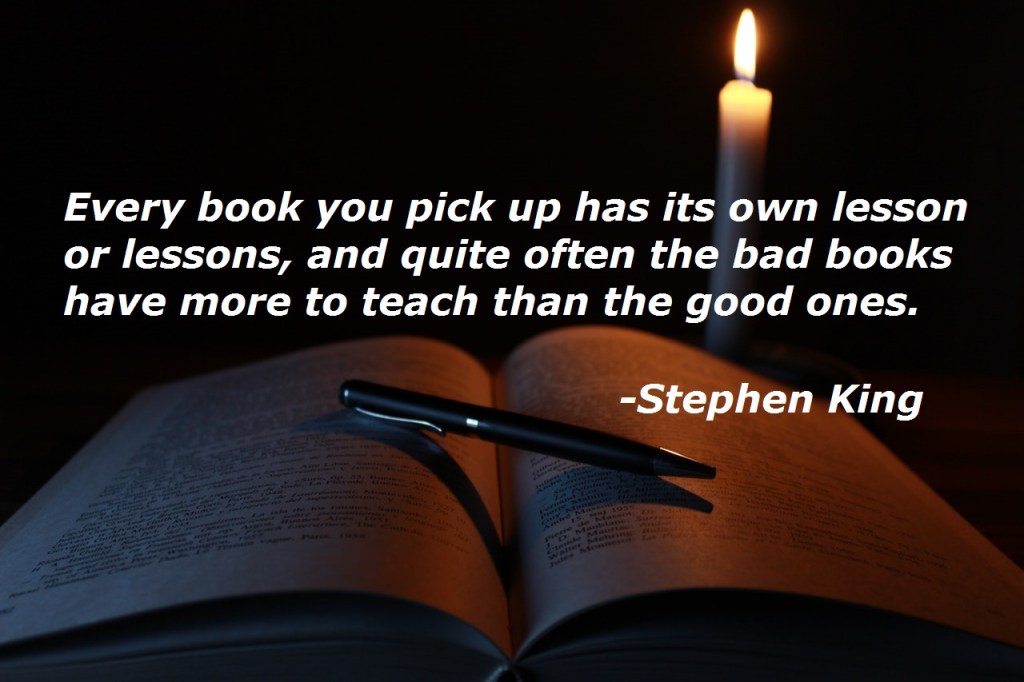
    “Every book you pick up has its own lesson or lessons, and quite often the bad books have more to teach than the good ones.”  – Stephen King, a.k.a. “The King of Horror”

    Today we have a few words of wisdom to share with you, someone who reads and writes. Yes, you are “someone who reads and writes.” Not specifically a reader or a writer, because usually we think of readers as people who like to read books and writers as people who write for a living or as a hobby. Here we mean anyone who reads anything and writes anything.

    If you text your friends or write emails for work. If you read your friend’s texts, restaurant menus, or read emails at work. Anyone who reads or writes.

    Take a moment to read some bad writing. Read an email full of grammar mistakes. Read a book that shouldn’t have been published. Why? Because you can learn a lot from reading something that is poorly written. Bad books can have just as important lessons to teach as good books.

    Good communication is vital for everyone. If you write clearly, you can avoid misunderstandings from bad texts. If you write well, you are a good communicator. And that’s just the beginning.

    Read a lot, and don’t just read the good stuff. When you read bad prose, you learn what not to write. If you want to write well, for blog posts or for your novel, then read a lot. Read good books and bad books. Be a critical reader and take lessons about what makes a piece of writing good, and what makes it bad. As author Stephen King once said, each book you read has valuable lessons to offer.

    What lessons have you learned from something you’ve read?
  • Technical Writing is Boring! (Or is it?)

    Technical Writing is Boring! (Or is it?)

    People think writers write novels, blog posts, or magazine articles. Technical writing isn’t top of mind. People also tend to think that technical writing is boring. It’s about writing instructions, and how many people have the patience to follow instructions these days? Now before you yawn, let’s get into why we need technical writing. 

    First, what is technical writing? 

    It’s not dry writing. I mean, technical writing is about a specific topic. The primary purpose is to provide instruction and information. Employee handbooks, standard operating procedures (SOPs), troubleshooting guides, user manuals, company documents, and case studies are all examples of technical writing.

    Why do we need technical writing? 

    Sometimes in life, we get stuck. We need help that is easy to follow. You’ve probably read an example or two of technical writing by now, especially if you bought a new computer or phone and read some documentation to figure out how to use it. If you’ve watched a video that gave you instructions, the transcript is an example of technical writing. 

    Technical writing organizes information into easily digestible bits. You can go to a table of contents to find the topic you’re interested in, and read just that section to get the information you need. You don’t need to read the entire book or PDF from cover to cover, or read each page of a website to find the answer you need.

    Why is technical writing fun to write?

    People may think that emotions and personal experience have no place in technical writing, so technical writing is boring. However, if you like organization and solving puzzles, you’ll like how technical writing follows a sequence. Technical writing will explain a concept clearly, using plain language without jargon or idioms. If a special term is used, the meaning is explained. 

    This is why technical writing is fun. It’s like being in an escape room and you’re faced with the challenge of organizing a bunch of information to get the answer you need. If you get it right, your mission is accomplished. You can also use your imagination in technical writing. You can create a handbook on how to capture and tame dragons.  

    Key Takeaways

    Technical writing provides valuable instructions and information. If you’ve picked up a user manual to find the answer to your question, you’ve read a piece of technical writing. This style of writing sticks to the facts and doesn’t include emotions or personal experiences. For this reason, some people think technical writing is boring. But other writers think technical writing is fun. It’s challenging to write information in a way that is easily understood and easily found by skimming and scanning. Technical writing has a very important role in providing readers with important information.