Tag: skills

  • Where to reduce clutter in your life? 3 Tips for a More Stress-Free Life

    Where to reduce clutter in your life? 3 Tips for a More Stress-Free Life

    Daily writing prompt
    Where can you reduce clutter in your life?

    Trash is treasure – you’ve heard that one person’s trash is another person’s treasure. So how do you decide what to remove and what to keep? We can reduce clutter in every aspect and place of our lives, from objects that get in the way to thoughts and people that take up unnecessary space.

    For certain, if you reduced the clutter in your life, you would have a more stress-free life. So here are three tips on how to get started on removing some of that weight from your day-to-day living.

    Tip 1: Define your clutter and gain some space

    Some people like a messy workspace because it boosts creative thinking. Or they keep objects because of the memories attached to them. Having a past and inspiration is a good thing. Or you might be the opposite and your desk is always organized and you’ll never find crumbs on your kitchen table. All your clothes and shoes are organized by color. Keeping pristine is also a good thing.

    If you can find the things you need, like your house keys, or the TV remote, or that matching sock, you’re organized in your own way. As long as your life is not a hazard to your health, like that big stack of boxes in the hallway that might topple anytime and injure you. Or photos that evoke painful memories and affect your mental health. In that case, maybe it’s time to let things go.

    No matter how you keep yourself organized, one rule to try is this: if you haven’t used that item before its expiry date, it’s time to toss it. This rule applies to old clothes and anything in your attic. If you haven’t used it in five years or you didn’t remember you had it, maybe it’s time to clear it out.

    Reducing clutter is hard, but it can also be rewarding as you gain space in your home, and you feel lighter because you’ve gotten rid of memories that weigh you down.

    Tip 2: Remove clutter that restricts growth

    Clutter can restrict your growth. You can trap yourself in your past. Just because you dressed a certain way for years doesn’t mean you have to have the same look or style tomorrow. Changing things up can refresh your life, especially if you’re feeling like you’re spinning in a rut. Time to rearrange furniture, get rid of extra belongings, and create a new phase in your existence.

    It’s time to rid yourself of the clutter in your brain: toxic thoughts like imposter syndrome. Whose thoughts are living rent-free in your head? A co-worker who keeps saying you’ll never get the promotion? A relative who keeps asking you when you’ll accomplish something in your life?

    Remove the mental clutter by setting small goals. If there’s a big project looming in your life, start with something small, like setting up the files for the project. It’s a small achievement, but you’re one step further ahead than yesterday. Complete big projects by finishing smaller tasks a bit at a time and the big project won’t be so impossible. It’s one way to slowly remove the mental clutter caused by negative thoughts.

    Tip 3: Remove toxic people

    People can be clutter too. Toxic coworkers or a toxic boss won’t help with your career. Make an escape plan. Sometimes you just need to quit right away, other times your financial situation requires you to be patient while you search for another job.

    Spend less time with toxic family members. Reconsider toxic friendships. Crabs in a bucket will pull at each other and keep each other down. Escape may not be easy. Make new friends, and build a new network to offset the toxic one. These new connections can also help to find a new job, lift you up by being there for you, or give you advice on how to change your life.

    Key Takeaways

    You can reduce the clutter in your life in several ways. By reducing clutter in your home or workspace, you’ll reorganize and refresh your surroundings. By assessing your mental load and your relationships, and reducing negativity, you’ll open doors to improved relationships and connections, and positive thinking.

    What do you do to reduce the clutter in your life?

  • 5 Leadership Tips for Self Improvement

    5 Leadership Tips for Self Improvement

    Daily writing prompt
    What makes a good leader?

    It’s easy to be a bad leader, but it’s more challenging to be a good one. You don’t need formal training to be a good leader, just some practical experience and the critical understanding that you should treat others how you want to be treated. And if you want to be the best leader you can, you’ll always be learning about self improvement. Here are some tips on what makes a good leader to get you started.

    Here’s what a good leader does well:

    1 Leads by example

    A good leader is very hands on. How else can you thoroughly understand the challenges that your team is facing, or how long it takes to complete a task if you haven’t worked on it yourself? Also, if the leader wants their team to work hard, the leader must work hard. The leader leads by example. 

    Even if the task is something you cannot do on your own, by working side by side with your team, you will see who gets the job done most efficiently, who leads others, and who is always eager to learn. Now you know the strengths and weaknesses of your team by working with them.

    2 Asks questions and does not make demands

    A good leader has an open mind. Instead of telling the team to finish the work by Friday, ask if they can complete it by Friday. This question gives them the opportunity to raise concerns and bring awareness to possible roadblocks.

    If a mistake is made, a good leader doesn’t make assumptions or immediately blame someone. A good leader points out the mistake and explains what needs to be fixed. They’ll ask what happened to find out what could have caused the error. The first suspect may not be the cause. Then, the leader works with the team to figure out a way to prevent the mistake from happening again.


    3 Adjusts their leadership style

    A good leader understands that one leadership style does not fit all. Some people need more support than others, especially if they are new to the job. This is not the same as micromanaging. The leader may need to show a new employee once how to do a task, and expect that person to be more independent the second time. 

    Some team members are more social and prefer more team interaction. And some are less social and like to be left alone to complete their tasks. The team leader must find a way for the team to work together while respecting everyone’s working preferences.

    4 Checks in with the team individually

    A good leader regularly checks in with each team member individually. The leader provides feedback on the team member’s performance and asks how they support the team member in their professional growth. What courses would this person like to take?

    They also see each person as an individual. By taking the time to talk with each person one-on-one, they will have a better idea about how to support that team member. That person may need time off to take their kids to appointments so they will need a more flexible schedule, for example. 

    5 Is never the smartest person in the room

    It can be tough on the ego if you aren’t the smartest person in the room. However, a leader should never be the smartest person in the room. 

    A leader can depend on a strong team with various areas of expertise to collaborate to get a job done. A leader can still be effective if they are always learning from their team or finding opportunities to learn together. A person who is always learning is always growing. 

    A person who knows that there is something they don’t know will always be humble and open-minded.

    These are all the traits of a good leader.

  • 5 Reasons to Join a Writing Group

    5 Reasons to Join a Writing Group

    Do you feel like you’re the only one in the world striving hard to achieve your writing goal? If you do, you’ve found one excellent reason to join a group. Writers often work on their masterpieces by themselves, stopping now and then to recall the spelling of a word or ponder whether to make the paragraph longer or shorter. But why ask yourself those questions when you could ask a bunch of like-minded individuals? Here are five reasons to join a writing group. 

    Social conversation with like-minded people

    Some writing groups like to get together to talk over a beer or a coffee. Now you might wonder how that’s different from socializing with friends. The difference is a group of writers talking about life, video games, jobs, or movies will eventually start talking about stories.

    They’ll compare movie plots with plots in novels. They’ll talk about historical events and how those events can become plots in stories.

    Life conversations revolve around writing. How does one find time to write if one has a full-time job? How do writers get inspiration for their writing? When is the best time of day to write?

    Just being around like-minded people can get you in the mood to either start writing or keep writing, knowing that other people face the same struggles.

    Discussions about writing

    Writing groups are a safe space to hold discussions in-person or online about writing. Unlike casually chatting with your friend (who doesn’t write outside of work) about a novel you are working on, your writing group is not only interested in what you’re doing, but they can provide you with support. They empathize with your struggles when you have writer’s block. 

    They know the pain when you forgot to save 1000 words because you shut off your computer by mistake at 3 a.m. Most importantly, they might have suggestions on books and other resources to help you write better or get over the hurdle of developing your protagonist.

    You have a group of people who have been where you are and know what you’re going through.

    Ideas, resources, and industry information 

    A writing group that meets in person and has an online discussion platform can keep the discussion going after an in-person meeting. For example, if the group sets up channels on a platform such as Discord, they can share thoughts under specific topics, such as conversations for future get togethers, self promos for books, writing topics, publishing topics, and critiques of each other’s work. 

    They can also share resources, such as writing books they recommend, and thoughts on industry trends for best ways to promote books, and what types of literature is most popular.

    Accountability for writing goals

    You can find people in the group who are looking for accountability partners. Some people find it difficult to find motivation to write or stick to their writing goals if they are easily distracted or overwhelmed by life’s challenges and distractions (good and bad).

    If you have an accountability partner, you know you will report to someone at the end of a designated time period to tell them about your writing progress. Between the two of you, you don’t want to be the one who didn’t achieve your writing goals!

    An audience

    The most important reason for joining a writing group is you already have an audience. This is especially important if you are a first-time writer and you don’t have an audience for your work. Your writing group is there to support you on your journey to finish (or just work on) your writing project. You have an audience who will give you feedback and comments and encourage you to keep writing.

    Key Takeaways

    Joining a writing group has a lot of perks. You’ll be in an environment of supportive, like-minded people who face some of the same writing struggles that you do. They can help you with resources and advice and hold you accountable to your writing goals. Also, if you’ve lost the motivation to write, your writing group can inspire you to start thinking about writing again.

  • What If Everyone on Earth Spoke the Same Language

    What If Everyone on Earth Spoke the Same Language

    Let’s imagine for a minute that we aren’t in a sci-fi movie. When you woke up this morning, everyone understood each other because we all spoke the same language. Convenient, right?

    We could travel from country to country without language barriers and easily communicate with people on other continents. Seems ideal at first. But when you examine the situation more closely, you’ll see why this reality may not come true. 

    Language is Culture

    Language is so complex that it’s not easy to create a language that is spoken worldwide. Every language tells you something about the people that speak it.

    For example, look at the number of words we have to express colors in English. The color red has over 20 synonyms for red (vermillion, scarlet, cherry, cerise, wine, ruby, crimson, coral, rose, auburn, bloody, blush, ruddy, coral, sanguine, maroon, florid, poppy, rusty, rouge). These words allow for beautiful imagery and poetry when we describe the rainbow.

    In contrast, colors in Chinese are expressed as the color (red) with modifiers (light red, dark red). There isn’t as much variation. But the Chinese value family, so the words to describe family are far more descriptive and precise than in English. It is not enough to say sister, brother, aunt, and uncle. They need to be exact. So if you ask how to say “aunt” in Chinese, you need to be specific and say, “How do you say aunt if she is your mom’s older sister”?

    People around the world have different cultures and cultural values. How could we have a universal language that captures all the world’s cultural values?

    Language is a Bunch of Concepts

    Often, we hear someone say, “I don’t know how to say it in English,” and they don’t mean they don’t know how to translate it into English. They’re saying that English doesn’t have such a concept. 

    Counting in French involves math, for example. Learning to count to twenty is useful because eighty is quatre-vingts (four twenties) and ninety-seven is quatre-vingt-dix-sept (four-twenty-seventeen).

    The Japanese language has different ways of counting items, depending on what the object is. For example, “one” when counting animals is ippiki, but “one” when counting umbrellas is ippon, and “one” for one drink is ippai. You can’t just say the same word to mean “one” cat and “one” pencil.

    In Cantonese, they classify food as “hot” or “cold,” but this concept doesn’t refer to temperature. Instead, it refers to yin and yang properties of food. So spicy food, mangos, chicken and lobster, for example, are “heaty” while pork, watermelon and crab, for example, are “cool.”

    It would be a challenge to capture all these concepts for all the languages of the world into one international language. 

    Language is History

    Language is a record of our history. English baffles people with its inconsistent spelling and pronunciation. For example, “through” and “threw” sound the same. But the “ough” sounds different when you say “bought” and “thought.” And “ough” changes its sound again when you say “though” and “sew.” 

    One reason for this inconsistency is how English evolved. “Knight” and “night” sound the same in modern English. But long ago, we did pronounce the “k” and the “g” in knight.

    English is continuing to evolve to be more inclusive. Instead of actor and actress, you can say actor for male and female actors. “Waiter” and “waitress” are evolving into “server.”

    Technology is also influencing language. American Sign Language (ASL) uses both hands to communicate concepts. As the popularity of the mobile phone and face-to-face calls became commonplace, ASL has evolved so it is possible to communicate while signing with one hand and holding the phone with the other hand.

    Key Takeaways

    What if everyone on earth spoke the same language? It would make communication a lot easier. But is it possible to have one universal language? Can one language capture all the nuances and cultures of all the peoples of the world? And can one language suffice to say everything we want to say as we continue into the future? What do you think?

  • Does punctuation matter? Some comma humor.

    Does punctuation matter? Some comma humor.

    Does punctuation matter? The answer is in this story about a panda that walked into a cafe, ordered a sandwich, ate it, and fired a gun into the air. But why did the panda do such a thing?

    The answer lies in a badly punctuated manual with a definition of “panda”:

    “Large black-and-white bear-like mammal, native to China. Eats, shoots and leaves.” – Lynne Truss, Eats, Shoots and Leaves

    Panda lying on table, slupping noodles.

    How important is it to learn punctuation rules?

    Let’s start with the disasters that could occur when the series comma is not used when it’s needed. The series comma (also called the Oxford comma, the Harvard comma, and the serial comma) is the comma that is used before you list the final item in a series of three or more items. For example, the serial comma is placed after “bunnies” in the following sentence:

    They like cats, bunnies, and bears.

    The series comma

    American English tends to use the series comma more than British English, but it really depends on which style guide a writer or editor is using.

    In some cases, the use of the series comma is necessary to clarify the meaning of a sentence, such as the sentence below, which doesn’t use the series comma.

    I like cooking my family and my pets. (Scary)

    A series comma changes the meaning.

    I like cooking, my family, and my pets. (Normal)

    Similarly, this sentence, without a series comma, describes a dog with two job titles:

    We went on a trip with my dog, the company CEO and my manager. 

    And this sentence describes a group of people and one dog.

    We went on a trip with my dog, the company CEO, and my manager. 

    Dog staring at woman, both are sitting at their computers at their desks.

    The period 

    A period shows the end of a complete thought and appears at the end of a sentence. Sometimes people follow their train of thought and place a period when they want to pause or conclude an idea. To check that you haven’t placed a period in the wrong spot, read your sentence out loud and check if the sentence makes sense.

    Notice the difference between the following two sentences:

    Help me get a job.
    Help me. Get a job.

    And notice the difference between these two sentences:

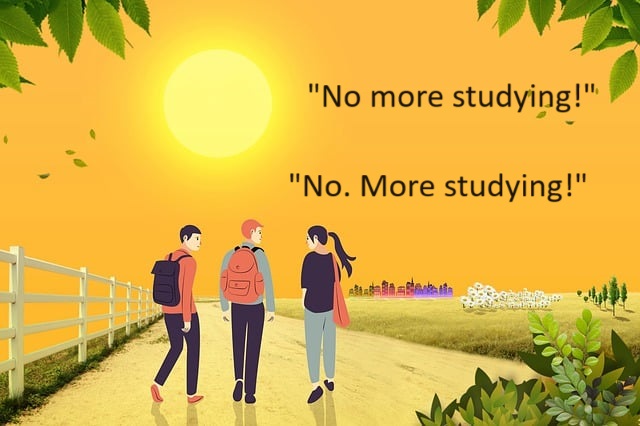
    No more studying!
    No. More studying!

    Students walking together. "No more studying!"

    Be your own editor

    Be your own editor and check your work. Don’t leave it up to autocorrect or free, readily available editing apps to make your final edits!

    Person shouts, "What do we want?"
People reply, "The end of autocorrect!"
Person shouts, "When do we want it?"
People reply, "Cow!"

    Photo Credits: GraphicMama-team (panda) Syaibatulhamdi (people walking), Karolina Grabowska (dog), Unknown source (autocorrect)