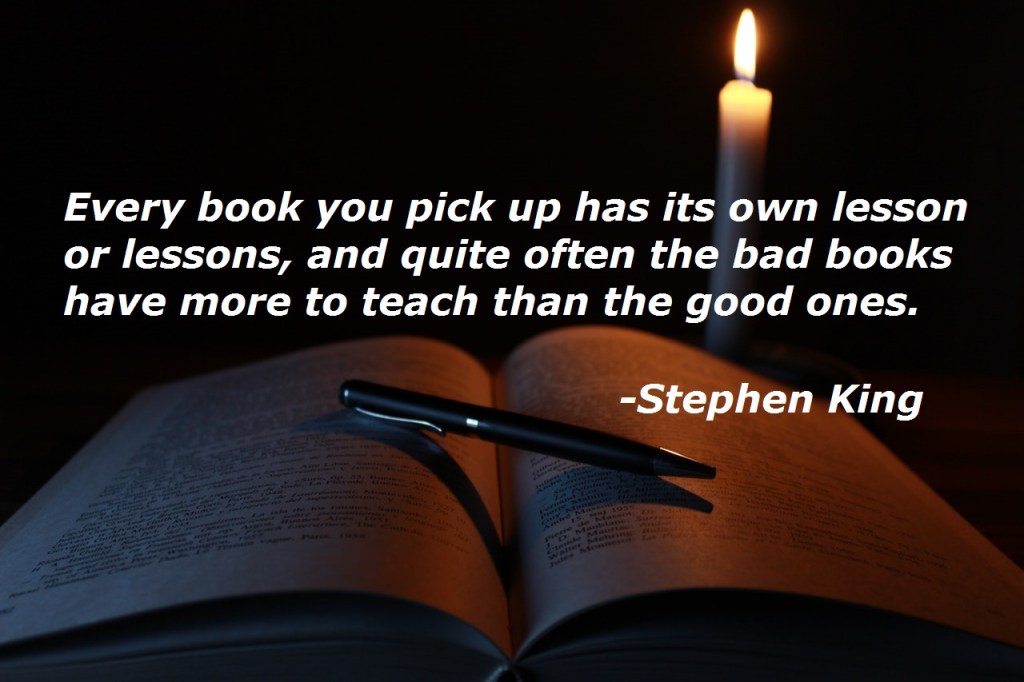
“Every book you pick up has its own lesson or lessons, and quite often the bad books have more to teach than the good ones.” – Stephen King, a.k.a. “The King of Horror”
Today we have a few words of wisdom to share with you, someone who reads and writes. Yes, you are “someone who reads and writes.” Not specifically a reader or a writer, because usually we think of readers as people who like to read books and writers as people who write for a living or as a hobby. Here we mean anyone who reads anything and writes anything.
If you text your friends or write emails for work. If you read your friend’s texts, restaurant menus, or read emails at work. Anyone who reads or writes.
Take a moment to read some bad writing. Read an email full of grammar mistakes. Read a book that shouldn’t have been published. Why? Because you can learn a lot from reading something that is poorly written. Bad books can have just as important lessons to teach as good books.
Good communication is vital for everyone. If you write clearly, you can avoid misunderstandings from bad texts. If you write well, you are a good communicator. And that’s just the beginning.
Read a lot, and don’t just read the good stuff. When you read bad prose, you learn what not to write. If you want to write well, for blog posts or for your novel, then read a lot. Read good books and bad books. Be a critical reader and take lessons about what makes a piece of writing good, and what makes it bad. As author Stephen King once said, each book you read has valuable lessons to offer.
What lessons have you learned from something you’ve read?
How many people do you know who have said, “I want to write a book”? Maybe writing a book is your goal. But ask anyone who has written a book, and they will tell you that writing a book from start to finish is not an easy feat. Don’t give up, though!
Here are some video lessons you should watch with tips from famous and successful writers on getting started on your book.
Stephen King on developing story ideas
Even if you’re not a fan of horror fiction, Stephen King is an author whose success is worth reading about. He’s published over 60 novels and 200 short stories and received multiple awards.
“Go where the story leads you,” he advises. Follow the story and the characters, and eventually you will have a book. Here are some of his other tips on writing a book and getting that story told.
Writing is self-taught. Read a lot. You’ll pick up more about narration by copying the style of writers you admire. Later, you will develop your own style.
Start with short stories and develop them into novels later on.
Write about something you really enjoy because you will be spending a lot of time developing that idea. Don’t worry about what your audience will like.
How to finish a book quickly: work three to four hours a day and write six pages.
Don’t be discouraged if your story is rejected.
For more writing advice from Stephen King, check out this video.
George R. R. Martin on world building and character development
If you’ve heard of Game of Thrones, then you know of George R. R. Martin’s work. His epic fantasy novels were adapted into the award-winning TV series. To writers looking for advice on what they should write, he says that writers should “write the stories that excite them, that interest them.”
He has many other tips for writers still working on their first book or first masterpiece:
Take a character and put them through a crisis. One way is to take something or someone a character loves and tear it away from them.
All fiction (literary fiction, science fiction, fantasy, and history) is more believable if you have real characters dealing with real problems.
When world building, keep track of details by making a list. For example, make a list of the characters, such as the kings mentioned in the story. Or draw a map of the world you are creating. When you are writing about your world, describe the scenes in detail. You want your readers to taste the food the characters are eating.
A writer is like an architect and a gardener. The writer knows the materials of the building and how many storeys the building has. The writer is also a gardener who plants the seed and knows what will come out of the soil. It would be surprising if you plant a potato and a geranium grows.
Scriptwriting helps for writing effective dialogue. Good dialogue has a lot of back and forth; it’s not a person making a long speech. When you finish writing, read your work aloud. You’ll find that what you write might not sound as good when you say it aloud.
Writing a book is like throwing dice. You don’t know if your work will succeed or fail. A real writer will write the book whether it sells or not.
For more writing advice from George R.R. Martin, check out this video.
Key Takeaways
Write a story or novel that interests you, without considering whether your audience will be interested in what you write. Writing a book is a skill that takes time to develop well, and if you’re open to learning from accomplished authors, you’ll pick up some great tips for honing your craft.
If you enjoyed this article, subscribe to make sure you don’t miss the next post!

 Vanya Wryter Consulting Services