Category: Writing and Editing

  • Why I Love Writing: Expression with Infinite Interpretations

    Why I Love Writing: Expression with Infinite Interpretations

    One of the things I enjoy most about writing is how much you can express yourself through words. Whether I’m creating instructional documents for my job or writing stories and blog posts in my free time, writing allows me to communicate ideas in a way that is both precise and open to interpretation.

    At work, my writing is focused on clarity. I create documents that explain procedures so someone can follow a process. In this context, my goal is to teach and guide the reader to a specific outcome. It’s satisfying to know my words helped someone accomplish a task successfully.

    But in my hobby writing, the goal shifts. I’m not just telling someone how to do something; I’m inviting them to experience something. Unlike videos, where the visuals are presented for you, writing leaves space for the imagination. The words on the page are only half the story—the rest is created in the reader’s mind.

    That’s the greatest part of writing fiction: the way a scene feels or a character looks can be interpreted in different ways. When I describe a main character, I might picture them vividly in my mind, but each reader will visualize their own image based on their interpretation and imagination.

    Writing is not just communication; it’s a creative collaboration between writer and reader.

    Daily writing prompt
    What do you enjoy most about writing?

  • Writing Sci-Fi and Creating a Visual Story

    Writing Sci-Fi and Creating a Visual Story

    I’ve always been a pen-and-paper storyteller (well, more of a typing into the computer storyteller these days). Recently, I’ve decided to venture into the realm of visual storytelling to breathe 2D life into my stories.

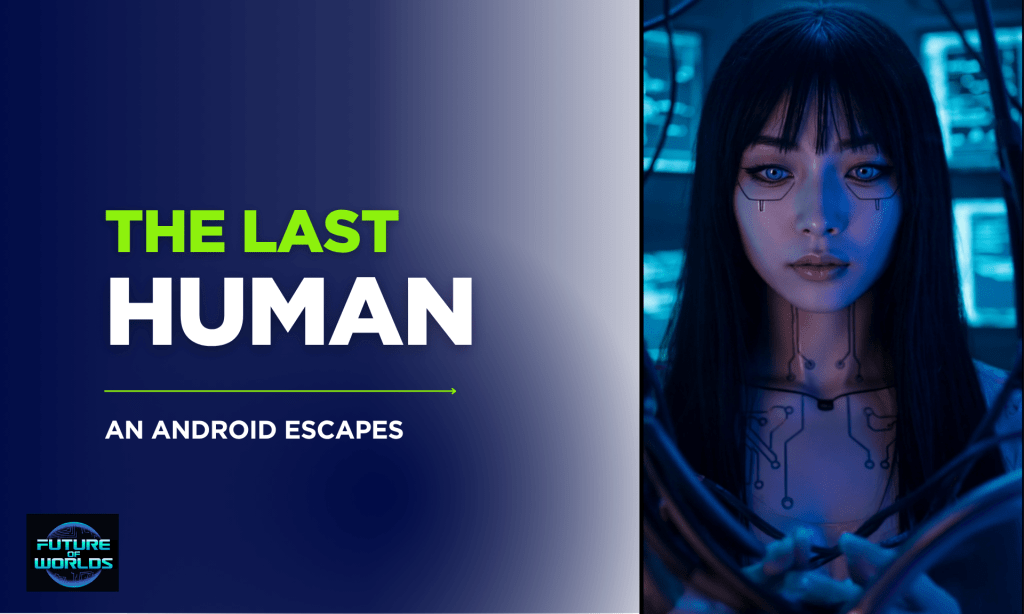
    “The Last Human” is the first chapter of a visual novel that I’m creating with friends. (We’re all writers with minimal technical skills in movie making.) The words of the story are given new life with video and music. It’s a little more work than typing a blog, but it’s also fun to share a story that people can see and hear!

    If you’re curious about how this android escapes her creator to discover what life is like beyond her little prison, check out this five-minute video of Chapter 1, parts 1 to 5!
    Link: https://youtu.be/t44oXOuhPfg

  • Do you remember growing old?

    Do you remember growing old?

    Daily writing prompt
    Describe one of your favorite moments.

    It just hits you very suddenly. That moment came for me in the most unexpected way: someone casually asked, “How old is your parent?” And then I did the math, because if my parent is X years old, that makes me Y years old. Scary thought. I’m not a kid anymore. I mean, I’m someone’s kid, but I’m not “a” kid. I don’t even remember growing old.

    I would say that was one of my favorite moments, when I felt like I was frozen in time. I was asked such a simple question, but it hit me with unexpected force. After I did the math and said the number out loud, I felt the weight of years not just on them, but on me too. In that moment, I realized how quickly time tiptoes past us while we’re busy studying, working, vacationing, and planning.

    I saw my past stretched out behind me like a well-worn road: childhood memories, familiar faces, laughter around the Christmas tree, plates and plates of delicious food. And ahead of me, the future was a blurry mist. I’m standing in the middle of the path.

    In that moment, I wanted nothing more than to freeze time. To pause everything and hold on to the now. All these moments in life are so fleeting. I don’t remember growing old. When did that start? When I paid my first bill? When I found my first gray hair?

    It reminded me to appreciate the life I’m living now—not just the big wins, but the quiet, everyday achievements. The fact that we’ve made it this far. That we’re still here. That we still have chances to love, laugh, and grow.

    Time is always moving, always pulling us forward. But in this moment—this precious, fragile now—I choose to appreciate what I have. This would be one of my favorite moments. 

    If you liked this post, subscribe so you don’t miss the next one!

  • Blogging in 2025: What’s Changed and What Still Works

    Blogging in 2025: What’s Changed and What Still Works

    Blogging has come a long way from personal journals and niche hobby sites. In 2025, it remains a popular form of communication, but how you blog and what works best have evolved. Whether you’re a seasoned writer or just starting out, understanding the current landscape is key to staying relevant. Here’s what’s changed—and what hasn’t.

    What’s Changed

    1. AI-Assisted Content Creation
    With the rise of AI writing tools and automated blogging software, content creation has become faster and more efficient. Bloggers can now use AI to outline, draft, and optimize content for search engine visibility, allowing more time for strategy and creativity.

    2. Search Intent Over Keywords
    Today’s SEO focuses on search intent optimization, meaning your content must answer user questions directly. Simply targeting a high-volume keyword isn’t enough—Google now rewards relevance and clarity over density.

    3. Voice and Visual Search Optimization
    As voice search SEO and visual content strategy grow, bloggers must adapt their writing to be more conversational and incorporate multimedia with proper alt text and image SEO best practices.

    4. User Experience (UX)
    Google’s Page Experience update has made things like mobile-friendly blog design, fast loading times, and clear formatting more important than ever. A smooth user experience boosts both rankings and reader engagement.

    What Still Works

    1. Quality Content Creation
    Publishing high-quality blog posts regularly remains essential. Informative, engaging, and well-structured content still drives organic traffic and builds domain authority.

    2. Email Marketing
    Building an email list for your blog continues to be a top way to grow your audience. With open rates higher than social media engagement, email remains a reliable channel in 2025.

    3. Evergreen Blog Topics
    Evergreen content—posts that stay relevant over time—still performs exceptionally well. Updating old blog posts with fresh insights can significantly improve SEO rankings.

    4. On-Page SEO Basics
    Using proper meta descriptions, header tags, internal linking, and clean URLs still matters. These on-page SEO fundamentals are the essentials of a successful blog.

    Key Takeaways

    In 2025, successful blogging combines time-tested techniques with smart adaptation. By prioritizing valuable content, SEO strategy, and reader engagement, you can build a blog that succeeds in a changing digital world.

  • Why I’d Love to Teach Quantum Computing for a Day

    Why I’d Love to Teach Quantum Computing for a Day

    Daily writing prompt
    What’s a job you would like to do for just one day?

    If I could have any job for just one day, I would want to be a quantum computing teacher. Teaching quantum computing isn’t just about explaining technology—it’s about understanding the applications in a field that is still developing. You become an expert on a topic that even scientists are still exploring, and that’s both challenging and exciting.

    Quantum computing combines physics, math, and computer science. Traditional computers (classical computers) use bits—ones and zeros—but quantum computers use qubits, which can exist in multiple states at once through a principle called superposition. Another important concept is quantum entanglement, where two qubits become linked so that the state of one instantly affects the other, even if they’re far apart. 

    But these principles aren’t just abstract—they have real-world applications. Quantum computing could revolutionize medicine by simulating complex molecules to help design new drugs. It might help us create stronger materials, improve weather forecasting, and transform cybersecurity through quantum encryption. In finance and logistics, quantum computers could solve optimization problems much faster than any classical computer. The potential is enormous, and it’s only just beginning.

    To teach quantum computing, you need a strong background in physics and math. Although I don’t have that, one can always still learn. Being a woman in STEM (science, technology, engineering, and math) would make this job even more meaningful. I’d love to show students—especially girls—that they can excel in this field too.

    Another reason this job appeals to me is because I love writing fiction. Quantum computing, quantum entanglement, and time travel are ideas often found in futuristic stories and TV shows. Think of worlds where computers open doors to parallel universes. Teaching quantum computing would feel like standing at the edge of science and science fiction—where imagination meets reality.

    So, for just one day, I’d love to be a quantum computing teacher. I’d help students understand the deep, strange, and beautiful ideas behind the next generation of technology. I’d connect cutting-edge science with storytelling, curiosity, and possibility. Because what could be better than helping others discover the future—and maybe inspiring a few future inventors or storytellers along the way?

    What is your dream job?