Tag: publishing

  • Self-Editing Resources for First-Time or New Writers

    Self-Editing Resources for First-Time or New Writers

    Repost

    Ask anyone who writes professionally or personally, and they’ll say that it’s hard – really hard – to find their own writing mistakes. When you are your own editor, it’s tough to remain objective and read your work with fresh eyes.

    Difficult is not the same as impossible, however. You can self-edit if you know what to look for, and you develop a process. If you’re a first-time author or new to writing professionally, you may have many questions about how to edit, what to edit, and when (what stages in your writing) to edit.

    We’ve got the answers you need with resources recommended by professional book editors.

    Here are some fabulous self-editing resources to invest your time in. If you want a break from the written word, this list includes podcasts to check out as well.

    Self-Editing: The Writing Process

    Self-editing for Self-publishers: Incorporating: A Style Guide for Fiction by Richard Bradburn

    Indie authors looking to self-publish will find this resource particularly useful. It describes a three-stage editing process similar to the traditionally published one, from structural to sentence level to proofreading.

    Self-Editing for Fiction Writers, Second Edition by Renni Brown and Dave King

    Two professional editors have written this book which teaches you editing techniques on exposition, point of view, and dialogue. They provide many examples taken from manuscripts that they have edited.

    Understanding Show, Don’t Tell And Really Getting It by Janice Hardy  

    This award-winning author uses examples to demonstrate the difference between showing, not telling, when writing a story. She helps authors understand the balance between backstory, description, and narrative. 

    Revising Your Novel: First Draft to Finished Draft: A Step-by-step Guide to Revising Your Novel by Janice Hardy  

    This book tackles the big-picture problems that can go wrong with a novel. It shows how to review character and point of view issues, plot structure problems, and setting problems. You will learn to write stronger prose and build better character arcs and compelling plots.

    Cover to Cover What First-Time Authors Need to Know about Editing by Sandra Wendel

    After writing your first book, read this book to learn what to do next, before you work with an editor and prepare the book for production and publication. This is an important resource if you know little to nothing about the publication process.

    Troubleshooting Your Novel Essential Techniques for Identifying and Solving Manuscript Problems by Steven James  

    This hands-on guide takes you through the steps that will increase your chances of selling your manuscript to a publisher or gathering an audience for your book. Topics covered include story progression, character development, narrative techniques, and troubleshooting common issues. 

    Write Great Fiction – Plot & Structure by James Scott Bell 

    If you struggle with creating a plot that engages your readers, this is a resource to add to your library. The book tackles common plot problems, developing story structure, and how to create strong beginnings, middles, and ends to your story.

    Keys to Great Writing Revised and Expanded Mastering the Elements of Composition and Revision by Stephen Wilbers and Faith Sullivan 

    The writing process can be daunting. This book provides helpful techniques for the entire writing process, from prewriting to proofreading. It also has exercises to strengthen your writing skills from the sentence to the paragraph level.

    The Magic of Fiction Crafting Words Into Story: The Writer’s Guide to Writing & Editing by Beth Hill 

    This handbook for the writing and editing process is a valuable resource on all aspects of writing and editing. It covers writing and self-editing your own stories, whether you are a first-time or experienced author. 

    Self-Editing at a Sentence Level

    The Best Punctuation Book, Period by June Casagrande 

    Whether you write for an online, print, academic, or business audience, this quick reference guide covers your questions about punctuation for all styles, including AP (Associated Press), MLA (Modern Language Association), APA (American Psychological Association), and Chicago Manual of Style.

    Editing Fiction at Sentence Level by Louise Harnby 

    This book teaches you how to self-edit your manuscript at the sentence level, from narrative to dialogue. Examples are also provided to demonstrate the lessons.

    Eats, Shoots & Leaves The Zero Tolerance Approach to Punctuation by Lynne Truss 

    This resource covers grammar and punctuation insights using humor and history. It is clear from this book that a simple comma or apostrophe can completely alter the meaning of a sentence – sometimes in a hilarious way.  

    Artful Sentences Syntax as Style by Virginia Tufte  

    This book breaks down standard sentence patterns and forms to show how they convey meaning. New writers and those who love language will find this book fascinating.

    The Elements of Style by William Strunk and Elwyn Brooks White 

    Among writing manuals, this book is considered a classic. It even has its own Wikipedia entry! This guide covers good writing and composition principles, lists commonly misused words and expressions, and lists often misspelled words.

    Self-Editing Resources: Podcasts

    The Midnight Quill Podcast hosted by writers T. C. Emerys, M. J. Glenn and Maisy Osbon

    Listen to discussions about writing techniques, worldbuilding and self-publishing, with new episodes every week.

    The Editing Podcast hosted by Louise Harnby and Denise Cowle

    Explore practical tips and insights for editors and proofreaders. This podcast is available in 60 countries. 

    Key Takeaways 

    New writers published authors will find value in self-editing resources. These books cover important topics in the editing and writing process. 

    Experienced writers will benefit from the review and the checklists, and new writers finishing their first manuscript will benefit from the insight and tips. 

    For some of the latest advice on editing, writers and editors can stream podcasts from multiple sources, such as YouTube and apps.

    If you enjoyed this article, subscribe so you don’t miss the next post!

  • Why Is Editing Your Work Important?

    Why Is Editing Your Work Important?

    Repost

    If you write for your job or business, you need to read this. If you write at all, you should read this. Editing is an important step in the writing process, and it’s more than checking for typos. A lot more because of what’s at stake.

    Editing can prevent awkward situations that result from typos, and it can prevent confusion from a poorly worded message. Here are four reasons to ask someone to edit your work. 

    Professionalism

    Editing is a key step in maintaining your professionalism. A quick review doesn’t take long and saves potential embarrassment and heartache.

    For example, if you’re sending a text for work, take an extra second to reread your message. Check your phone didn’t surprise you with autocorrect. Anyone who has used a smartphone long enough has likely experienced an unusual autocorrect suggestion.

    When writing emails, check that you’ve spelled the recipient’s name correctly. You don’t like it when people get your name wrong, so treat others with that in mind!

    The other party can guess your meaning when you skip a word. However, “I will finish by tomorrow” and “I will not finish by tomorrow” have a completely different meaning.

    Editing your work can include checking what you do. I once saw a section on a website that looked like internal notes to team members – because someone had accidentally hit publish instead of save.

    Clarify Meaning

    It’s clear in your mind what you want to say. Asking a coworker or taking a break before rereading your work can make a huge difference. You may find that your writing isn’t as straightforward as you thought.

    Getting someone else to read your work can give you valuable insight. They may ask questions that make you realize you left out details or your meaning wasn’t clear. Or they may have suggestions about how to write something more concisely. Why take fifty words to say something that you can express in thirty?

    When you read your work aloud, you might realize you are wordy. You might discover that you need more commas to break up chunks of text in a sentence. Or you may have a sentence that goes on forever and you need to add a period before you pass out from lack of oxygen.

    Verify Details

    Review important details before publishing a report or sending an email. A simple typo could send your client to the wrong address or invite a colleague to attend a meeting at the wrong time.

    Numbers can be boring to check, but they are worth verifying. For example, suppose you have completed several calculations. You’re typing up a table of numbers or copying a bunch of monetary totals as part of a project proposal. Double check your numbers. You don’t want your proposal to say that you can do the project for $1000 when your team quoted $10,000 for the job!

    New ideas

    Asking someone edit or check over your work is the same as getting a fresh pair of eyes. You’ll see your work from a new perspective. Your coworker could provide suggestions on a more engaging way to word your email.

    A colleague could provide ideas for another way to present your information. For example, taking a paragraph of statistics and presenting it as a graph or colourful infographic.

    Key Takeaways

    It is worth taking the time to double check your work. You could be saving yourself the embarrassment of a costly typo. You could gain insight into writing in a more appealing way to your audience. Be open to learning from mistakes and learning new ways to write.

    If you enjoyed this article, subscribe to make sure you don’t miss the next post!

  • What If Books Were Free?

    What If Books Were Free?

    What if books were free? I admit, I would like a free book about a topic I’m only mildly interested in. It’s much easier to get a free copy of a book these days. You can press download, and viola! you have a free ebook to enjoy.

    Here’s another perspective. An author can spend months or years to write a book. That’s hundreds and thousands of hours put into a piece of writing.

    Recently, an author was horrified to find her book could be downloaded for free on a website. She asked for help to prevent this from happening.

    Imagine working for thousands of hours for no pay. I know the feeling. I’ve worked as a book editor with authors who spend two years on a book and don’t finish it. I’ve also worked with authors who patiently work through several drafts, rewriting the same chapters until perfection.

    It’s horrifying to see thousands of hours of hard work given away for nothing. What would you do if you came across a free book?

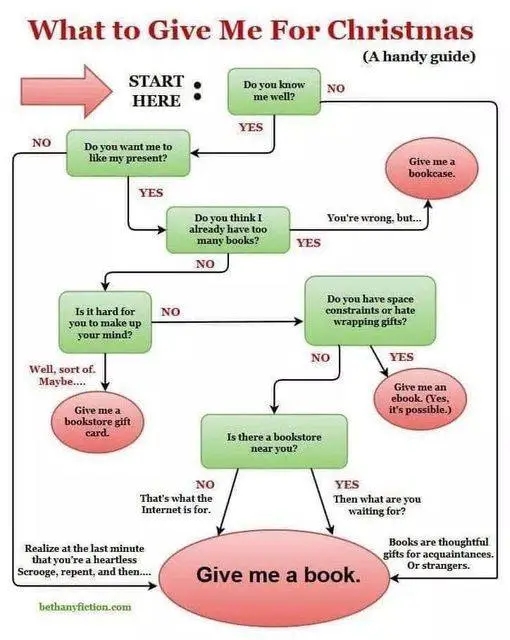
    And on another note for book lovers, I’ll leave you with this handy guide for buying books.

    image credit: bethanyfiction.com

  • Humor and Horror: Workplace Typos We Wish We Could Take Back

    Humor and Horror: Workplace Typos We Wish We Could Take Back

    If you communicate with other humans by typing messages, you’ve probably experienced this horrifying moment. For me, it was swearing at my dad when my fat fingers switched two letters on my phone and instead of typing “ok,” I typed a swear word. Also when I emailed my favorite author and said, “I’m a writer too!” and signed the email with “Thanks you.” When these mistakes happen at work, it can be worse (or just as bad). And we’re not alone.

    Here is a collection of typos that I found circulating on the internet. They appear in different types of media, from internet searches to videos to websites. For this reason, I am unable to track down or credit the original owner. If you are the owner or know the owner, let me know! I could relate to these typos, and I hope that you will too.

    Imagine having a terrible workday when your computer asks if you want to exist. In a world where AI is everywhere, I can’t help but wonder if some artificial being wants to take over my job. Or my life.

    For those who design programs, this message reminds them of the importance of doing a final QA to check for typos before releasing a program to the public.

    This warm message is both heartwarming and memorable for teachers. The students are showing appreciation for what their teacher taught them, such as spelling and vocabulary. It is also a reminder that sometimes, students are eager to apply what they’ve learned, but they still have more to learn.

    These labels are all spelled differently. As an editor, I can relate to this. I’ve been aghast to find the chapters in books are not the same, such as using a different format from one chapter to the next. Sometimes, you just don’t realize there’s a problem until you compare everything side by side.

    If you’ve ever ordered several copies of something, such as a company brochure or a business card, and only noticed the typo after several copies were made, you will appreciate this sale-priced item.

    Sometimes, a typo can show a lot of resilience and pass through several sets of eyes and stages of approval. Sometimes, you just need to appreciate their tenacity.

    This isn’t quite a typo but I wanted to share this one. Something got lost in translation but this translation sure is sweet. I would love to experience what tiny grass dreaming is like. It sounds fun. It is better than the original language, which says that tiny grass is resting… do not disturb. Sweet dreams!

    If you like what you’re reading, subscribe for more.