Journaling isn’t something people associate immediately with entrepreneurs, but it’s an important part of building mental toughness and setting up the road to success. Here’s why freelancers, small business owners, and entrepreneurs should keep a journal.
Reflection and Mindset
It’s not easy to start your own business. Find me a business owner who says that it’s easy to succeed at your own business, and I’ll owe you a fire-breathing dragon.
Mental toughness is crucial for the self-employed. There are guaranteed bad days when you question the wisdom of your decisions and guaranteed good days when you see your dream within reach.
Journaling helps build that mental toughness. Write about what went well and what you need to work on. It’s a time to evaluate your progress, work out your problems, and face your fears.
When you see your fears and problems in print, you can look your “adversary” in the face. Is it fear of failure? Is it financial struggles? What can you do next to deal with these issues?
Write about your successes as well. Celebrate your first customer or first employee. Be proud of your new skills.
Document these good days and bad days as a reminder that starting a business is like a roller coaster ride, and if you hang on, you’ll get past the ups and downs.
Goal Setting
Putting your thoughts on paper is the first step to getting organized. It’s okay to write your thoughts in a jumble in your journal. When you’ve got what’s on your mind on paper, you can start planning next steps.
For example, you’re excited about getting your first client.
What’s next? Would repeating the same actions get you the same results? Could you get the next client in half the time it took you to acquire the first?
If you’re deeply concerned about your financial situation (maybe you owe money from loans to start your business), then jot down a plan. What could you do to ease your stress? It could be taking a closer look at your bank balance. Or speaking to someone for some advice.
Journaling is a first step to setting goals and making plans after getting your thoughts on paper.
Writing Skills
When you write often, you improve your writing skills.
It’s a way to eliminate writer’s block if you’re the type who self edits while you write. You become obsessed with your spelling, grammar, and quality of writing instead of simply writing down your thoughts.
When you write more often, your writing skills improve for writing emails and reports. Writing also helps you organize your ideas if you create mind maps, flow charts, or outlines.
The best part of writing is inspiring yourself. It’s a challenge to start your own business. Document your wins, no matter how big or small. At a future date, look back and see how much you’ve learned and what progress you’ve made.
If you enjoyed this article, subscribe to make sure you don’t miss the next post!
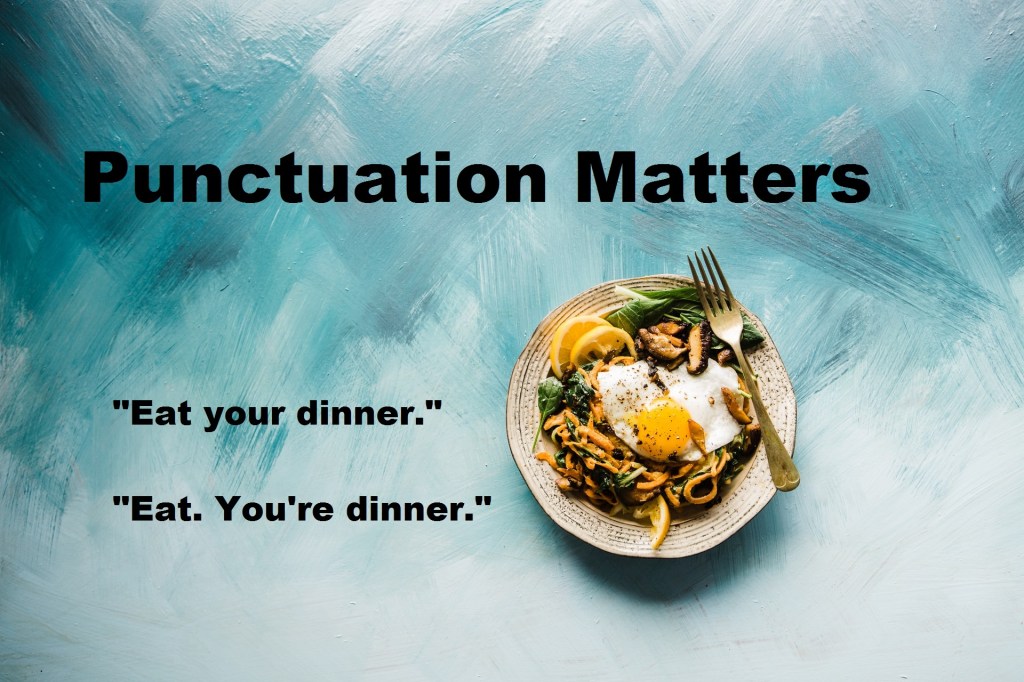
What if you want to ask someone a question but you shout at them instead? A typo with your punctuation can be a minor mistake in some cases, but in others, your punctuation can change the meaning of your words.
Here are some examples that show why punctuation is important. In these cases, the result of bad punctuation can be humorous, but at the workplace, be sure to double check your writing!
Punctuation Tip 1: Commas
Commas separate words, clauses, and ideas. Without commas, the meaning of a sentence changes drastically.
Sentence 1: Without commas, the sentence sounds like someone with some questionable preferences that society may not accept. With commas, it’s clear what this person’s interests are.
I take great pleasure in eating my dog and my plants.
I take great pleasure in eating, my dog, and my plants.
Photo Credit: Jamie Street
Sentence 2: A comma shows who you are speaking to. Without a comma, the person you’re addressing becomes part of the action.
We’re going to learn to cut and paste, kids!
We’regoing to learn to cut and paste kids.
Photo Credit: Sigmund
Punctuation Tip 2: Quotes
Quotation marks show us what someone has said. They also indicate the title of a work, such as poetry, and imply an alternate meaning of a word.
Sentence 3: Moving the placement of the quotation marks in the following examples changes the person attending the birthday party from Trixie to Pam.
“Guess who’s coming to your birthday? Trixie!” said my cousin Pam.
“Guess who’s coming to your birthday?” Trixie said. “My cousin Pam!”
Photo Credit: Nick Stephenson
Sentence 4: Adding quotes implies that the housework is not done the way we expect.
I vacuum the floor everyday.
I “vacuum” the floor everyday.
Photo Credit: YoonJae Baik
Punctuation Tip 3: Hyphens
A hyphen joins words or parts of words. It can also join words acting as adjectives before a noun.
Sentence 5: What would you rather have, 25 $1 bills or 20 $5 bills?
Twenty-five dollar bills.
Twenty five-dollar bills.
Photo Credit: Alexander Schimmeck
Sentence 6: It’s a common sight at restaurants to see a man eating a chicken. But adding a hyphen creates a creature best kept in horror movies.
Man eating chicken.
Man-eating chicken.
Photo Credit: Hannah Oliver
Punctuation Tip 4: Semicolons
A semicolon joins two complete sentences or ideas without using a joining word like and, but, so, for, and yet.
Sentence 7: If your loved one hurt you, which version of the sentence would you rather see? A semicolon mends the heart. Without a semicolon, someone is not happy about the situation.
I’m sorry; I love you.
I’m sorry I love you.
Photo Credit: Kelly Sikkema
Punctuation Tip 5: Colons
A colon announces that a list or an explanation is about to follow. It can also join sentences.
Sentence 8: Notice how the colon makes a woman powerful but without the colon, a woman loses her power and becomes dependent.
A woman: without her, man is nothing.
A woman without her man is nothing.
Photo Credit: Molly Blackbird
Bottom Line
Correct use of punctuation can make a tremendous difference in the meaning of a sentence. Remember to check that you’re using punctuation correctly! Otherwise, you can create some funny or horrifying situations.
If you enjoyed this article, subscribe to make sure you don’t miss the next post!
Online shopping, electronic mail, cloud computing, chatbots, and virtual reality are changing our everyday lives. But these technological advances would not be the same without technical writing.
Technical writing – including software documentation – is the instructions, user guides, and more that impact our use of these tech services. As our reliance on technology increases, so will our need for technical documentation.
Here are several ways that technical writing will influence and improve your everyday life.
What is technical writing?
Some people think that technical writing is as boring as watching paint dry. Unlike fiction, technical writing is stripped of descriptive language and lively metaphors. In contrast to poetry and narrative, in technical writing, sentences are unambiguous.
There is a crucial reason for the plain language.
Technology is global, so we need a language that conveys the message to everyone. Technical writing must use language that everyone, both native and non-native speakers, understands. How important is plain and simple messaging?
For example, imagine reading instructions so confusing that you delete a critical file at work! Someone could be fired.
Technical writing is clear communication.
The Society of Technical Communication, which is a professional association in the field of technical communication, gives this definition:
Technical communication is a broad field and includes any form of communication that exhibits one or more of the following characteristics:
Communicating about technical or specialized topics, such as computer applications, medical procedures, or environmental regulations.
Communicating by using technology, such as web pages, help files, or social media sites.
Providing instructions about how to do something, regardless of how technical the task is or even if technology is used to create or distribute that communication.
Technology and technical communication go hand-in-hand. The need for technical writing is expected to increase over the next ten years as our reliance on technology increases.
According to the US Bureau of Labor Statistics, “Employment of technical writers is projected to grow 7 percent from 2019 to 2029, faster than the average for all occupations. Employment growth will be driven by the continuing expansion of scientific and technical products. An increase in Web-based product support should also increase demand for technical writers. Job opportunities, especially for applicants with technical skills, are expected to be good.”
Photo Credit: Bence Boros
Why do we need technical writing?
Technical writing is a part of our everyday lives. Everything has gone or is going online. With the increased use of tools and services, we have an increased need for instructions and user manuals. Here are some situations in which you may have come across technical writing:
When you log into a company’s website to use their services, you follow directions on entering your personal information.
When you use new software, you may refer to the user manual or FAQ page for answers to your questions. The increase in cloud-based services and SaaS (software as a service) as more employees work from home or communicate online will increase the need for user-focused documentation that is easy to find and understand.
When you shop online or read the news, precise and detailed infographics provide you with product information or statistics.
Now imagine all these situations without clear communication. Imagine reading confusing directions as you fill out your application on a company website. Imagine searching endlessly through a user manual and not finding the answer you need.
Technical writing clarifies and explains. It also provides us with important information, as shown in the following examples.
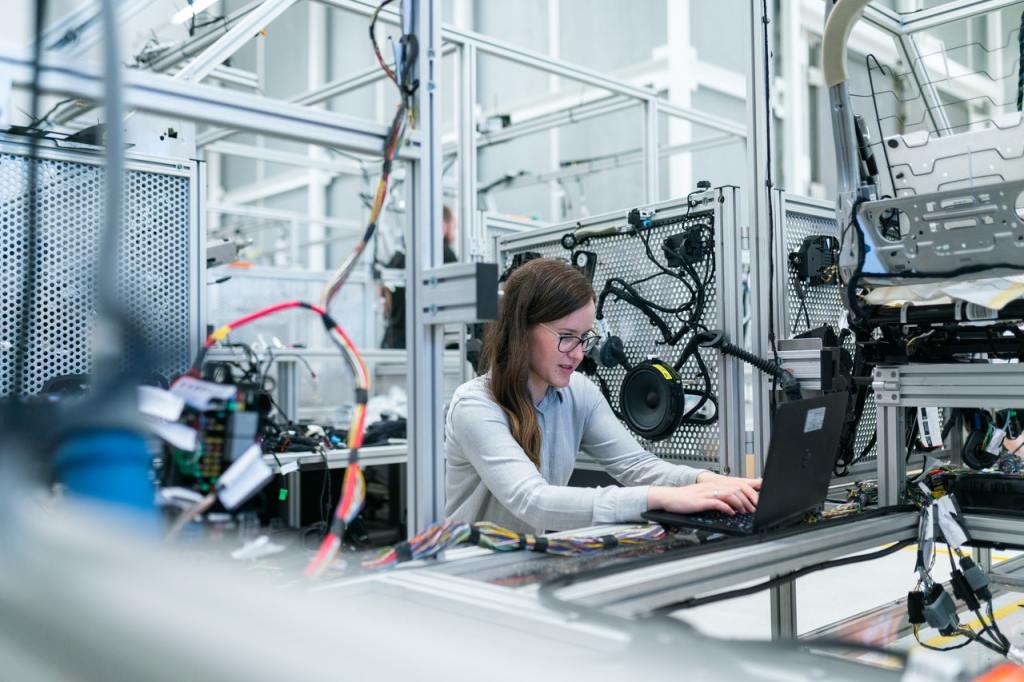
Photo Credit: ThisIsEngineering
What are some examples of technical writing?
Technical writing is more than user manuals and software instructions. It includes reports, data sheets, and procedures. For example:
Manual for using a device or program
A manual that explains all the features and uses for your house alarm, which has remote access through your phone.
A manual that answers questions on how to use CRM tools such as Slack or Trello.
Technical report
A report by an engineering company that includes research, design criteria, images and illustrations, and data relevant to a project.
A report about scientific findings.
Email
An email about new changes to company policies.
Technical specification data sheets
Your computer’s technical specification data sheet which has detailed information about the operating systems, warnings, and compatibility for connecting to the company network.
A material safety data sheet (MSDS) with details about a product’s hazard information, measures for accident prevention, and what to do for first aid.
Manuals that document how to write documents:
The MLA Handbook (Modern Language Association Handbook) which documents how to cite sources for scholarly writing, such as research papers.
The Chicago Manual of Style which is a style guide for writing and citations for publications.
Standard operating procedures (SOPS):
Standard protocols for completing tasks according to agency standards, such as the Food and Drug Administration’s SOPs for a food business’s operating procedures.
A flowchart that illustrates the SOPs for how a call center processes open tickets from customer issues.
Photo Credit: ThisIsEngineering
Plain Language Versus Simplified Technical English (STE)
We need user manuals. Some people toss manuals aside to muddle through learning how to use a new smartphone on their own. However, not everyone knows how to operate an aircraft. Not everyone knows how to register their business.
And not every parent knows how to set up their child’s PlayStation or bouncy house.
Businesses want to sell things that people understand how to use and repair. They need user manuals that are easy to read and understand.
Plain language clarifies written communication as much as possible so that both native and non-native speakers of English can communicate with each other. Standardized language eases communication, despite differences from region to region.
This clarity is especially vital for highly technical industries, such as aerospace. Explaining the intricacies of building a plane is not easy, and ambiguous communication can result in serious errors.
Simplified Technical English (STE) was created to simplify communication for the aerospace and defense industries. It is also similar to plain language in its structure.
Here are some characteristics of STE and plain language. Notice the emphasis on clarity:
Active voice: the subject or doer of the action is in the sentence or clearly implied.
(You) enter your last name in the first cell.
Accurate word choice
Turn the red switch to the right until you hear three clicks. Then press the square button.
Important information is written in the main clause.
The first stage of the experiment was successful, despite the concerns of three researchers.
Brief, not wordy
All employees must register for the training before Thursday.
Avoid jargon
The patient had peripheral oedema (ankle swelling).
Key Takeaways
The need for technical writing will increase with our reliance on technology for working from home, SaaS, cloud computing, and other services like online shopping. As technology becomes more integrated into our lives, we can expect technical writing to improve user experience with clear instructions and product information.
If you enjoyed this article, subscribe to make sure you don’t miss the next post!





 Vanya Wryter Consulting Services