Writing Tips for Motivation

Words are food.

Words keep us going. They motivate us.

When you’re feeling down, or you’ve hit writer’s block, follow the advice of your favorite writer.

When you’re concerned you can’t make a deadline for a writing project, break your main goal into small, little goals. Just write for five minutes, or finish a paragraph. Tiny steps get you through the day.

When you’re hungry for ideas, look around you for inspiration. Read a book. Watch a movie. Talk to people.

And when you finish writing your book, your blog post, or your report…applaud yourself. Writing doesn’t have to be perfect the first time.

Just write.

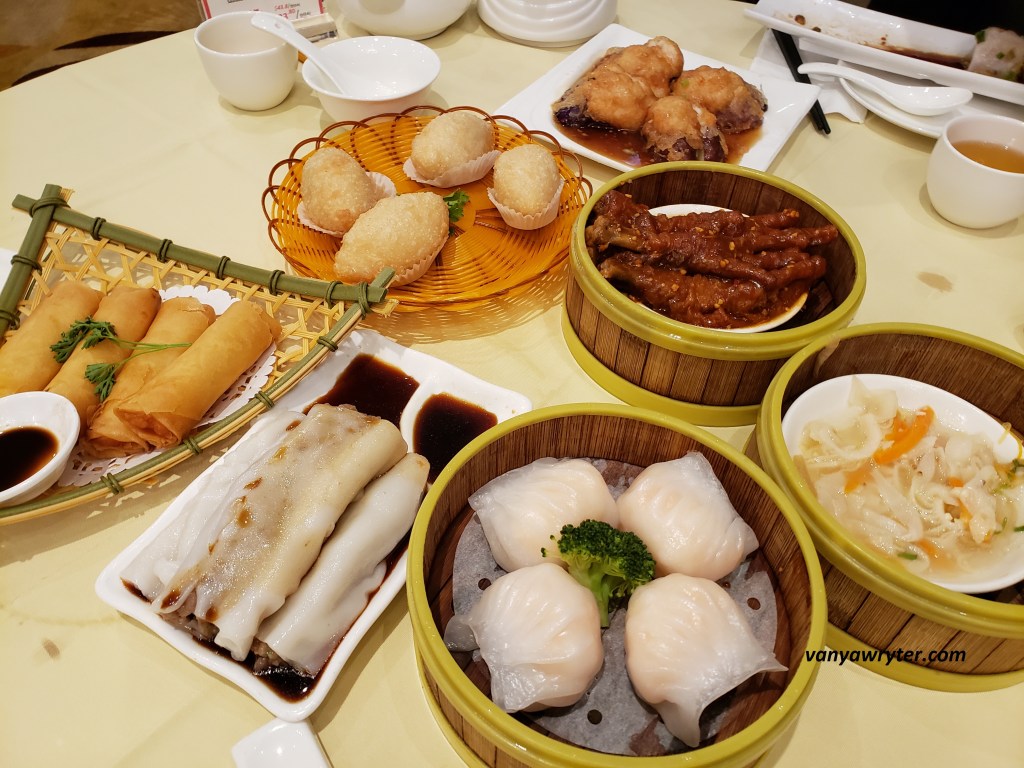
Business Review: Dim Sum Restaurants

Usually, your goal when you dine at a restaurant is to satisfy your hunger. But this time, I’d like to change your perspective and look at dim sum restaurants from the perspective of a business owner with a time machine.

Many restaurants closed or only served takeout during the pandemic. When restaurants reopened for dine-in this summer, it was time to catch up on a tradition of weekend dim sum. But the place was noticeably less busy than pre-pandemic, and the staff wore masks. Customers had to check their temperature with a device. Dim sum wasn’t the same as before. 

How has the tradition of dim sum changed over the decades to adapt to the times and will it continue? My recent dim sum experience brought back memories and made me question the future of dim sum restaurants.

Getting ready for dim sum

Is dim sum breakfast or lunch? Or maybe brunch?

Older customers start dim sum as early as 9:30 or 10 in the morning. But if you have children, you might not arrive at dim sum until 11 am or 12 noon. So it could be breakfast or it could be lunch. You can even arrive for dim sum as late as 1 pm.

Children raised on weekend dim sum know the routine. They might not speak the Chinese language as fluently as their parents, but they know the names of dishes after hearing them for so many weekends from birth to adulthood.

Also, as bilingual speakers, they’ve learned the difference in terminology too.

“Dim sum” means “touch heart” but you only say you’re going to dim sum if you’re speaking English. For example, telling English-speaking friends that you’re going to dim sum with family. In Cantonese, you’d say you’re going to “yum cha” (not dim sum!) which means “drink tea.”

Dim sum begins with tea selection as your party is being seated at your table. The serving staff will ask you what tea you would like. Jasmine, chrysanthemum, oolong, sau mei, and bo lei are the most popular types of tea.

Once you’ve ordered your tea, it’s time to order food.

Ordering the dim sum: before

Years ago, ordering dim sum was like a sport. Veteran dim sum patrons had mastered the strategy. Back then, servers pushed carts of the food to each occupied table. As the cart neared a table, the server would call out the names of all the dishes in their cart. Sometimes, the server will come up to your table and lift the lid for each type of dim sum.

This serving style was a great way to learn the names of all the dishes.

A problem arose if the restaurant was very busy and ran out of the item you wanted before the cart arrived at your table.

Avid dim sum goers came up with a strategy for this issue.

All carts originate from the door separating the dining area from the kitchen. Thus, diners keep a sharp eye on The Door.

If a cart appears with the type of dim sum that you’re craving, your table will “dispatch” someone to the cart to see if the item you want is there, fresh from the kitchen. You give the server your card so they can stamp it and show receipt of the dish, and then you take your prize (dim sum) back to your table.

Maybe servers didn’t like being swarmed at the kitchen door or swarmed in the middle of an aisle (especially by people who sat furthest from the kitchen). Maybe having heated carts moving between tables became a safety hazard. Over time, this tradition came to an end.

Ordering the dim sum: now

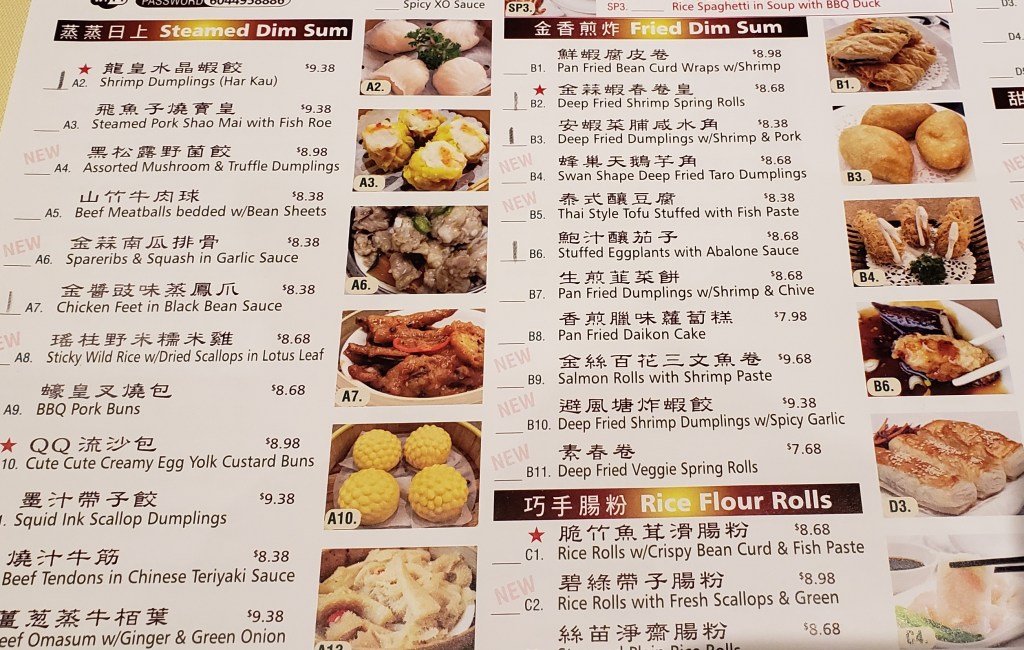
These days, you arrive, order your tea, and then peruse a menu of items. The dim still comes in three sizes: small, medium, and large. Next to the item you want, you write how many of the dish you want, and then a server takes your sheet of selections and gives you a printout of what you selected.

This new style is far less fun and less dramatic. No chasing down carts. Also, some items don’t have a photo, so this style is not as effective for learning the names of dishes.

In the future, the far future, they might come up with a blended approach from the past and the present. Each item on the menu could have a 3D representation that appears when you press on the picture. This way, you can be more adventurous when trying out a new dish. A 3D rendering is more appealing than guessing if you want to try a new dish based on its name.

End of the meal

Having dim sum requires strategy, especially if you have a couple of families dining together.

When a group of friends goes out for dim sum, the restaurant staff will ask to split the bill evenly amongst the friends. When a family goes out for dim sum, a parent usually pays. When a combined family goes out for yum cha, things get interesting.

For example, at one table, you have the grandparents, a daughter and her family, and a son and his family dining together. The siblings have also invited a cousin and the cousin’s spouse. This situation requires strategy at the end of the meal.

Either the bill arrives and one of the adults pounces on the bill, or the bill arrives and the adults all grab for it at once. The winner pays for the entire table.

Another scenario is an adult goes to the bathroom (or pretends to go) and finds their way to the cashier on the way back. By the time someone asks for the bill, it has magically been paid.

Good times.

During the pandemic, restaurants struggled to stay in business. Some took extreme measures to comply with health restrictions. For example, one Chinese restaurant placed tables in their parking lot and served dim sum outside. Other restaurants served only takeout.

Take out dim sum doesn’t taste as good unless you can get home quickly and dive into the food right away. Reheated dim sum doesn’t taste the same.

Dim sum is a work of art. It takes skill to make the dumplings and other dishes. There are high labour costs and food costs, so restaurants have thin profit margins. They make their money back with the dinner menu. To keep a steady flow of business from morning to mid-afternoon, restaurants offer discounts on dim sum during off-hours.

During the pandemic, the price of dim sum dishes went up significantly from several factors. For example, tables were spaced further apart, meaning fewer guests, and staff had to wear masks and face shields, adding to the cost of operations.

Key Takeaways

Going to dim sum is a long tradition that will still be around generations from now. There will continue to be modifications, such as how customers select their dishes, but yum cha with family and friends will outlast pandemics and changes in technology.

If you enjoyed this article, subscribe to make sure you don’t miss the next post!

Motivational Quotes for Entrepreneurs: Barbara Corcoran

What’s your opinion?

How important is sex appeal where you work?

Should your performance be judged by what you wear and how you present yourself, or by your skills and achievements alone?

4 Success Tips for Remote Work Companies

How would you feel about never meeting your coworkers in person? As remote work increases in popularity, more and more companies hire staff living in different cities and opposites sides of the country. It’s possible to never see your coworkers except at virtual meetings.
A new company culture must exist so employees and contractors feel connected and welcome, not isolated. Here are four tips for creating a positive company culture if you have a remote team.

1 Onboarding process includes an informal meeting with the team

One of the most important aspects of company culture is inclusivity: having team members feel like they are part of the team and not an extra.

Before a contractor’s first project or as an employee’s first week of work, schedule an informal meeting with team or department members they will be working with. Ask each person to introduce themselves and share something about their personal lives, such as hobbies, favorite pets, or places to visit. This initial connection helps to build relationships and gives a sense of everyone’s personality.

Often remote teams communicate by text or voice message, removing a person’s tone of voice. Even if they use voice messages, facial expressions and body language are missing. If someone types a short text message, their intention or mood is too open to interpretation. Was the message typed in a hurry, or was the team member angry?

Having that initial meeting helps smooth out friction and doubt. If the person seemed easy-going on the virtual meeting, but you know she is very busy with projects, she probably typed the short text in a hurry and isn’t upset with something you said!

2 Mentor or supervisor/contact person is responsive and supportive

It’s possible to work on a project for weeks, and your only liaison with the company or department is your mentor or project supervisor during that time. They become your lifeline to “civilization” while you work, remotely and alone.

When you have a question or problem to fix, a contact person who is responsive and warm is crucial. There is nothing worse than asking a question, seeing a read receipt on the text, and not getting a response for 24 hours. The remote worker can feel stranded on a deserted island.

Having a mentor who is warm and positive is more important than a knowledgeable mentor. Even if he doesn’t have a solution for your question, you won’t feel anxious about “bothering” him with another question. Eventually, you’ll work out the problem together.

3 Clear procedures and best practices

Documentation is key to running a remote company. Unlike working at an office, an employee can’t pop over to the next cubicle to ask a coworker for a procedure manual.

Team members need to know how to use a CRM or communication software to communicate with the team. Do they use Slack to ask questions in a group chat? Do they go to Google Drive to find the correct procedures for opening an account with an overseas client?

When remote team members know where to look for information or ask for information, the company runs smoothly, even if company members never physically cross paths throughout the entire work year.

4 Support and appreciation for work accomplished

Whenever a team member or contractor finishes a significant task or a project, it’s a great feeling when the supervisor or mentor thanks that person for their achievement. It’s even better when the mentor says that the company CEO or the entire department appreciates the accomplishment.

For a contractor especially, it isn’t very reassuring when they finish a project, get a paycheck, but never hear any feedback about what happened to their work. Was the client okay with the project? More than okay? Emailing a contractor to “send an invoice for completing the project” can create a feeling of isolation.

Getting feedback and hearing that the work was well-received gives team members and contractors the assurance that more work is on the horizon because of a job well done.

Key Takeaways

For companies that are 100 percent remote, scheduling time for employees and contractors to meet the team is an important step to effective communication. When everyone is clear on their role and they feel appreciated, it will feel like a team of people in separate rooms of the same house, and not a random bunch of people scattered across the globe!

If you enjoyed this article, subscribe to make sure you don’t miss the next post!