Successful Cold Market Prospecting

Wouldn’t life be perfect if you opened your own business and customers started to appear? The reality is potential customers are everywhere if you can understand exactly what they are looking for.

You don’t need to know what flavour of ice cream they crave, or what features they want on their smartphone. You just need to get a better idea about their goals. Everyone is looking for something better: improved health, more money, career advancement, bigger goals… more adventures.

The story behind each person is worth discovering… just take the time to learn more about them by asking questions.

When you’ve got the undivided attention of a potential customer in front of you, that’s the moment to get to know them better. There are four types of questions to ask if you are prospecting your cold market (people you’ve just met). Where you start depends on the flow of the conversation and how social your prospect is.

The four questions fall into a technique called the FORM method: family, occupation, recreation, and money. You can use this for a B2C business (business to consumer), especially for an MLM or network marketing business.

When you have the opportunity to speak with your prospect, start with an ice breaker question. Find out what brings them to the networking event. Or ask them what they’ve been doing since your last conversation or meeting.

Let the conversation develop organically. Don’t force a question to complete your checklist. Eventually, you want to find answers to the four types of questions to get as complete a picture about your prospect as possible.

Ask questions about their family.

The topic of family can be as casual or personal as you want it to be, depending on whether your prospect opens the door to this, or whether you feel comfortable asking questions about family.

If your prospect mentions that the reason they want to start their own business is they want to be able to provide for their family, then you can find out more. What do they mean by family? Their parents? Their spouse and children?

If your prospect is asking about the health products you are selling are “Not for me, it’s for my sister,” then that comment opens the door to more discussion about why your prospect is the one doing the research.

Perhaps they are the one who takes initiative. Or they are the one who will be paying for the treatment. It is also possible they are the family member who is most open to new techniques and inventions. Knowing this information will help steer you in the best direction for your business. If the prospect is seriously investigating products for their sibling, then meeting with the sibling is the next step.

Your prospect may be inquiring about your services because she is expanding her own business. You observe a wedding band on her finger as she is reaching for her coffee cup. You could find out about her spouse by making a comment about what it’s like for you to have a significant other who supports you as a business owner.

Relating to the prospect helps you to start a discussion to find out if your prospect is hesitant to spend more on services because of family obligations.

Ask questions about their occupation.

Sometimes, it may be difficult to find out about a prospect’s personal situation while talking about business. Some people are just less likely to open up, or don’t see how their family life affects how they network with business contacts.

If your prospect has a job, it’s usually safe to ask what they do for a living and how long they have been working at that job. Other questions you might ask are whether they enjoy their work, or what they like about what they do. These questions about employment reveal quite a bit about your prospect.

If your prospect has been working for a long time at a job they hate and wish they could change their career, it’s possible they aren’t very ambitious. It’s also possible that family obligations prevent them from taking the risk to change careers or jobs.

If your prospect has a history of ambitious career advancements, and projects that involve leadership and responsibility, then you are likely to be dealing with someone who is open to changes and leaving their comfort zone if it results in self improvement.

Learning about your prospect’s personality and goals by asking questions about their occupation will help you to figure out how likely they are to try a new product or service, particularly if you are selling a high-ticket item, or something that is new to the market.

Ask questions about recreation.

What does your prospect like to do for fun? Where do they like to travel? What hobbies do they have? Do they play sports or enjoy fitness?

Of all the topics for FORMing, this one is best for small talk, particularly if you are just starting to get to know your prospect.

If your business is wealth creation, such as investments, then asking your prospect about their interest in travel or hobbies will tell you more about how they prioritize their money.

Do they like to save up for long vacations overseas? Do they actively participate in activities such as skiing and fishing? Or are they happy with local day hikes and trips to the library?  If they wish they could go on vacation three times a year, then find out more about their plans to see how your business can help them.

Similarly, discovering that your prospect is very fit and has a gym membership they regularly use, camping equipment that doesn’t catch dust, and an abundance of stories about local hikes, then they are more likely to be interested in your health business, particularly if they want to recover from muscular injuries faster.

The opposite can also be true. You may find out that your prospect spends their time watching shows on TV because they struggle with health issues. Finding out that they wish they could play baseball with their friends can open the door to a discussion about how your health business could help them.

Ask questions about their financial goals.

People are more guarded when talking about their finances, particularly with people they don’t know well. If your prospect is someone you’ve just met, then asking about their financial goals is a lot more challenging, but not impossible. The line of questioning will be more indirect, particularly if the prospect isn’t as open.

Asking about the prospect’s occupation can tell you a bit about their financial goals. If your prospect is a lawyer who has expensive hobbies and just bought a house last year, this may tell you something about the income bracket they are aspiring to.

Ask questions about how they are liking the new home and neighbourhood. Maybe they’ll drop a hint that their spouse is happy and that’s what matters most to them. It could mean they are motivated to please their spouse with a certain lifestyle.

If the prospect says they want to cut back on spending, or they want to get another job to afford the things they want, then this information will reveal something about their income goals. One prospect may be in debt and believes spending less is the key to a better life. Another prospect may be struggling with living within their means, and believes it’s possible to afford more, if they increase their cashflow.

Summary

No matter which topic you begin with in the FORMing process, remember to listen and be genuinely interested in your prospect. Each piece of information may provide you with clues about your prospect’s values and goals. If you understand your prospect, then you will be better prepared to help them with your product or service.

NOTE: During the current COVID-19 pandemic, you can also FORM a prospect over a virtual meeting, or socially distanced meeting, depending on the health and safety standards where you live.

If you like this post, subscribe to make sure you don’t miss the next one!

Leadership and Race: Are Leadership Skills Affected By Our Identity?

Can we teach leadership skills without considering race and ethnicity? For a long time, I thought leadership was a skill that everyone could learn. But when I wanted to cite an example of a well-known female Asian business leader as an example for this article, I couldn’t think of a single name. I realized I had made an important discovery and after a little more digging, I found an alarming pattern.

The more research I did, the more I realized leadership in business and one’s chances of earning an executive level position were in fact strongly affected by one’s ethnic background. Asians in the United States, for example, held many professional positions but few top-level leadership positions.

When I looked at my own personal experiences with race, it was clear that race and ethnicity determined how people perceive you. If that were the case, how could we teach leadership skills so that all races and ethnicities would have a fair shot at executive positions?

Can Asians Ever Be Canadian?

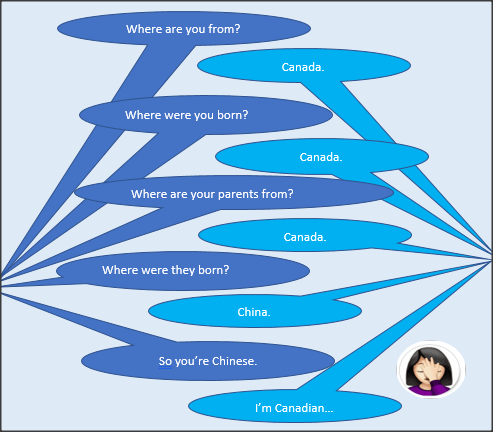
Asians born in Canada or born in the US (or any nation that isn’t considered an Asian country) are familiar with the following inquisition when they try to explain to people that they are Canadian (or American or something other than Asian).

I’ve always considered myself to be Canadian. As for role models, I choose them from any ethnic background, although I prefer successful female businesswomen, so that I could aspire to become like them.

I have quite a few women role models: teachers I admire, bosses that inspired me, and favourite authors. But out of all them, none were Asian. When I looked at my business mentors, the situation was also grim.

My two business mentors are highly successful millionaires or near millionaires and both are Chinese. They are examples of how immigrants could come to Canada, work hard, and become financially successful. They were leaders that I could follow but they were men.

The successful women leaders that I could think of were the wives of these men. They hadn’t created their financial success on their own, but they learned leadership skills to help their husbands in their careers.

I decided to look past my own experience and see if I could find more successful Asian leaders in North America. First, I wanted to establish what qualities I wanted to see in a strong leader.

What Leadership Skills Should We Teach Managers And Executives?

When you think of leaders that you admire, what qualities do they have? Are they good listeners? Do they show empathy? Do they inspire you to work hard to attain their level of success?

The leaders I admire are very good at taking charge, providing direction for the team, and being someone you can depend upon. At the same time, even though they are the leader, or the boss, I never feel like they are demanding me to complete a task. They ask me in such a way that I feel that I’m doing them a favour. A favour that I’m not likely to refuse, of course, because it’s a request from a supervisor.

Do Asians have the leadership qualities that I’ve identified?

Maybe they do. And maybe they don’t. The American workforce either lacks Asians that have what it takes to be an effective leader, or they aren’t seen as having the qualities needed for leadership. A closer look at numbers reveals a gloomy situation.

How High Is the Bamboo (Glass) Ceiling for Leadership?

A 2010 study cited by Harvard Business Review (HBR) found that “Asians do outperform other minorities and white people when it comes to education, employment, and income.” If they are so successful, then shouldn’t they also successfully climb the corporate ladder as well?  

Apparently, they don’t have far to climb before they bump into the glass ceiling. HBR used the term “bamboo ceiling” – the equivalent to the glass ceiling. In addition to the 2010 report, it cited a 2015 report on diversity.

It found that, “Asians represent only 1.5% of corporate officer positions in the Fortune 500, according to 2012 data.” The situation for Asian women was worse because these women represented only 3.1% of executives five tech companies in a study, while Asian men represented 13.5%.

What could be creating these limitations?

All races face stereotyping at the workplace. Employment data cited above suggests that Asians are highly competent at finding high paying jobs. Their success may make them appear threatening in the workplace. However, Asians are also perceived to have a critical weakness.

The HBR article study observed that “stereotypes about Asians lacking social skills make them seem unfit for leadership.”

An article in Bloomberg suggests that Asian culture encourages communication and networking styles that go against the “mainstream dynamic of assertiveness and directness.” For this reason, Asian Americans are considered as fitting for “low- to mid-level management positions, but not top-level leadership.”

How Many Asians Are In Executive Positions?

A Silicon Valley report found that Asians were so underrepresented in leadership positions that they were grouped into other, larger categories. In the report, “Asian men are lumped into a ‘non-underrepresented’ category with white men” while “Asian women are assigned to a category that includes women of all races.”

These types of numbers were repeated in other industries, where Asians continued to be underrepresented in the executive ranks of companies. See the table below.

What can be done to increase the number of Asians in top level executive jobs? Could their social skills truly be so lacking that they would be unsuitable leaders? Or would it be possible to teach leadership skills in such a way to compensate for disadvantages from any cultural differences?

Future of Leadership Skills

It would be interesting to see the data for other races and ethnicities. What is the ratio of their ethnic group in jobs in an industry, compared to the percentage in executive positions for that industry?

If a wide gap exists between the lower ranks and the executive ranks, what can be done to level the playing field in leadership?

From these studies in this article alone, it seems that perception of cultural differences affect how people from different races are promoted to leadership positions.

In future, one recommendation would be to design leadership training skills that address stereotyping and culture. It’s possible to have talented and skilled leaders equally represented from all ethnic backgrounds.

If you like this post, subscribe to make sure you don’t miss the next one!

Why Women Should be Entrepreneurs

Both women and men can be successful entrepreneurs, but in times of severe economic disruption, women should turn to entrepreneurship for many reasons. It offers them control of their career, schedule, and workload. It keeps women independent of trends in the job market and breaks traditional barriers. Most importantly, entrepreneurship is a strong career alternative to defy the terrible impact of a pandemic.

This year, the coronavirus resulted in many jobs being lost and businesses being permanently closed. Women bore the brunt of job losses more than men. According to NPR, in September of this year, “an eye-popping 865,000 women left the U.S. workforce — four times more than men.”

Adapting to Changes in the Job Market

Despite changes in gender stereotypes over the years, more women lost jobs than men in 2020. They also found it impossible to continue working because childcare and housework were mostly their responsibility. Women are more likely to stay home to care for sick parents and watch over children who may have to be homeschooled.

Even before the coronavirus pandemic, the job market was already changing. The days of a career that lasts more than 30 years, with a 9 to 5 schedule, and holiday and medical benefits, were starting to become extinct. Labor statistics from 2015 state that a person can hold a total of 10 jobs by the age of 40, but that number is predicted to grow to over 12.

Millennials, born between the 1980s to 2000s, will have an even greater challenge finding a career or job that lasts more than five years and pays enough to fulfill their financial needs.

Becoming an entrepreneur is becoming a choice more and more worthy of consideration. We cannot rely on an employer to provide us with financial stability. If we are our own boss, our future is in our own hands.

The Global Entrepreneurship Monitor, which is the world’s foremost study of entrepreneurship, found that in a five-year period up to 2016, female entrepreneurship had risen 13% on average, while male entrepreneurship had risen 5% in the same period. More and more women are going into business for themselves. One reason is they have the talent for it.

Women Possess the Traits to Succeed as Entrepreneurs

Women have the personality traits to succeed in business. Firstly, they are great multi-taskers because of their ability to wear many hats. Many are able to juggle a full-time career while running a household.

Secondly, their method of communication is more of a friends-first approach when networking. During the pandemic, many female entrepreneurs have connected with other freelancers and small business owners via Zoom meetings. They are open communicators, willing to share ideas and learn new approaches.

Third, they are solid leaders who can plan long term and envision where they are headed. Women are motivated. They set goals for business development and leadership, as well as for personal development. They want financial independence, even if they are married.

Women Face Barriers in the Traditional Workplace

The fourth Industrial Revolution has impacted the traditional workplace. Nearly 4.8 million office and administrative jobs, for example, will vanish from the world by 2020. Women will lose more than five jobs for each one gained, while men will only lose about three jobs for each one gained.

Technological advances, such as robotics and 3D printing, are impacting administrative roles – traditionally women’s roles. Male-dominated industries, such as architecture and engineering, will not be negatively impacted by technology. Jobs in these sectors are expected to grow. In 2016, only 11% of the jobs in these industries were held by women.

However, not all changes in the workplace are harmful to women. Higher-skilled workers, such as those in jobs requiring analytics or social skills, saw a larger increase in pay than jobs requiring physical labor. This trend has helped women make larger gains in salary overall, although the average salary of men still remains higher. In addition, mothers have childcare responsibilities. Women may take maternity leave after having a child, or work reduced hours after having children, which affects their paycheck.

A survey of recruiters also paints a harsh picture for female workers. Forty-two percent of all the high-level recruitment and strategy officers said the reason for recruiting more women was “fairness and equality.” Twenty-three percent said that expanding the talent pool was their reason for hiring women. None of the 100 largest global recruiters surveyed cited “financial returns” as a reason for hiring more women.

Another barrier is a woman’s appearance. If she is wearing makeup and high heels, it shows that she cares about her job. But being well dressed can also mean she is trying too hard at her job, depending on who you ask. Studies show that women promoted most at work are perceived to be more attractive, taller, and thinner.

Company statistics seem to support these findings on barriers to employment. A 2020 analysis found women made up 23% of executive positions, 29% of senior managers, and 37% of managers. Compare those statistics to 42% of professionals and 47% of support staff positions held by women.

photo of woman writing on tablet computer while using laptop
Photo by Anthony Shkraba on Pexels.com

The World Needs More Female Entrepreneurs

The benefits of being a female entrepreneur have an impact on a global to a personal level. Women entrepreneurs can be their own boss. Their business will contribute to the economy by creating jobs or beginning new careers for other women. There is no limit to their income potential.

Women who want to spend time with their family can set up a home-based business that allows them to have the flexibility to balance work and family life. Most importantly, they can choose a career that they are passionate about and develop their business in the direction that they want.

The list of successful female entrepreneurs continues to increase over time. Billionaire Tory Burch, for example, began her fashion empire in her kitchen. One of the wealthiest women in the world, Oprah Winfrey, started life in poverty and became a media mogul with her own television show and production company.

Becoming an entrepreneur will require stepping out of your comfort zone, but for women looking to reach past the skies to challenge their own limits, this career path is definitely one to consider.

If you enjoyed this article, subscribe to make sure you don’t miss the next post!

How to Create Strong Company Culture for Remote Teams

What comes to mind when you hear “teamwork” with your coworkers? Most likely, working in person in an office together with other people. However, these days, teamwork has taken on a new meaning for global companies with employees and contractors in multiple time zones. How do you develop a sense of community and company culture when your remote team is spread across countries?

Technology has enabled us to work from any location we choose, whether from home, at a coffee shop, in our car, or in a rented workspace. 

A remote company can have a physical office location, but the team only works at the office if they want to. There aren’t enough desks for everyone, even if they all decide to show up to work there. Another type of remote company doesn’t have a central office. Everyone works from home.

These types of remote companies can develop a company culture and connection between team members because they have the following common factors.

Strong Leadership and Clear Goals

A positive company culture depends on strong leadership from management and a clear goal or purpose from day one.

At one remote company where I worked, I had a phone call with my new supervisor, who set up a series of Zoom meetings for me, gave me an email address to access company files, and assigned me tasks to complete.

I faced several challenges that first week. I had to chase down team members on the other side of the country or on another continent. When I needed to find a teammate I didn’t know, I had to figure out how to get a hold of them. Unlike a traditional office, there was no reception desk to call or a central place with all employee numbers written down.

Unlike a traditional office, you can’t wander the halls to find someone who can help you or knock on someone’s door to ask for help. With a remote company, that email or phone number is your lifeline. Clear guidance lessens any frustration that could arise from these unexpected issues.

My supervisor usually checked in to make sure problems could be solved or suggested how to find a solution. Having someone I could rely on to clarify things was important. Otherwise, it’s easy to start feeling isolated and alone without clarity.

My supervisor was also a role model for company culture. When I started working with other team members on projects, I set up my tasks with them the same way my supervisor did. I also checked in with team members about projects. Clear communication is vital to a remote company.

Responsive and Frequent Communication

Building a successful, remote team depends on responsive and frequent communication. Having platforms, apps, and chats set up for team messages is the first step. The second is creating a culture of responsiveness.

For one company that I worked with, communication was very infrequent. People messaged the team with reminders of team meetings or items that were due for multiple people. When anyone posted a link to a completed project or suggested an idea, one or two people responded with a thumbs up. Sometimes there would be no communication for hours or days.

As a result, it was easy to feel detached from the company, like working on a deserted island. The infrequent messaging was like seeing a beacon of light, a frail trail of words in the darkness.

In contrast, another remote company I worked with had multiple chats set up and used platforms such as Slack. When one person posted an idea for review, multiple people wrote in with feedback and suggestions. A social chat group was filled with lengthy banter about weekend activities, jokes about life, and friendly jokes about coworkers.

Although I was working alone in a room, I felt like I was in an office full of people because of all the frequent communication. 

Someone at this company had started this culture of frequent communication. New team members continued the culture. Not all the chatter was about work, although it could start with a work topic. People wanted to stay in touch.

Getting to Know the Team on a Personal Level

Socializing helps a team to gel. Otherwise, you have a group of people working on tasks. When you’re just a cog in a wheel, it’s much more difficult to be invested in the company. Getting to know the team on a personal level further develops company culture.

The first step to getting to know coworkers is the jokes and quick comments about a favorite food or weekend activity during a Zoom meeting or in a team chat. It’s also important to meet with them outside of work.

Pre-covid, meeting in person for company social events such as themed lunches, Christmas parties, or company functions was one way to get to know coworkers. It’s different talking with someone in person than watching them on a Zoom screen or reading their DMs.

You connect better with people when you see their body language and hear their voice. Messaging apps do not capture these aspects of a person.

Most importantly, when you don’t have meeting time limits, it’s much easier to get into deep conversations about your coworker’s hobbies and vacations. When you know more about someone on a personal level, it becomes more like working for friends than strangers who are a name and a tiny facial profile on an app.

Now that we are highly discouraged from meeting in person, getting to know people on your remote team is harder. Harder but not impossible. I was surprised when I attended a strategy meeting, and we discussed not goals for the company, but goals for each attendee.

It was intriguing to hear about this personal side of people I had been working with remotely. At the end of the session, we had created goals for the company’s future. I also had a clear picture of the people working on this team.

Summary

Creating a strong company culture for a remote team takes effort. You need leadership and clear goals for the company and individuals. Frequent and responsive communication is necessary for building connections. Most importantly, getting to know your team members on a personal level develops a sense of community.

If you liked this post, subscribe so you don’t miss the next one!

Halloween: How a Pandemic Made 2020 the Scariest Year of All

Halloween for most people is the scariest time of the year, but many would agree that 2020 is a whole year to be afraid of. I’ve seen memes warning time travellers to skip this year entirely!

Unless you’ve been living in Antarctic and isolated from all communication, you would probably agree that COVID-19 deeply touched – I mean slammed – your life off course these past few months. Now that Halloween is around the corner, let’s count down some scaries from this pandemic, starting with the year itself.

Theme of 2020: Panic Pandemic

To those who usually say that Halloween lasts just one night – the joke is on them this year. Some have said that this year feels like a Stephen King movie and I would strongly agree. Just consider all that has happened.

Beloved actors, musicians and athletes have passed away. Killer hornets were on the loose. Staycation and remote work replaced travel plans and commuting to offices on a global level. People lost jobs and businesses closed.

The scary part is, I’ve built up an immunity to the plight of the unemployed and shops forever closing doors.

Maybe I’m a monster in the making to be so insensitive, but there’s only so much drama the human body can take over several months. All the news is slowly chipping away at whatever’s left of my emotional reserves.

Some news is too difficult to process so the human brain files it under “it’s the pandemic year.” Otherwise I would spend too much time arguing logic with the illogical. Toilet paper, for instance. COVID-19 is a respiratory disease. I understand the hand sanitizer shortage, but there was also a toilet paper shortage. Finding toilet paper in the store was like finding gold.

Pandemic Issues that Were Sad and Scary

Halloween is a time to put on a costume and become someone or something else. But this year, it felt like people removed costumes that they had been wearing for many years.

Facebook friends and real-life friends became polarized on the election and on COVID: Democrat or Republican, pro China or pro Hong Kong, face masks or no face masks. People did not sit on the fence with these pairings. They sided clearly with one or the other.

For example, if you were pro-mask, you couldn’t believe how ridiculous, selfish, and uneducated the anti-maskers were in their choice to not wear a face covering. If you were anti-mask, you couldn’t believe how pro-maskers were like sheep who were okay with breathing in contaminated air and giving up their personal freedom.

People became so offended as they argued back and forth on Facebook that sometimes I would see the ugly aftermath in a follow up post. Someone would say that they had to unfriend someone to protect their mental health.

Meanwhile, as the year progressed, the number of COVID-19 cases worldwide continued to climb, and so did the death toll.

It seemed like we were actors in a live action game of WhoDunnit. The bizarre and unusual were normal. Logic could fly out the window as we tried to solve the mystery of what would happen next during the pandemic.

Those who didn’t know any victims of COVID wondered if the pandemic were a hoax. Those who did know people who had caught COVID-19 who lived or died, were waiting for the shoe to drop. They could be next if they didn’t take the necessary precautions to protect themselves.

Halloween Doesn’t Bring People Together Anymore

In previous years, Halloween was one night that brought people and entire communities together. People would decorate their houses, and in some neighbourhoods, children would dress up in elaborate costumes and go door to door, walking in groups, for candy.

Kids would walk with their friends and adults would walk together, watching their children while talking among themselves. In some neighbourhoods, people seemed to know each other.

It was also the one time of the year that people would welcome you for walking up to their door and admiring their Halloween decorations. If you live in a big city, this sense of community is not that easy to find.

I once had a talk with a woman who had decorated her entire house. She said it had taken 15 hours to assemble all the robotic creatures, mood lighting, fog machine, and graveyard. The décor was so elaborate that her house had been featured on the news. She offered me some candy for visiting her, after we had finished our friendly chat.

In past years, Halloween parties were a wonderful occasion to bring people together to socialize, have fun, and pretend to be someone else. I once went to a Harry Potter themed party for adults. For one activity, we pretended to have magical powers! What a nice change from the adult world where taxes are real and won’t go away.

Of course, the pandemic changed Halloween this year. Most parents I spoke to weren’t interested in taking their children door-to-door for safety reasons. And just days before Halloween, we were told by health officials to tighten and decrease our social circles because even small gatherings weren’t safe. Many local Halloween themed events were closed.

Instead of the annual sense of community in some neighbourhoods, this year, we were going to isolate ourselves into our family units and spend even more time at home.

Halloween Made “Ugly” Acceptable… and Things Did Get Ugly This Year

Halloween was the one day of the year that bullies didn’t laugh at you for being ugly or weird looking. Fat or thin, tall or short, you were normal.

No one cared who was behind the costume or the mask. It didn’t matter what race or ethnicity you were, or whether you were rich or poor. For one night of the year, each child going trick-or-treating was equal, no matter what their ethnic or economic background was. Anyone could get some candy and treats.

By October 30, 2020, however, some major changes darkened this sense of equality. Racism was once again a major topic in the news, with people polarizing over BLM, marches, and violence. Locally, violence against Asians skyrocketed as they were blamed as a race for scattering a virus across the world.

Friends of mine were yelled at because they were Asian and wearing masks. A friend who was born in Canada didn’t want to wear a mask because he was afraid people would think he was from China.

And if the racism issue weren’t bad enough, friends and coworkers lost jobs or worked reduced hours. People who lost jobs were accused of being lazy when they applied for government support. People who wanted to work became frustrated when they applied to hundreds of jobs with no reply.

Polarization spread like a disease day to day. For one night, on October 31, I wished everyone would be equal again. I wished you could put on a costume and be someone else and not be judged for your race or economic class.

For one night, you were supposed to have fun and enjoy yourself.  Spend time with the kids. Carve a pumpkin or two. Eat some candy. Watch a scary movie.

Halloween’s Scary Surprise

I should point out that not everything about the pandemic was bad. I was house bound so much I had time to get addicted to Tik Tok videos. And what I discovered was that people’s view of witches had changed over time.

Witch influencers with 20K to 100K + followers were making videos and giving out advice about witchcraft, divination, tarot, incense, astrology, spells, and a lot of other topics. Witchcraft was trendy.

Some videos were a bit creepy. But the traditional idea of witches as evil was non-existent. This year was full of surprises.

Not everything about the pandemic was dark and dreary after all.

But it definitely was a strange year, as if the scary and weird part of Halloween had been let loose for 365 days. If you know where I can find a time machine, let me know. I’ll be glad to use it.