Why You Should Charge More to Keep Customers Happy

What should you do when your competitors charge cheaper rates? Should you lower your rates to stay in the game? Charging less may make sense, but it isn’t the best solution. The simple answer is you should charge more

Here’s why. Think about how much money you save by buying a cheap pen at the dollar store. How would you feel if you lost that pen the next day? Most likely, you’ll get another one without a second thought. 

But say you bought a Titanium, 18K limited edition gold pen for $24,000. (Maybe you won’t ever spend that much on a pen, but let’s pretend for a minute that you do.) You bought it to reward yourself for some hard work.

Every so often, you use it to sign only the most important of documents. You invested a considerable sum into it, so you store it in a secure place, and you always know exactly where it is. You will cherish the pen that costs you more money. 

Let’s apply that line of thinking to your clients. How can your business become as valuable to your clients as that gold pen? There’s more to it than just a higher price point. Here are three quick tips on how to charge more while keeping clients satisfied.

Tip 1: Provide Clients with Time

The first reason you should charge more is people value their time. No matter how much or how little money you have, you cannot buy time. Everyone has the same 24 hours a day, and none of us can get that time back when a day has passed.

Exactly how much do people value time? In one marketing experiment involving a lemonade stand, a sign about spending time got twice as much business as a sign about spending money. Another study involving college students and iPods had similar results: time had more value.

If your business provides a service, think about how you can save your client time. For example, what can you do to anticipate your customer’s needs before they make the request? Are there common questions that you can answer while explaining your services?

A survey by Forrester found that “73% of consumers say that valuing their time is the most important thing a company can do when providing customer service.” When you provide the service that they are looking for, then 93% are likely to return to buy from you again.

That same survey also found that “consumers are willing to spend 17% more on a company that has outstanding customer service.” People will pay more for first-rate treatment.

As a consumer, I’ve returned to a company even if they are more expensive because I know they will get things right the first time. Less time to get something done means less stress and money well spent.

Tip 2: Give Them Value for the Price

Now you know that customers are willing to pay more to save time and get decent service. But what if you just started your business and you’re facing tough competition? Would you charge less to stay competitive?

Times are uncertain these days with unprecedented job losses and talk of a possible recession. However, going cheap won’t help your business. 

An example is a free workshop. You’ve probably seen plenty of them offered on Facebook, meetups, and other sites. A free education can improve your skills or knowledge. However, if you have a scheduling conflict, dropping the workshop is an easy decision. You paid nothing, so you lose nothing by not attending.

It’s a different situation if you paid for the workshop. Let’s say you invested $1000 for the workshop in advance. You believed it would be a gamechanger for your life. You will likely make every effort to attend, even if you had a stressful day or lack sleep.  

It’s about the value. If you bring a quality experience to your new business, or you’re selling a quality product, charge what you’re worth.

Always make this pen analogy. You might think that the Graf von Faber-Castel Pen for $2 thousand is kind of pricey. But, consider this: the Fulgor Nocturnus by Tibaldi has a price tag of $8 million.

For one pen.

At a higher price point, you customer will go out of their way to ensure that they value your product or service. They will take care of that $2 thousand or $4 thousand pen. They will immediately apply what they learn from your $1000 workshop. You get the idea.

Tip 3: Raise Your Value

You might have done this before: stood in front of two products at the store, comparing them, and wondering what exactly you are getting for that price difference. What it comes down to is perceived value.

An example is how Shreddies marketed their square-shaped cereal. They turned the product to the side to look like a diamond instead of a square and called it “Diamond Shreddies.” Some people then thought the product had better taste.

Wine tasting is another example of expecting more value with a higher price tag. Some people wonder if expert wine tasters can actually tell the difference between cheap wine and expensive wine.

In a test where an average bottle of wine was poured into two bottles, one with a superior label and another with an ordinary label, “Forty experts said the wine with the fancy label was worth drinking, while only 12 said the cheap wine was.”

Even expert wine tasters agree: if you pay more, you think you are getting more value. As a business owner with great value to offer in your service or product, don’t be afraid to charge more.

Summary

What do your customers consider as a good product or service? It’s about perception. Understand what they are looking for and what they need. Then provide them with great value at a higher price point. Offer them that gold pen.

If you like this post, subscribe to make sure you don’t miss the next one!

TikTok Personal Finance Influencers that Entrepreneurs Should Know

How much financial knowledge could you learn from a 15 to 60 second TikTok video? You might think that TikTok is an unusual source of financial advice, but it has been growing in popularity recently. This trend does prompt a question: Does it matter where you get your financial education?

Statistics about financial literacy are grim. According to a Global Finance Literacy Excellence Center survey, “Americans have a financial literacy problem: 63% of Americans are financially illiterate.”

Perhaps one approach to learning more about investing, credit, and banking is to start with snapshots of financial advice by watching some videos. After that, follow up with more detailed research from other sources. Here are some finance influencers on TikTok who share their insights on financial literacy.

Personal Finance Influencer: Humphrey Yang

Humphrey Yang (@humphreytalks), 2.1M followers
Background: Previously worked as a financial advisor

What he talks about: Shares valuable insights about investing, budgeting, business, and entrepreneurship. His topics include explaining how Bitcoin works, concepts of budgeting (Should you buy fresh or canned tuna?), and whether you should invest in buying a Tesla.

Advice for entrepreneurs: If you’re thinking of starting a franchise, he has advice for you about the cost and what to consider before opening one. He has also investigated the cost of creating a product such as a Hydroflask, in case you were interested in the profit margin of selling products.

Financial Psychologist Influencer: Dr. Brad Klontz

Dr. Brad Klontz (@Drbradklontz), 309.5K followers
Background: Financial psychologist and author

What he talks about: He educates young people about the reality of acquiring wealth and smashes some common misconceptions. He addresses concepts such as wealth makes people bad, fake it ‘til you have the wealth you claim to have, and money equals happiness. For those misled by unrealistic wealth goals, Klontz shows that flashy lifestyles may not be what they appear to be.  

Advice for entrepreneurs: His videos talk about automating saving and investing – a goal of entrepreneurs. If your goal is to join the millionaire club, you should know that “rich” is short-term, but “wealthy” is sustainable long-term over generations.

Personal Financial Influencer: Alexa Carlin

Alexa Carlin (@alexarosecarlin), 145K followers
Background: Entrepreneur at the age of 17

What she talks about: Carlin’s goal is to improve people’s lives with her advice on achieving financial freedom through investments or ventures. She is especially interested in helping women become financially independent. Watch her videos for advice on topics such as motivation, becoming more confident, staying focused on your goals, and writing a compelling LinkedIn bio.

Advice for entrepreneurs: She teaches us how to establish a brand by writing a book. Many influencers, coaches, and businesspeople have written a book because it establishes credibility, is a PR opportunity, and positions them as a go-to expert.

Personal Finance Influencer: Keyla Katz

Keyla Katz (@ikeyli), 353K followers
Background: Experience with family budgeting, establishing credit, and generating income

What she talks about: She wants to help others by sharing her own hard-earned lessons with finance. Her family had lived paycheque to paycheque, and she had destroyed her credit at one point. Now she teaches others about money management, budgeting, watching your bank account for overspending, and rebuilding credit.

Advice for entrepreneurs: Katz’s videos teach you about generating extra cash through side hustles such as working for Uber Eats, taking on projects through Fiverr, and making money from YouTube videos.

Related: TikTok Fitness Influencers Entrepreneurs Should Know

Personal Finance Influencer: Zaid Admani

Zaid Admani (@admani_explains), 236K followers
Background: Day trader at 18 years of age, self education about finance

What he talks about: You won’t be overwhelmed by industry jargon when you watch Admani’s videos. His interest in finance is self-taught, so he understands how his audience likes concepts explained. He covers investing in Bitcoin, Ethereum, and crypto, the federal reserve, and the financial goals of companies such as Amazon and Apple.

Advice for entrepreneurs:  Entrepreneurs interested in learning about scaling their business will want to see his videos about Netflix and Disney’s increase in subscriber numbers to beat the competition in the streaming industry. Similarly, if you’re interested in business, you’ll want to watch Uber’s acquisition of Drizly as a step to dominate the delivery industry.

Personal Finance Influencer: Antonette Aquino

Antonette Aquino (@antonetteaquino_), 284.1K followers
Background:  Family breadwinner at 17, training to become financial advisor

What she talks about: Her videos cover setting financial goals (Is it realistic to make $1 million in 5 years?), questions to ask yourself before buying stock, and cashflow versus investing. She wants millennials and Gen Z to learn about finance, financial planning, and investing from an early age. That advice includes finding the right mentor.

Advice for entrepreneurs: For those seeking success in the business world, she has great tips to share. First, to be valued in business, you need to be very skilled at what you do or have social media leverage. Second, if you want to create a positive company culture, you first need to experience the employee perspective before becoming an employer.

Financial Literacy Influencer: Vivian Tu

Vivian Tu (@yourrichbff), 435K followers
Background: Nicknamed Your Rich BFF, worked at Wall Street and traded stocks

What she talks about: Her videos answer questions about personal finance: for example, how to raise your credit score, negotiating your salary at a new job, the importance of time versus money when investing long-term, and saving for retirement. And of course, she also offers tips on trading and how to find the right mentor.

Advice for entrepreneurs: Watch for her insight about side hustles such as reselling high-priced sneakers and joining MLMs (multilevel marketing). Valuable skills for entrepreneurs that she covers are negotiation (how to negotiate your rent and your medical bills) and paying yourself first (so your bills are covered and you have money for savings).

Key Takeaway

TikTok has more to offer than amusing cat videos and dance routines: you can learn about personal finance and improve your financial literacy. A number of TikTok influencers have posted videos with valuable financial advice that you should check out, and each video only takes less than 60 seconds of your time!

If you enjoyed this article, subscribe to make sure you don’t miss the next post!

Business Etiquette for Entrepreneurs

Life would be a little too easy if we could become an expert at one skill and then build a thriving business around it. Once we’ve figured out what we want to do, and we are open for business, we still have to market ourselves; otherwise, we may find ourselves waiting. Waiting like we do at a surprise party, wondering when the guest of honour will arrive. In this case, our guest of honour is our future client. And ideally, our future client would know how to find us. One way is to lead them to us with a trail of personal connections. You might have been thinking of bread crumbs, and metaphorically, you could think of it that way. Entrepreneurs are keen to add value and bring success to other people’s lives. If you aren’t in business to help others, then chances are, you won’t get far in your journey. After reading The 5 Essential People Skills by Dale Carnegie Training, I thought of some tips that really boost a business owner’s reputation and bring them more clients. I’ve even added some suggestions to the original list in the book. My biggest tip starts with the old adage, “Do unto others as you would have them do unto you.” This bit of advice applies the moment you venture out to meet new people.

Social networking that grows your business

If you’re looking to increase your client base, always search for networking events that your potential clients could be attending. A glance at the event description will help you gauge the likelihood that your potential client will be there. If you’re not sure, then ask yourself what your potential client is looking for and whether this event could be the answer to their search. When you are at the event, interact with as many people as possible. These opportunities are like mini job interviews. Introduce yourself and keep the conversation light with social or general work topics that avoid debate and hostility. For example, sports, current events, and the weather are fairly neutral. You may even talk about your background and your work. When you are asked a question, try to keep your answers less than a minute long to avoid babbling. Show that you’re interested in the other person by using your active listening skills. Nod and acknowledge points that he or she is making. Use appropriate body language, such as maintaining eye contact and facing the person you are speaking to. If the person you are talking to is a little on the quiet side, guide the conversation with open-ended questions such as, “How long have you been in business?” instead of closed questions (that request yes/no answers) such as, “Have you been to this event before?” Instead of expecting to get something out of the meeting right away, give value first. Instead of just looking for potential clients, and abruptly ending the conversation when you realize this person will never do business with you, find out what you can do to give them value. Ask what brings her to the networking event to see what she is looking for. Maybe she wants a specific type of business connection. Ask someone to tell you more about his business and compliment him on an aspect that you like. This attitude of giving value will make you instantly likable. As you continue to network, your new business acquaintance might introduce you to others at the event. Having someone introduce you to a stranger makes it much easier to connect with others than by starting a conversation from the cold. Similarly, introduce people you’ve just met to others. At the end of the event, you may find yourself with a whole deck of business cards and possibilities. In summary: connect by talking about social topics, practice active listening, add value to others, and introduce new connections to your network.

Follow up with new connections as soon as possible

When you return to your office after a networking event, it’s easy to get caught up with all the tasks that you missed during your absence, and to fall back into your usual routine. Set some time aside to follow up with the new connections you made at the event. If you can, send them an email within 24 hours. Keep your new collection of business cards organized. I sometimes write a quick note on each one to remind me where I met each person. If you’re more ambitious, enter each new connection into a database. This way, if someone asks you if you know an event photographer, you have people you can recommend. As I go through the list of new connections, I also note who I said I would follow up with. Following up on promises is crucial when you have your own businesses. People get a sense of how trustworthy and reliable you are right from the start of your new connection. If you said you would shoot them an email to set up a meeting time, send that email to mention where you connected and remind them of the purpose of your meeting. If you said you were going to introduce someone to your network, email them to make the introduction. It’s possible a quick email to refer Pam, who you met at the networking event, to Steven, who you know is great at marketing, will start a series of opportunities. You never know. For example, Steven may thank you by sending you some real estate business from his network. Or Pam might send you useful links to websites that give you some good business leads. The possibilities from a single networking event can be very far-reaching. In summary, follow up with connections as soon as possible, whether it is to set up a time for another meeting, or to introduce people to each other from your network.

Check that your information is up to date and easily available

New connections will want to know more about you. First, if they met many people at the event, they might not remember details about you right away. Have some keywords on your business card that jog their memory. “Realtor.” “I help you with your marketing needs.” “Business consultant.” If your business card doesn’t have your photo, make sure your LinkedIn profile has one. They may look you up on LinkedIn to remind them who they were talking with about X business opportunity! Your profile may also have details about skills that interest them, even if it didn’t come up in conversation. For example, a woman I met was looking for someone with publishing experience, but we had only talked about marketing. When she saw publishing in my profile, she inquired about it. Your website is also an excellent source of information about you and your company. A new contact can find testimonials vouching for your great service. It is also where they can subscribe to your blog and continue to get information about your business niche. I started a partnership when a new contact suggested posting a referral to his company on my website. The benefit was my clients could enjoy a discount for his services, and he would pay me an amount for the referral. It’s not the same as an affiliate program, but it’s a similar idea. In summary, your LinkedIn profile and your website are ways to help increase your business. When someone refers leads to you, promote them back by sending business their way. You can also work out a type of partnership that is mutually beneficial.

Pay it forward

The overall idea for successfully increasing your client base is to pay it forward. When you meet someone new at a networking event, or even online through a LinkedIn group, add value to them first. Always add value first. Even if it’s just to compliment them if you can’t think of a way to help out their business. When you meet someone for the first time, listen intently and show interest in what they do. It will make a favorable initial impression. You want people to see how much you want to help others, and how much other people matter to you. Think of ways to help people without considering how you can get money back for your time. Entrepreneurs aren’t paid by the hour or by salary. They don’t necessarily get rewarded every two weeks for their hard work with a paycheque. Sometimes they send out all these good vibes, follow up on leads, and build new bridges… and don’t reap the reward until weeks or months later when a referral turns into a paid project or a lucrative partnership. Sometimes a promising lead turns into nothing. However, if you focus on paying it forward, if you work on helping others first, eventually, you start to get results! If you enjoyed this article, subscribe to make sure you don’t miss the next post!

Common Math Mistakes People Need to Stop Making

Remember how you were always told to pay attention in math class? If you did, then you wouldn’t have been caught making these common math mistakes. Take a look at these real-life marketing examples and see if you can catch where the math went wrong.

Math Mistakes that Cost Money

Remember when your math teacher taught you about fractions? Back then, you might not have realized how fractions could help you to decide which burger to buy. In the 1980s, A&W marketed their competition for McDonald’s Quarter Pounder.

The A&W one-third pound hamburger was a hit with customers who liked the taste and thought it was a better product than the Quarter Pounder. Both burgers were the same price. However, people thought that price-wise, the quarter-pound hamburger was the better deal.

Consumers believed that four was bigger than three, which meant that for the same price, a quarter-pound of meat was the better value.

Sometimes, marketers and businesses just cannot assume that consumers know how to compare fractions.

Best Value for Your Money

Sometimes a marketing blunder occurs because people just can’t do the math. At other times, marketers are counting on consumer math skills to influence what they buy.

Take a look at these price points. You can get the small fries for $6.00. Or you can pay a dollar more for twice the amount of fries at 32 oz. Seems like a bargain! Then you have the third choice, $9.50 for almost three times the amount of fries. Which one is the best bargain?

When considering the three choices, you’re not just looking for the best bargain anymore. You’re looking for the best value. The large size seems to be the best value for your money, as well as the best choice.

Think again, however. Do you want to buy 88 oz of fries? Sometimes the math isn’t about calculating the best value, but the best deal for what you need. If 32 oz of fries is enough for you, then paying a dollar more for twice the fries (32 oz) is the best choice.

Photo credit: Sara Van Der Werf

One Little Dot Makes a Big Difference

How are your money math skills? In a few different price listings, we’ve noticed the placement of a little dot can make a big difference. Look at the picture that follows.

What would you rather pay for? 89¢ pancakes or .89¢ pancakes?

Well, 89¢ pancakes seem like a good deal. They cost less than a dollar. But .89¢ pancakes must be from another time! When was the last time you could buy something for less than a penny?

(In the USA, you might be able to find a penny in your pocket to buy your breakfast. In Canada, however, they stopped making pennies, so you can’t even find a penny for your less than a penny pancakes.)

Photo credit: Sara Van Der Werf

How Much Are You Getting? Do the Math… If You Can!

Do you make mistakes when calculating how much value you’re getting? Someone made a math mistake with percents. See if you can solve the following math problem.

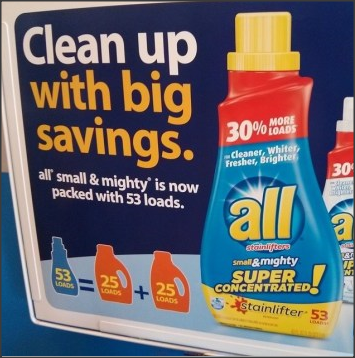
The previous laundry detergent size could wash 25 loads. The new, larger size laundry detergent can clean 53 loads. According to the equation on the ad, 25 + 25 = 53, or roughly double the number of loads for the new size. Seems like the new size is a better deal than the old one… until you notice another number on the bottle.

The new detergent size does 30% more loads than the previous one. The ad wants you to think that 30% approximately doubles what you’ll get with the new product. What do you think?

Photo credit: Sara Van Der Werf

Key Takeaways

Paying attention in math class does have its benefits! Those math skills can help you to find the best value, catch misleading calculations, and avoid tiny but significant mistakes. Did you catch all the common consumer math mistakes right away?

If you enjoyed this article, subscribe to make sure you don’t miss the next post!

Powerful Persuasive Writing Tips You Should Know

Think of the last time you saw an ad that almost persuaded you to buy something you didn’t even need. Well-crafted words can be very convincing and powerful. They can influence your decisions.

Here are some powerful, persuasive writing tips you should know to write copy that convinces your reader to buy from you. First, we start with defining persuasive writing.

What is Persuasive Writing?

Persuasive writing is writing that gets your reader to agree with you. To achieve this, you’ll need to have facts, statistics, and other research from credible sources. When your point of view or opinion is backed up with strong and credible evidence, your reader is more likely to agree with you.

What Makes Persuasive Writing “Persuasive”?

Persuasive writing has three key elements. It has ethos, which is the beliefs of a group of people or a culture. If the writer seems to understand the beliefs of the reader, then the writer can write to the reader’s sense of ethos. The second is logos. The writer must appeal to the reader’s sense of logic by providing scientific evidence and facts. The third element is pathos, which is appealing to the passion and feelings of the reader.

If the piece of writing cannot appeal to the reader’s beliefs, sense of logic, or emotions, then it will have difficulty persuading the reader to agree with the point of view it is presenting.

How Can You Use Persuasive Writing at Work?

If your job is to influence people through the written word, then persuasive writing will be an extremely handy skill to have.

The marketing industry needs writers who can write to persuade customers to buy products and services. Advertising and marketing copywriters, for example, write copy for web content, email campaigns, marketing brochures, ads, and corporate brochures.

Persuasive writing skills are also needed for press releases, copy for fundraisers, and articles about government policies.

How Can Persuasive Writing Help Your Business?

Persuading your customers and clients to invest in your products and services is key to your business’s success. Dr. Robert B. Cialdini’s research on the psychology of persuasion has had a tremendous impact on marketing.

One concept he has proven is the principle of reciprocity. Humans naturally want to return favours and pay back debts. An example of this in marketing is a business that gives advice and tips its to website visitors in the form of free blogs, training courses, and PDF downloads. The informative, free content increases the likelihood that people will pay for the company’s products and services in the future.

Another principle is social proof: whatever most people are doing, then someone who joins the group will do the same, even if the behaviour doesn’t make logical sense. Consider how a worker may work a little longer just because everyone else in the department is working late. And think of the last time you decided whether to give a new restaurant a try because of how busy it looked. If you read about a trend that is popular with your age group, you’ll be more likely to try it.

Scarcity is another persuasive tactic. An ad for “the last available room,” “30% off your purchase today only,” and “offer ends at midnight tonight” will create a fear of missing out (FOMO).

Persuasive writing will give people the push they need to decide to subscribe to your email list, buy two for the price of one, sign up for a course, or invest in your consulting services.

Key Takeaways

Persuasive writing uses psychology to give people that nudge to make a decision now. It wins you over with logic and appeals to your emotions. It may even play to your fears (FOMO) or convince you to make a purchase because of the free value you have already received. Persuasive writing creates action through the power of words.

If you enjoyed this article, subscribe to make sure you don’t miss the next post!