Online dating requires a specific skill set, just like job interviews and resume writing do, wouldn’t you agree?
You need to find photos that show off the very best qualities of your appearance, personality, and what you like to do. No selfies, group shots, blurry shots, sunglasses or covering your face shots. Writing a profile that shows off your personality because bare minimum profiles make it harder to someone to decide if they like you.
Most importantly, understanding how to use the dating app to your best advantage. Statistics say after the first few days, your chances of finding the perfect match starts to drop! And after you get a match, be patient and tolerant of what could happen. A match can suddenly disappear mid conversation.
What tip would you give someone who is trying online dating?
Would you feel more comfortable crafting a handwritten letter or sending a quick text? Most likely you answered “text” because most of us feel a bit out of practice when it comes to writing by hand. In fact, our writing skills (by hand or keyboard) has been declining each generation! A perfect example of this is the tradition of writing letters to Santa Claus at this time of year.
Good kids (well, all kids) are still writing their wish list to Santa at the North Pole. But over time, people haven’t been writing as well as they used to. When was the last time you picked up a pen and wrote a complete letter to someone? How confident are you in your grammar and spelling each time you compose an email for work?
If you’re feeling a bit shaky about your writing skills, you aren’t alone. Entrepreneurs have noticed, and they’re doing something about it. Whether you need to write a letter to Santa or need some help with business writing, you can count on your own secret elf to help you out with this task. What is this secret elf… well, tech?
I’ll answer that in a bit. First, we need to understand how we got here – why the marketplace created a need for technology to assist us with writing in the first place.
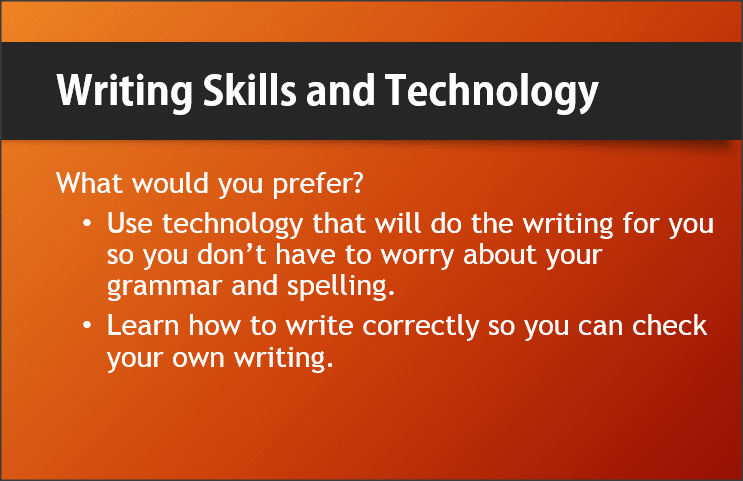
Writing Skills and the Impact of Technology
These days, our writing skills are at the point where we may need help to write our letters. Blame technology for the decline in our writing. (And then thank technology for saving us, ironically.) Like dinosaurs that couldn’t adapt to change, we stopped seeing the value of composition when we didn’t need to grip a pen in hand.
Why write a note when you can send a text or voice message? Technology is so much more convenient and painless. Back when we had to write pages and pages of sentences by hand, you could get callouses on your fingers just from holding your pen for hours. And back then, you could get a high from sniffing liquid whiteout when painting over your mistakes.
Those were the days when writing was a workout, you double checked your spelling, and you could identify verbs and nouns. Now we spend more time rapid firing messages with abbreviated words on our apps, LOL. (LOL is laugh out loud, if you still like to handwrite things.)
A study showed just how much times have changed. The study found that these days, college students are spending more time on social media now than reading. When it comes to assignments, they are graded on the content of what they write, not their writing ability!
In fact, a study found that “Teachers have been reporting anecdotally that even compared to five years ago, many are seeing declines in vocabulary, grammar, writing, and analysis.” Good writing skills are on their way to extinction.
Despite this trend with writing skills, people still treasure a handwritten message. Think about your reaction to a hand scrawled message on a birthday card. Or a quickly jotted note from a loved one. There is something about handwriting that technology just can’t replace.
The Skills Behind Writing a Handwritten Letter
It’s been a long time since most of us have seen something as rare as a handwritten letter. A survey of Americans found that “33 percent say they haven’t gotten a handwritten note in more than a year,” and another survey said that “fifteen percent of Americans say they haven’t written a note to someone in more than five years.”
Think of how wonderful it would be to receive a handwritten note. Years ago, people cherished handwritten letters a lot more, and it was a way to communicate messages that you could keep someplace safe and look back at them time and time again. The early letters to Santa is one example of this way to pass on advice.
Photo credit: Jonathan Borba
That’s right – pass on advice, not send Santa a list of toys. The tradition of writing letters to Santa has a long history that has evolved a lot over time. At first, the letters weren’t about getting toys. Over a century ago, Santa was writing letters of advice to children. He would comment on their past behaviour over the year and how they could improve for the coming year! Santa (well, the parents) would leave these letters near the fireplace.
As it became more common to buy stamps in the 1860s, American children started to send letters to Santa at the North Pole, where they believed he lived and worked. The tradition evolved to what it is today: children who are good ask for toys that they would like to see under the tree at Christmas.
Technology has also evolved. If you don’t know how to write a letter – or struggle with letter writing in general – you can still be a competent writer.
Websites such as emailsanta.com make the writing process super easy for those who want to write a basic letter to Santa. You choose a stamp, go to a webpage with the skeletal structure of a letter, and fill in all the blanks. And just like that, presto, your letter to Santa is complete! You will also instantly get an answer back.
You could say that letter writing programs such as this one is contributing to the decline in writing skills because the process has become so automated. But you could also say that technology can help with teaching writing skills.
At the marthastewart.com site, they teach you how to write a letter to Santa Claus. It even has instructions on how to get the letter sent back to the child’s home. When the child reads the letter, they will find a personalized answer from Santa himself. The secret of course, is the additional instructions to the parent on how they can write the reply as Santa before the letter is returned.
I don’t remember writing to Santa as a child, but I’m sure back then I would have been impressed that he took the time to write to me, one kid out of millions. I was already content that he could spare a few seconds on Christmas Eve to drop into my home and fill my stockings with gifts.
With all this technology, what will happen to letter writing in the future? Will children be sending voice messages or video messages to Santa in a couple centuries?
Photo credit: Valentin Petkov
Are Shortcuts to Writing the Solution to Writing Skills?
Chances are written messages will still be around for a while. Entrepreneurs are constantly devising new ways to answer our desires for personalized content and bridge the writing skills gap.
If your handwriting looks like a chicken scratched some random ink on the page, digital handwriting services are here to rescue you. Marketing research has found that customers are more likely to read a handwritten message. Just think of the last time you held a pile of mail in your hand and you saw handwritten words on an envelope. Weren’t you assuming a friend or family member had written to you?
I was surprised when one such envelope with handwriting on it turned out to be a marketing campaign from some company I hadn’t even heard of. However, I’ll give them credit for piquing my interest for a good minute while I opened the envelope to see what was inside.
Thanks to technology, we don’t need to hire a human to handwrite each letter or note to a potential customer. We’ve got automated bulk mail machines to send the same letter to hundreds of people at the same time. The handwritten text just adds that extra personal touch.
With these services, it is even possible to get these digital handwriting services to “handwrite” your annual Christmas letter to your family.
Entrepreneurs are always looking for ways to solve problems. Writing skills may be on the decline generation after generation, but AI (artificial intelligence) could save you.
A site such as copy.ai is geared toward brainstorming the copy for digital agencies, copywriters, and ecommerce brands. There’s no excuse for writer’s block anymore. Not when a website can help you with copy creation for Facebook, your blog, Instagram, and more. There’s a fee for the service, of course, but maybe now you won’t need to pay for writing courses to improve your skills.
I wonder what people from two centuries ago would say about our writing skills today. Would parents have preferred to use technology to handwrite their Santa letters to their children?
Summary
Handwritten letters seem to be a lost art. Nowadays, people’s writing skills aren’t as good as they used to be.
However, entrepreneurs and businesses have found a way to solve the writing skills gap. A letter to Santa could be composed using technology you find online. At the office, you can employ the services of a website to write your copy for you. Despite these changes, one thing remains the same.
People still value receiving a handwritten note. Perhaps you could handwrite a short letter to a loved one this Christmas and see what happens.
If you enjoyed this article, subscribe to make sure you don’t miss the next post!
“…the Snapchat generation may produce more writing than any group of teenagers before it, writing copious text messages and social media posts, but when it comes to the formal writing expected at school and work, they struggle with the mechanics of simple sentences.” – Dana Goldstein, The New York Times
Why did you become an entrepreneur? You most likely wanted a challenge, income security, financial success, or you weren’t happy with your situation at work. No matter what your reason, developing a wealth mindset is important to becoming successful as an entrepreneur. One way to develop that mindset is by reading Robb Report.
What is a wealth mindset and why Robb Report? To start with, here are some important stats you should know. In the world, there are 582 million entrepreneurs. You’re not alone! And as of 2016, 25 million Americans had already started or were already running a business of their own. Sounds positive, but also consider this: within the first year, 22.5% of small businesses fail.
Why Develop an Entrepreneur Wealth Mindset?
To avoid becoming a statistic, or a cautionary tale for entrepreneurs, it’s important to develop a wealth mindset. Contrary to what it may suggest, a wealth mindset isn’t just about getting rich and having money. Wealth is also about abundance.
Do you read or hear about people complaining about how expensive the cost of living has become? What about people complaining about their salary and how they want to be paid more but they aren’t? I read negative comments about costs and salaries and prices all the time. It’s easy for people to complain.
The problem is your mind gets cluttered with the negativity. You could be hearing a voice in your head saying your career goal is out of reach, that your income goal is impossible, or no one wants to buy what you want to sell.
The entrepreneur wealth mindset defeats those thoughts. You want to see the world as abundant. You want to start believing that there is enough money to go around, and there are enough customers to go around.
No matter how dark those early days are as you struggle with the first few years of your business, you must believe that wealth is totally attainable. You have to believe that one day, your business will start to turn a profit and you can tell your friends and family, “I did it! I told you I would.”
What Does Robb Report Tell Us About Wealth Mindset?
My business mentor taught me reading the Robb Report is one way to develop a wealth mindset. The Robb Report is both a print and online luxury magazine about luxury vehicles, vacations, dining, and fashion. The target market is the superrich, those “with an average income of $1.25 million and an average net worth of $7.5 million.”
What if you’re nowhere near that income bracket?
No worries if you’re short by a few million. It’s all about the mindset. Read what the wealthy read about. According to Robb Report, the top three most popular articles for 2019 were about a $250 million dollar yacht, American restaurants rated by Michelin, and America’s biggest 3 million square foot mall in Rutherford, NJ. Most of these popular topics are quite relatable to us all. Many of us like to eat and shop.
The amount we spend when shopping is a bit different in the Robb Report universe. The magazine is not at all squeamish about listing the price of an item. A Frette Chains Wool Blanket, for example, is described in a highly desirable way:
“Frette is not a new name in the world of luxury textiles—it was one of the official purveyors to the Italian royal family back in the late 1800s, after all—and this grey throw readily fits in with the brand’s storied oeuvre. Made of soft virgin wool, it’s a dream to curl up in.“
Underneath the description is the price: $1067. No problem! The typical Robb Report audience does not bat an eye when dropping a few hundred – or thousand – on an item. Many of us more humble entrepreneurs might balk at spending over a thousand on what better be the blanket of the century.
However, when you start reading these articles, you can train your brain to think with a wealth mindset. You start to think differently: Money comes to you in abundance. One day, you will be able to afford what you want without calculating how each purchase will impact your finances.
You don’t have to start buying thousand-dollar accessories for your home. But you can start to think of things that you thought were expensive as being more affordable, more within reach.
How A Wealth Mindset Readjusts Your Income Scale
Think about how you view wealth. What do you consider a low income? Middle income? High income? Most people think of six figures (even 100,000) to be high income and unattainable. Now consider why you have this income scale in your mind.
I remember a friend of mine once said she was in the high-income bracket because she cleared $100K. To her, $100K was the upper end of the income bracket for people. Many would agree with her. I once read an article about how “most people” can’t afford a house in Vancouver. They also say you should expect to be thousands of dollars in debt after college.
These types of thoughts adjust your income scale in your mind in a certain way. Being in debt from buying a $800K house, or in debt from college means you expect to be only generating so much income from your career, your business, your investments, etc.
Retrain your brain. Set your goals higher. Redefine what you think of as your middle-income goal. Your high income goal. Why should a high income be just $100K? Why not $500K? Why not a million? Set higher goals for yourself, and your perception of wealth will change too.
For example, yes, you could be in debt when you first start a business. But eventually abundance will find you and you will find the income you are looking for. Tell yourself you can afford luxuries. You deserve it. You deserve abundance, whether that wealth means more money, more free time, better health, or achieving your dreams.
And one day, when you see a PieCaken holiday dessert, “one cinnamon buttercream-encased package” you’ll say, “$99? I’ll take it. Looks delicious.” Like they say, in Robb Report, “It’s the perfect confection for those among us who simply don’t want to choose just one dessert.”
Summary
Developing a wealth mindset is an important first step in your road to success as an entrepreneur. Reading magazines like Robb Report will retrain your brain to visualize wealth – abundance – as an attainable goal. You will tear down mental walls and redefine what you think is possible.
If you enjoyed this article, subscribe to make sure you don’t miss the next post!
Let’s say you’re a typical entrepreneur. And like 80% of entrepreneurs, you use your smartphone to run your business. Now let’s say, for a challenge, you lose your access to your favoured piece of technology. Would you still be able to do business like normal if you didn’t have it? Would you be able to survive without your smartphone?
According to PeoplePerHour, “over 80% of entrepreneurs use smartphones to run or manage their business.” Without their smartphones, how different would life be for entrepreneurs? In most cases, as you will see, it’s like a throwback in time.
In 2018, 51.9% of those aged 24 to 44 checked their phone every 30 minutes. – Statistics Canada
Connections, Meetings and Calls on the Go
Entrepreneurs run their business using calendar apps and messaging services to keep track of their schedules, take and receive calls, and schedule and attend meetings. When it’s almost time for a meeting, an alarm on their phone will go off as a reminder.
Getting ready for business trips are a no-sweat, easy activity with apps to remind you where you’re supposed to be and when. You can book a hotel, a car rental, and a plane ticket from the comfort of your phone, no matter where you are. Even if you’re in the bathroom.
Virtual meetings already structure a part of your day, but they don’t limit where you have to be. There’s no need to rush to the office to attend a meeting. You can turn on your smartphone camera and attend from the inside of your car in between running errands.
If you want to send a message without making a phone call, you can type a quick text. If you’re in a rush, and you want to send a long (ish) message, you can send one by voice. All these tasks are convenient and quick to do.
But an entrepreneur without a smartphone would be working quite differently.
Without their calendar apps, entrepreneurs would be keeping track of all the events in their day with a day planner or a wall calendar. They would need a pen to jot down all their notes in their day planner, and have a purse or a small bag to keep the planner with them when they leave their desk. Planning one’s day already requires a lot more stuff.
A wall calendar is also handy for keeping your month organized, but unless you take your calendar with you, you may need to memorize when you have some of your appointments and project deadlines. And for all those random thoughts, ideas, and memos you may have, you’ll need a little pad of sticky post-it notes. Your wall or desk will become quite colourful.
Video conferencing will have limitations if you don’t have a smartphone. When you’re at the office, you’ll need to go to the meeting room, where the screen, telephone, and speakers are already set up for your call. You probably had to book the room in advance as well.
If you have a call at your home office, then you need to be back at your desk, where your camera and speakers are set up for an optimal meeting experience. You might have a virtual background set up. Everything that is in view of your camera in your room is quite presentable.
You may have had to kick out your cat or put your pet in the next room. Same with the kids, although it will be harder to kick them out of the room. At least with a smartphone, you can easily move yourself to a new location wherever there is WiFi or data. You can even hide in a brightly lit closet.
No matter which option the entrepreneur chooses for doing business meetings without a phone, they are limited by the location of their laptop or tablet, and WiFi connection.
Organizing yourself, messaging others, and attending meetings is still survivable without a smartphone. You just need to rely more on other types of technology, a big laptop, and good old paper documents like planners and post it notes.
When Entrepreneurs Need Their Documents
Security has improved to the point that we can share files in the cloud. We can access the same document from our smartphone, our tablet, or our laptop. Not only can we access from any device, but we can also access our files from anywhere.
Mobile payments have also become a cinch to do from mobile devices. You can make a payment or do your banking from your bed. Or make an online purchase while watching TV. You can be a lot more spontaneous than if you have just a laptop or tablet.
Got a few minutes to make a mobile payment? You’d have to take out that laptop, set it up, find a place to set it up, and so on. If you don’t have a laptop, you would need some time to walk over to the bank to make a payment.
It’s not so long ago when entrepreneurs would get creative with getting documents prepared. You could lug your heavy laptop with you to do a presentation at a meeting with a client at their office.
And before we had data plans, you could bring a backup of your files on your USB drive in case your WiFi connection failed. You also had the messy alternative of printing out a copy of your file to put in a file folder or portfolio for safe keeping. Not only does this option affect our tree population, but it just means doubling the amount of stuff you have to bring with you.
No matter what option you choose, USB or paper, not having your smartphone means requiring access to more devices and a lot less flexibility. Laptops require more space. Paper copies take longer to navigate because you can’t skip directly to a section you want unless you already know which page it’s on.
Most freelancers, business owners and entrepreneurs appreciate the fact that smartphones offer them the opportunity to quickly check their emails, upload new products to their websites and even interact with their customers, all on the go. And while this is great, it is the addiction and the urge to always check your smartphone every other second that is worrying. – PeoplePerHour
Keeping Up With News and Social Media
Keeping up with the trends is quicker and easier with a smartphone. You don’t need to stop for the morning paper when you’re on the way to work. You don’t need to surf the internet on your work computer for news headlines. One click on your smartphone news app and you can quickly scan all the biggest headlines, check out sports scores, and the latest numbers for the stock market and real estate market.
Who has the patience these days to scan a newspaper for headlines when you can Google search what you want? Why slowly read through everything on a page when you can move from one item to another in seconds with the flick of a finger?
In fact, the availability and abundance of information, has affected how much time we can spend on things. Our attention span has dropped by 4 seconds in just four years.
A 2016 Microsoft consumer study claimed the attention span for human beings had dropped from 12 seconds in 2000 to 8 seconds (lower than the notoriously ill-focused goldfish) mainly because of the effects of the increasingly digitalized lifestyle on the brain. – PeoplePerHour
Solopreneurs who work on their own social media marketing can check the status of social media posts, look for leads and potential clients on Facebook, and see what their friends are up to on Facebook and Instagram.
When it comes to personal social media use, men and women are looking for different things. Men are more likely to use social media for news and see who they can meet on dating apps. Women are more likely to use social media to see what their friends and family are doing.
Without a smartphone, entrepreneurs would have to wait until they are at their workstation to check for social media and news updates on their laptops or tablets. It’s not as convenient as checking while on a bus ride, during a commercial for a TV show, or when sitting around having a tea or coffee.
Summary
Entrepreneurs can continue to do business without their smartphones. They can survive without the convenience of this technology. But they will also lose many of the conveniences they are used to, making it more difficult to run a business from anywhere at almost any time.







 Vanya Wryter Consulting Services