Read Bad Books with Bad Writing

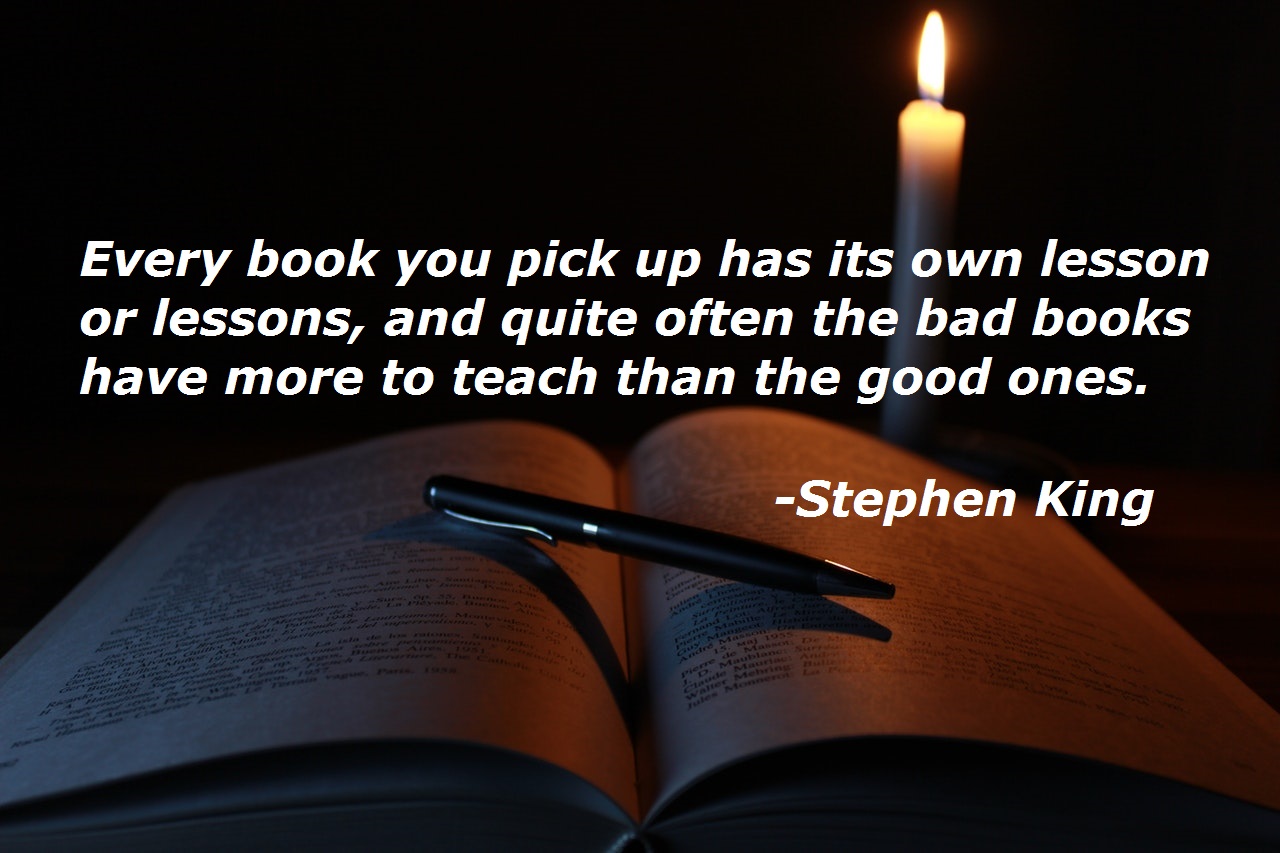
“Every book you pick up has its own lesson or lessons, and quite often the bad books have more to teach than the good ones.”  – Stephen King, a.k.a. “The King of Horror”

Today we have a few words of wisdom to share with you, someone who reads and writes. Yes, you are “someone who reads and writes.” Not specifically a reader or a writer, because usually we think of readers as people who like to read books and writers as people who write for a living or as a hobby. Here we mean anyone who reads anything and writes anything.

If you text your friends or write emails for work. If you read your friend’s texts, restaurant menus, or read emails at work. Anyone who reads or writes.

Take a moment to read some bad writing. Read an email full of grammar mistakes. Read a book that shouldn’t have been published. Why? Because you can learn a lot from reading something that is poorly written. Bad books can have just as important lessons to teach as good books.

Good communication is vital for everyone. If you write clearly, you can avoid misunderstandings from bad texts. If you write well, you are a good communicator. And that’s just the beginning.

Read a lot, and don’t just read the good stuff. When you read bad prose, you learn what not to write. If you want to write well, for blog posts or for your novel, then read a lot. Read good books and bad books. Be a critical reader and take lessons about what makes a piece of writing good, and what makes it bad. As author Stephen King once said, each book you read has valuable lessons to offer.

What lessons have you learned from something you’ve read?

Artificial Intelligence (AI): Helpful or Harmful to Jobs?

Is artificial intelligence (AI) harmful or helpful to our jobs? Will we lose our jobs to AI? Many already have faced the answers to those questions. People have lost work to AI and certain jobs will disappear completely. On the upside, AI has enhanced our work by eliminating our repetitive tasks. AI can also reduce the time it takes to complete tasks. Most importantly, AI will create new jobs. Let’s dive into this topic further.

Will AI replace jobs?

At first, artificial intelligence (AI) was helping us to do jobs better and faster by completing repetitive tasks. Having someone (or something) complete all the boring tasks is a good time saver. But AI will continue to improve to the point of replacing jobs and people. Here are some examples. 

In customer service, bots answer frequently asked questions (FAQs) from customers, so staff are free to answer infrequent or more complex questions. Robot waiters can take dishes and drinks to customer’s tables. AI can use existing examples of writing and art to create stories and artwork similar to an existing style.

Can AI help us to do our jobs better?

AI is already helping us to do our jobs better and faster. It can help us to find errors in our writing. It can also learn from our writing style and remind us to use a spelling or word specific to our company or industry.

It can act as a personal assistant to schedule meetings with clients and coworkers. It can generate automatic email responses so that customers will receive generated, immediate responses to their messages. Chatbots can handle frequently asked questions and common issues, handle inquiries and decide when a more complex situation needs to be passed to a human support agent.

How can we foolproof ourselves from losing jobs to AI?

AI will replace jobs in the future. It has already replaced jobs. If AI hasn’t replaced your job, chances are, your job will be affected by AI in some way, such as automating part of your job or changing the way you do your job.

Jobs that AI won’t replace are those that require human interaction. For example, although AI can be used to teach in the classroom, it cannot replace the trust and close relationships that teachers have with their students. Teachers can intervene if there are arguments between students or help a student who is having personal issues at home. 

AI cannot listen to a person’s problems and help a person through a mental health crisis. Similarly, it does not have the sensitivity to deal with a sudden job layoff, or answer a question about health benefit coverage that will have a severe impact on a person’s family.

Why is AI beneficial for society?

AI helps us to complete repetitive tasks more efficiently, freeing us to do other things. Instead of marking the same test a hundred times, AI can score all the tests in a matter of minutes, saving a human one to several hours of boring work.

AI can also help people to improve their skills. For example, it can suggest ways for bad writers to improve their writing by identifying their spelling mistakes and suggesting better ways to write their sentences. This is not the same as replacing professional writers. People who need to write reports or emails at work aren’t going to invest in a professional writer to write an internal report. But they will appreciate having something to check their grammar before the report goes to their supervisor.

Similarly, people will value a robot vacuum cleaner, pool cleaner, or pet food dispenser to help with chores around the house. One day, a robot may even be able to do all the basic housecleaning that people dislike. 

However, technology cannot replace all tasks, especially those that require special skills. People who can afford it will want to hire writers to produce a piece of writing exactly to their specifications. People with expensive heirlooms or valuables will want the human touch to do the job right when they need a thorough cleaning of their homes.

Key Takeaways

As with any advancement in technology, jobs will disappear and jobs will be created. Jobs that require a human element will be the hardest for AI to replace. But AI will also provide us with many benefits, such as replacing boring and time-consuming tasks. Jobs will also be created that are related to the creation and maintenance of AI. 

What do you think? How has AI affected your work?
Hustle Culture and the Pursuit of Goals

Do you think putting in long hours of hard work is the key to success in today’s work environment? People talk about hustle culture as a necessary part of doing well at work. They brag about missing sleep and skipping meals to make more money and achieve their next promotion. What do you think?

Is taking time off similar to being lazy? Do we want to look back at how we collect overtime hours like success badges to brag about?

Some say hustle culture is necessary these days to reach the economic success we aim for. Food isn’t cheap and housing is barely affordable for some people. Quality of life is eating healthy, but unless we have the financial ability to buy the food we need, or afford the vacation that will give us the mental health break we need, hustle culture can’t be avoided.

What do you think? Is hustle culture an important part of career success?

Technical Writing is Boring! (Or is it?)

People think writers write novels, blog posts, or magazine articles. Technical writing isn’t top of mind. People also tend to think that technical writing is boring. It’s about writing instructions, and how many people have the patience to follow instructions these days? Now before you yawn, let’s get into why we need technical writing. 

First, what is technical writing? 

It’s not dry writing. I mean, technical writing is about a specific topic. The primary purpose is to provide instruction and information. Employee handbooks, standard operating procedures (SOPs), troubleshooting guides, user manuals, company documents, and case studies are all examples of technical writing.

Why do we need technical writing? 

Sometimes in life, we get stuck. We need help that is easy to follow. You’ve probably read an example or two of technical writing by now, especially if you bought a new computer or phone and read some documentation to figure out how to use it. If you’ve watched a video that gave you instructions, the transcript is an example of technical writing. 

Technical writing organizes information into easily digestible bits. You can go to a table of contents to find the topic you’re interested in, and read just that section to get the information you need. You don’t need to read the entire book or PDF from cover to cover, or read each page of a website to find the answer you need.

Why is technical writing fun to write?

People may think that emotions and personal experience have no place in technical writing, so technical writing is boring. However, if you like organization and solving puzzles, you’ll like how technical writing follows a sequence. Technical writing will explain a concept clearly, using plain language without jargon or idioms. If a special term is used, the meaning is explained. 

This is why technical writing is fun. It’s like being in an escape room and you’re faced with the challenge of organizing a bunch of information to get the answer you need. If you get it right, your mission is accomplished. You can also use your imagination in technical writing. You can create a handbook on how to capture and tame dragons.  

Key Takeaways

Technical writing provides valuable instructions and information. If you’ve picked up a user manual to find the answer to your question, you’ve read a piece of technical writing. This style of writing sticks to the facts and doesn’t include emotions or personal experiences. For this reason, some people think technical writing is boring. But other writers think technical writing is fun. It’s challenging to write information in a way that is easily understood and easily found by skimming and scanning. Technical writing has a very important role in providing readers with important information. 

9 Things to be Thankful for This Season

Canadians celebrate Thanksgiving in October while Americans celebrate in November. As the season changes from summer to fall, today is as good a day as any to reflect on what we can be thankful for. Here are nine things to be thankful for this season.

1 Friends and family

Thanksgiving is the perfect time to reflect and be thankful for the good friends and family members who we have in our lives. The ones who make us laugh and make us feel valued.

2 Food

Turkey is the most popular food choice at this time of year. It doesn’t matter what you choose to celebrate the occasion with – good food is delicious food worth eating.

3. Autumn weather

Crisp, cool mornings to start the day. When the sun comes out, the golden colors add to the mixture of hues.

4. Pumpkins

Thank you to the abundance of pumpkins at this time of year: pumpkin pie, pumpkin spice lattes, pumpkin seeds, pumpkin-orange colored themes, and jack-o-lanterns.

5. Movies

Celebrating movies that put us in a thankful mood – even if the movie is not about Thanksgiving. 

6. Nature

Such a beautiful time of year for walks in nature. The air is crisp in the mornings and cool at night, the sound of leaves crunching under your feet. Animals and other critters are busy getting ready for winter.

7. Holidays

Time off, whether you celebrate in October or November. It’s a time to recharge and spend time with family, enjoy a meal, and think of gratitude.

8. Colors

Celebrate a change in color, from summer greens to autumn golds, yellows, and browns.

9. Mazes

Walking through a corn maze taller than yourself, using a map, and trying your best to get out as quickly as you can. 

What would you like to add to this list?